49 works in this view — arrow keys or swipe to move between them.
Dance in Art · 2019
Vive la polka
Unknown artist
- Medium:
- Lithograph
- Dance:
- Polka
- Era:
- Late 1800s (Victorian Ballroom)
- Source:
- New York Public Library
- Rights:
- Public domain — free to use, share and adapt.
- Recorded as:
- public_domain
The polka transformed European social dancing in the mid-1800s and remained a staple of ballroom, folk, and recreational dancing to this day. This image is both a commercial artifact of the polka's cultural saturation and a technical record of how the dance was actually performed and taught—the closed hold, the upright frame, the distinctive lift and spread of the skirt that created its visual signature. For dancers and dance historians, it is evidence of a moment when a new dance form swept through society and became the vehicle for courtship, display, and pleasure in ballroom culture.
What you are looking at
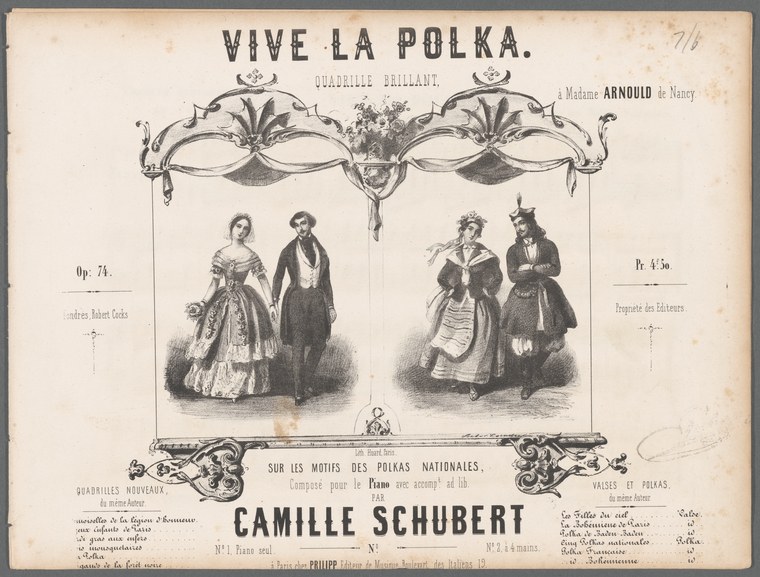
This is a lithographic sheet music cover for a polka composition, decorated with an ornamental border in the Romantic style. The central image shows four figures in mid-nineteenth-century dress arranged in two pairs. On the left, a woman in a full light-coloured ball gown with an off-shoulder neckline stands beside a man in dark evening wear; on the right, another couple mirrors this arrangement, the woman in an elaborately trimmed dark dress with white underlay, the man in formal coat and top hat. Both pairs are positioned as if caught mid-movement, with the women's skirts suggesting the swirl and lift of active dancing. The composition is framed by a symmetrical ornamental cartouche at the top featuring scrollwork and floral motifs, and similar decorative elements at the bottom. The title 'VIVE LA POLKA' appears in bold capitals at the top, with publication information and composer credits arranged around the border.
The dancing
The dancers are shown in the closed ballroom hold characteristic of the polka: each couple faces forward with the man's right hand at the woman's back, their bodies in profile or three-quarter view to display the skirts. The women's postures are upright with arms at the sides or lightly held; their full skirts are lifted and spread, captured at the moment of their greatest extension during a turn or hop. The men stand firm, providing the frame for their partners' movement. All four figures are rendered with the formal stiffness typical of nineteenth-century fashion illustration, yet there is evident energy in the outward spread of the fabric and the forward tilt of the torsos.
The dance depicted
The work documents the polka, the most popular ballroom dance of the mid-nineteenth century across Europe and North America. The polka originated in Bohemia in the 1830s and spread rapidly through salon and ballroom culture. This image captures it as a closed-position couples dance performed in formal evening dress—the style and setting that made it the dominant social dance of the 1840s through 1870s. The composition shows both the characteristic frame (the upright, side-by-side position) and the characteristic energy: the swinging lift and lateral movement that created the dance's distinctive hoppy, bouncing quality. The enthusiastic title 'Vive la Polka' ('Long Live the Polka') reflects the dance's cultural dominance in this period.
How it was made
This is a lithograph, a process that allowed rapid, economical reproduction of images for sheet music covers and popular prints. Lithographic stone retains fine detail and the capacity for both bold outlines and subtle shading, as seen here in the rendering of the figures' faces and the fabric textures. The medium allowed for rapid distribution to music publishers and households across France and beyond, making this both a commercial object and a document of mass popular culture. The print's relatively small size and bright paper suggest it was a working cover for sheet music rather than a fine art print.
About this work
This is a mid-nineteenth-century French lithographic sheet music cover celebrating the polka at the height of its popularity. It shows two couples in the formal ballroom dress and closed-position frame of the social ballroom dance, with the women's skirts caught in mid-swirl. The work is a commercial object—mass-produced as a cover for a polka composition by composer Camille Schubert—yet it is also a precise record of how the dance was performed, dressed, and understood in its moment. It belongs in a dance gallery because it preserves not just the visual spectacle of a vanished social practice, but the conventions of gesture, hold, and bodily frame that defined a dance form that shaped European and American ballroom culture for a generation.
How to look at it
Look at the moment the artist chose: the women's skirts are at maximum extension and lift, suggesting the characteristic hop and swing of the polka's forward-moving steps. Notice how the men frame their partners—upright, facing forward, allowing the women's bodies and skirts to display. The four figures represent two stages of the same dance phrase, doubling the visual impact and creating a narrative of the dance in motion. The ornamental border, with its theatre-curtain formality, frames this moment as a spectacle worthy of display—not a private activity but a social performance.
The artist
The artist is not recorded. The work credits composer Camille Schubert and publisher Madame Arnould de Nancy, but the lithographer's name does not appear. This reflects the common practice of sheet music covers and popular prints of the period, where the illustrator was often anonymous labour in a publishing workshop rather than a named artist. The quality of the work—the assured line, the anatomical understanding, the decorative confidence—suggests a trained commercial artist working within an established house style.
The period
The polka arrived in Paris from Bohemia in 1840 and swept ballroom Europe and North America within five years, becoming the dominant social dance of the mid-Victorian era. Sheet music for polkas proliferated from the 1840s onward, and polka covers became a major category of commercial lithographic art. Dance images in this period were usually confined to sheet music covers, illustrated periodicals, and theatrical prints; domestic display of dance imagery was rare. The formal dress, the ballroom setting, and the celebratory tone of the title reflect the polka's association with respectable middle-class sociability and modern entertainment. By the 1860s, when this cover appears to date, the polka was already being challenged by the waltz and other dances, but it remained a fixture of ballroom culture and would survive well into the twentieth century.
Where it lives
This work is held in the New York Public Library collection and identified as a French lithograph of the late 1800s. It is a working sheet music cover, not a fine art print, and would have circulated as a functional object in music publishers' catalogues and domestic music rooms.
Dance in this work
Questions about this work
When was the polka invented and how did it spread?
The polka originated in Bohemia in the early 1830s. It reached Paris around 1840 and spread across Europe and North America with extraordinary speed, becoming the dominant ballroom dance of the 1840s through 1870s. Unlike slower, more formal dances, the polka was fast, energetic, and required active participation from both partners, making it modern and exciting. Sheet music covers like this one were a major vehicle for its promotion and popularization.
Why are the women's skirts so important in this image?
The polka's characteristic bouncing, hopping movement created a distinctive swinging and lifting action in long skirts. The moment the artist captures—with the skirts at maximum spread and lift—was one of the dance's most visually striking features. For women in the tight bodices and heavy skirts of the period, this lift and swing provided one of the few sanctioned moments of visible, energetic movement. The emphasis on the skirt in dance imagery of this era reflects its centrality to the dance's visual and physical experience.
What does the title 'Vive la Polka' suggest about the dance's cultural status?
The phrase 'Vive la Polka' ('Long Live the Polka') echoes the revolutionary slogan 'Vive la République,' positioning the polka as a cause for celebration and mass participation. In the 1840s, the polka's association with democratic, non-aristocratic enjoyment and its rapid adoption across class boundaries gave it a radical energy. By calling for it to 'live long,' the cover tapped into this sense that the polka represented something new and energizing in social and cultural life.
How does this image compare to how the polka is performed today?
The polka's basic structure—a closed-position couples dance with a characteristic hopping, forward-moving step—has remained remarkably stable. What has changed is dress and context: the formal evening wear, the ballroom setting, and the social formality evident here are gone. Modern polka is performed in folk costume in some traditions, in casual modern dress in ballroom contexts, and remains a staple of Central European, German, and Scandinavian folk dance. The footwork and frame remain instantly recognizable from this nineteenth-century image.
More Polka artwork