49 works in this view — arrow keys or swipe to move between them.
Dance in Art
Ballroom polkas
Unknown artist
- Medium:
- Lithograph
- Dance:
- Polka
- Era:
- Late 1800s (Victorian Ballroom)
- Source:
- New York Public Library
- Rights:
- Public domain — free to use, share and adapt.
- Recorded as:
- public_domain
This print is a rare window into how ballroom dance was marketed and visualized in the 19th-century American city. It shows the polka not as a folk dance but as an urban, commercial phenomenon with distinct costumes, professional arrangements, and a deliberate appeal to middle-class respectability. The image captures the moment when lithographic printing made dance culture visible and reproducible at scale, allowing a single choreographic moment to circulate as a purchasable image.
What you are looking at
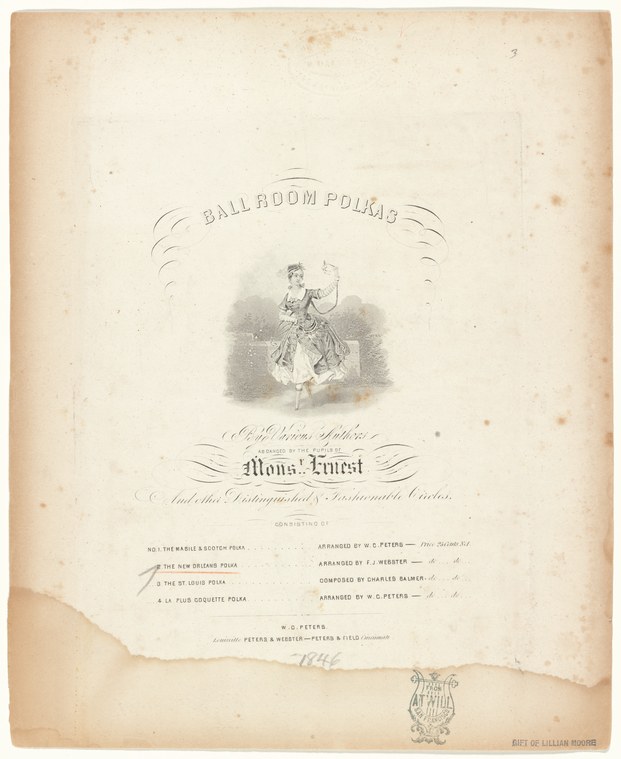
A lithograph showing a fashionably dressed woman in mid-polka, captured in a moment of dynamic rotation. She wears a full-skirted ball gown with a fitted bodice, her skirt caught in a swirl that suggests rapid turning. The composition is tightly focused on the single figure against a plain background, with decorative calligraphic text arching above reading "BALLROOM POLKAS" and below identifying this as a piece by or featuring "Mons. Ernest." The woman's pose is buoyant and energetic—her body tilted, one arm raised with apparent animation, the other positioned for balance or contact with an unseen partner. The technique of the lithograph allows fine detail in her costume and delicate rendering of the fabric's movement. At the bottom of the page are several printed lines in smaller type, listing variants or related pieces: "The Parisian Polka," "The New Orleans Polka," "The St. Louis Polka," and "The Four Coquette Polka," each with credited arrangers. This is sheet music cover art or a promotional print, designed to advertise a suite of popular dance compositions.
The dancing
A single female dancer shown in three-quarter view, her body in a state of energetic turn or rotation. Her weight appears distributed to suggest forward momentum and rotation simultaneously. The raised arm and angled torso are characteristic of the polka's animated, bouncing quality. Though no partner is visible in the frame, the positioning of her arms and the implied direction of movement suggest she is dancing in the closed or semi-closed embrace typical of ballroom polka. The artist has captured a fleeting instant: her skirt is mid-flare, her posture is expansive, and her expression—insofar as it is rendered—conveys the liveliness the dance demands.
The dance depicted
This is unambiguously the polka, one of the most popular ballroom dances of the 19th century. The polka originated in Bohemia in the 1830s and swept through Europe and America by the 1840s-50s, becoming a staple of ballroom dance culture throughout the Victorian era. The image advertises a suite of polka variations, each identified by geographic origin—Parisian, New Orleans, St. Louis—suggesting that the polka had become sufficiently established that regional variants and novelty versions were marketable. The woman's costume and the refined setting indicate this is ballroom polka for the urban middle and upper classes, not folk or rural performance. The energetic, bouncing quality visible in her posture aligns with contemporary descriptions of the polka as requiring sprightly, rapid footwork and a lively demeanor.
How it was made
This is a lithograph, a printmaking technique that allowed for relatively inexpensive mass production compared to engraving. The document shows the characteristic qualities of 19th-century commercial lithography: crisp lines, fine shading in the figure, and decorative typography. Lithographic printing made sheet music covers and dance instruction materials widely accessible and affordable, allowing popular dances and their musical accompaniments to circulate rapidly through urban ballroom culture. The ornamental script and careful composition indicate this was designed as a commercial product intended to appeal visually to potential buyers—sheet music purchasers who wanted both the music and an attractive cover image.
About this work
This is a sheet music cover or promotional print for a suite of polka compositions arranged for ballroom performance, probably published in the mid-to-late 1800s in New York or a major American city. It serves as both advertisement and instruction, showing a well-dressed woman executing the energetic, rotational movement characteristic of the dance. The polka was among the most democratic of Victorian ballroom dances—fashionable enough for elegant drawing rooms but sufficiently simple and vigorous to appeal to a broad urban audience. This image documents not just a dance but a moment in popular culture when ballroom dance was a central leisure activity and when dance music and imagery were mass-produced commodities. The multiple regional variants listed (Parisian, New Orleans, St. Louis) suggest an American market and the commercial strategy of creating novelty versions of an established craze.
How to look at it
Notice the moment the artist chose to freeze: the woman is captured at the height of a rotational turn, with her skirt fully flared and her body in dynamic imbalance. This is not a static pose but a slice of movement. The raised arm and angled torso show the sprightly, bouncing quality that made the polka so visually distinctive compared to the more gliding, sustained movement of the waltz. Observe also the conventions of commercial lithography at work: the decorative frame of calligraphic text, the careful attention to costume detail (the flounces and trim of the ball gown), and the idealized, refined rendering of the female form. This is a promotional image designed to make the dance look both respectable and irresistible.
The artist
The lithograph is credited to arrangements by multiple hands—credited arrangers include W. Petter and F. Harlseth—but the primary artist or designer of the cover image is not recorded. This is typical of commercial sheet music production in the era: the visual and musical components were often created by different hands, and cover art frequently went uncredited or was attributed to the publisher or arranger rather than to a dedicated designer.
The period
The polka emerged in the 1830s-40s and became the dominant fashionable ballroom dance of the mid-to-late 19th century, rivaling and eventually supplementing the waltz in popularity. Unlike the waltz, the polka was perceived as energetic, playful, and democratic—less formal and more accessible to a broad urban middle class. The 1840s-1860s saw an explosion of polka mania in Europe and America, with polka music, polka fashions, and polka-themed entertainments saturating popular culture. By the time this print was made (likely 1860s-1880s), the polka was well-established enough that publishers could market regional and novelty variants. Lithographic printing technology, which became increasingly sophisticated and affordable mid-century, made it economically viable to produce lavish illustrated sheet music covers designed to attract buyers. This convergence of fashion, music, technology, and commerce created a market for exactly this kind of object: a visually appealing, affordable print that advertised both the music and the social practice of ballroom dance.
Where it lives
The print is held in the New York Public Library and is part of a collection of dance-related sheet music and imagery from the 19th century. It is identified as a lithograph but lacks a specific date, accession number, or publisher attribution in the available record. The internal evidence of typography, costume, and printing technique suggests a date in the 1860s-1880s and an American (likely New York) origin.
Dance in this work
Questions about this work
What is the polka and why was it so popular?
The polka was a ballroom dance that originated in Bohemia in the 1830s and became the craze of the Victorian era. It was faster, bouncier, and less formal than the waltz, and it appealed to a broad urban middle class who found it more fun and accessible. The dance requires energetic footwork and a playful spirit, and it became synonymous with urban leisure and respectability.
Who danced the polka and in what settings?
The polka was danced in ballrooms, assembly halls, and private drawing rooms by the urban middle and upper classes throughout Europe and America. It was a couple's dance, typically performed in a semi-closed embrace, and it was particularly popular among younger dancers. Commercial dance halls and public ballrooms made polka dancing accessible to a wide audience.
What do the regional variants (Parisian, New Orleans, St. Louis) mean?
These are novelty versions or arrangements of the basic polka, probably incorporating local musical styles, rhythmic variations, or slight choreographic changes. The existence of such variants suggests that by the time this print was made, the polka was established enough that composers and publishers could market regional or fashionable variations as distinct products for music buyers and dancers.
Why is this a lithograph and what does that tell us?
Lithography was an affordable, efficient method of mass-producing illustrated prints in the 19th century. It allowed publishers to create visually attractive sheet music covers that could be sold cheaply to a broad audience. This print is evidence of how dance culture had become a consumer commodity, marketed through images that were both instructive and decorative.
More Polka artwork