48 works in this view — arrow keys or swipe to move between them.
Dance in Art · 2019
The suck-in polka
Unknown artist
- Medium:
- Lithograph
- Dance:
- Polka
- Era:
- Late 1800s (Victorian Ballroom)
- Source:
- New York Public Library
- Rights:
- Public domain — free to use, share and adapt.
- Recorded as:
- public_domain
This print documents the polka's role in Victorian social life not through an idealized representation but through satire, revealing real anxieties about propriety, gender, and movement. For dance historians, it is evidence of how vigorously the period's dances were discussed, mocked, and defended—and how a new social dance could spark moral panic and commercial humor in equal measure.
What you are looking at
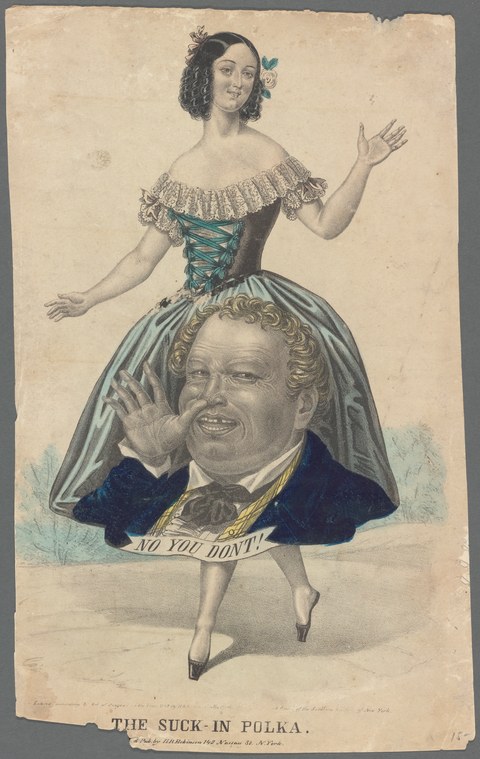
A hand-colored lithograph presenting a visual pun on Victorian social manners and the polka craze. A fashionable young woman in an off-shoulder dress with a ruffled neckline, corseted waist in teal blue, and full skirt stands in a posed dancing position with one arm raised and the other extended. Her body twists dynamically, one leg forward in a step. The remarkable feature is that her skirt forms the head and shoulders of a portly, bearded man in formal dress (dark jacket, yellow shirt front), his face rendered in caricature with a slight smile. A banner below reads "NO YOU DON'T!" The composition is a double image: the woman's full figure is simultaneously the man's oversized head, a graphic conceit that transforms the dance itself into social commentary.
The dancing
The woman is depicted mid-movement in a lively, asymmetrical pose typical of social dance—weight shifted, torso twisted, one arm lifted and slightly back, the other extended forward in a natural gesture of motion. The pose suggests quick, energetic footwork rather than the formal frame of ballroom closed position. Her upper body is animated and individual, while her lower body (the skirt) is repurposed as the man's physiognomy, creating a visual trick that dissolves the boundary between dancer and observer.
The dance depicted
The title identifies this as the "suck-in polka," a specific variant or witty version of the polka dance that was wildly popular in the Victorian era. The polka is a fast-paced, couples' social dance in 2/4 time, and this image captures the characteristic sprightliness and social exuberance of the style. The phrase "NO YOU DON'T!" suggests a playful resistance or flirtation—possibly commentary on the physical proximity demanded by polka dancing, which shocked conservative society. The image satirizes both the dance itself and male vanity, suggesting the dance could transform an unfortunate gentleman into a ridiculous spectacle.
How it was made
This is a color lithograph, a process that allowed for mass production and popular distribution. Lithography's capacity to combine line with tonal areas and hand-coloring made it ideal for satirical and comic prints sold to a broad urban middle-class audience. The technique allowed the artist to render the caricatured face and the fashionable dress with equal precision, and the hand-coloring (in teal, flesh tones, and subtle wash) adds commercial appeal and visual impact. The print is likely from a series of dance satires or social commentary pieces.
About this work
This is a satirical lithograph from the height of the polka's popularity in the mid-to-late nineteenth century, playing on contemporary anxieties about the dance's physical intimacy and its effects on both participants. The image weaponizes the double-image technique—a common trick in popular prints of the era—to turn the elegant woman dancer into an instrument of mockery toward a specific male subject. It belongs in a dance gallery not because it documents actual polka movement (though the pose is recognizably active and sprightly) but because it reveals how dance was culturally contested: a site of transgression, comedy, and social anxiety. The print is evidence of the polka's grip on the Victorian imagination and of how dance could be satirized through the female body.
How to look at it
The viewer should first see the woman as a dancer—note the asymmetrical stance, the lifted arm, the twisted torso, all captured mid-step in a posture that reads as spirited and mobile. Then the eye will be drawn to the impossible second reading: the skirt that becomes a man's head. This optical trick was common in nineteenth-century popular prints and relies on the viewer's complicity in the joke. The title and banner anchor the satire: the woman's body is saying "no you don't" to the gentleman she dances with (or whose head she is literally wearing). The moment frozen is not a moment of pure dance but of social interaction interrupted by a visual gag.
The artist
The artist is not recorded, but the print was likely produced by a commercial lithography house in New York (the NYPL attribution suggests American origin and circulation). The style, composition, and satirical purpose align with the broader American tradition of popular lithographic humor and social commentary that flourished in the 1840s–1860s, when prints like this were affordable, widely distributed, and frequently topical.
The period
The polka arrived in Western Europe in the 1830s from Bohemia and swept through ballrooms with extraordinary speed, reaching New York by the 1840s. It became a flashpoint for social debate: conservatives saw it as indecent because it required closer physical contact between partners than the waltz, and because its tempo and energy seemed to incite uncontrolled movement. Women's magazines debated its propriety, etiquette books struggled to codify its rules, and popular prints like this one both mocked and celebrated the craze. In art, the polka appeared in satirical and genre scenes far more often than in academic painting, making popular prints its primary artistic record.
Where it lives
The print is held by the New York Public Library and appears to have been part of commercial circulation in the United States during the polka craze. It is classified as a lithograph, and the hand-coloring suggests it was finished either in the workshop or as a deluxe version for a paying customer.
Dance in this work
Questions about this work
What is the 'suck-in polka'?
The title likely refers to a specific step or variation of the polka, or is simply a witty sexual innuendo (polka was associated with flirtation and physical closeness). The exact step cannot be determined from the image, but the name suggests the dance was commodified and named in ways that invited both enthusiasm and mockery.
Why is the man's face in the woman's skirt?
This is a double-image or composite-head lithograph, a popular trick in nineteenth-century satire. The visual conceit—that the woman's skirt is the man's face—is the point: it suggests the woman has literally rendered him ridiculous, or that dancing with her is a humbling experience. The title's defiant 'NO YOU DON'T!' reinforces the woman's agency.
Was the polka really controversial?
Yes. Conservative critics objected to its speed, its close hold, and the freedom of movement it allowed dancers (especially women). The polka was seen as a modern, slightly dangerous social practice. Satirical prints like this one both amplified and mocked those anxieties, making the dance newsworthy and desirable.
What does this print tell us about Victorian dance?
It shows that dance was a serious social matter—serious enough to warrant satire and public commentary. It also reveals that Victorian society was far from prudish about sexual innuendo; the humor relies on a winking understanding of bodily contact and masculine humiliation.
More Polka artwork