47 works in this view — arrow keys or swipe to move between them.
Dance in Art · 2023
Jullien's celebrated polkas
Unknown artist
- Medium:
- Lithograph
- Dance:
- Polka
- Era:
- Late 1800s (Victorian Ballroom)
- Source:
- New York Public Library
- Rights:
- Public domain — free to use, share and adapt.
- Recorded as:
- public_domain
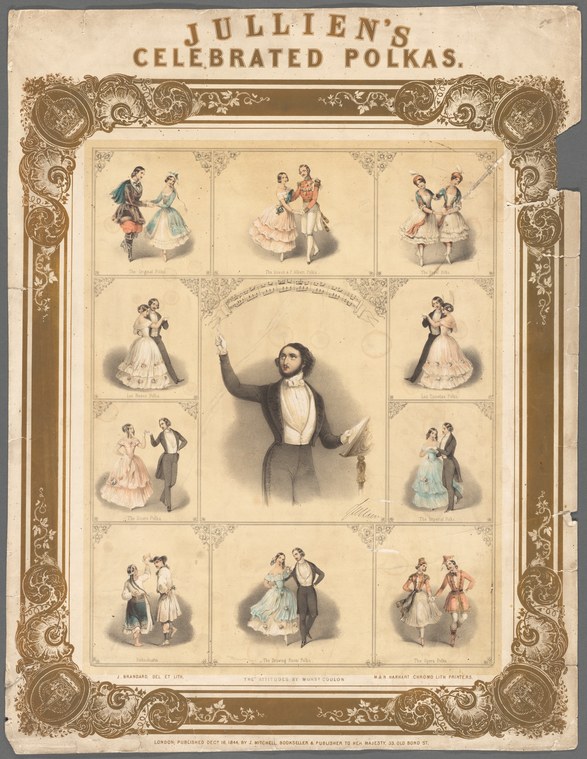
For dancers and historians, this print is a visual teaching document: it shows the polka's characteristic frame, posture, and rotational action frozen in twelve variations, offering insight into how the dance was learned and practiced. It also reveals the role of the named dance master—Jullien—in creating and controlling variations of popular dances, a practice central to 19th-century ballroom culture. The survival of such prints in archives like the New York Public Library shows how thoroughly dance was embedded in commercial print culture and how dancers used images to transmit and preserve technique.
What you are looking at
This is a composite lithographic print showing twelve vignettes arranged in a grid around a central figure. Each vignette depicts a couple dancing the polka in fashionable dress of the mid-to-late 19th century. The men wear formal dark coats with white shirt fronts; the women wear full-skirted dresses with corseted waists, some with plaid or patterned fabrics, others plain. The central figure is a man in formal dress with his arm raised in a conducting or demonstrating gesture, likely representing Jullien himself as choreographer or dance master. The surrounding twelve scenes show the polka in various configurations—some pairs are close together mid-turn, others are more formal and upright. The lithography is finely detailed with hand-coloured tints in warm ochres and flesh tones against a cream ground. An ornate decorative border of scrollwork and circular emblems frames the entire composition. The title "JULLIEN'S CELEBRATED POLKAS" appears at the top in large capitals.
The dancing
The dancers throughout hold the closed ballroom position standard to the polka: the man's right hand at the woman's waist, his left hand holding her right hand out to the side, creating the characteristic frame. The women's bodies lean slightly forward into the frame, their full skirts creating volume and movement. The postures are consistently upright and formal, with the weight appearing to be on the balls of the feet—characteristic of the bouncing, springy action of polka footwork. Several vignettes freeze the moment mid-turn, with the couples' bodies twisted and skirts splayed to suggest rotational movement. The central figure's raised arm and commanding posture differentiate him as an instructor or master of the form rather than a participant.
The dance depicted
This print documents the polka, a couple dance that swept through European and American ballrooms from the 1840s onward. The polka is a springing, turning dance in 2/4 time, characterized by a hop-step action and energetic rotation. Jullien—almost certainly the Paris-based dance master and choreographer Jules-Joseph Martinet, known professionally as Jullien—was famous for creating variations and "celebrated" versions of popular dances. The image shows the polka as a fashionable ballroom dance performed by the middle and upper classes in formal dress, emphasizing its role in Victorian social dancing culture. The twelve variations suggest different figures, tempos, or arrangements that made up Jullien's choreographic vocabulary for the dance.
How it was made
This is a hand-coloured lithograph, a medium that allowed rapid production and distribution of popular dance imagery in the 19th century. Lithography's reliance on drawn rather than engraved lines gave the artist flexibility to render the flowing movement of the skirts and the subtle postures of the dancers with a softer line than traditional engraving would permit. The decorative border and overall composition suggest this was a commercial print—likely a broadside or sheet for display—aimed at ballroom dancers and their teachers as both a record of fashionable steps and a promotional object. The hand-colouring, applied after printing, made each copy slightly unique and allowed the printer to emphasize the richness of the fabrics and the vitality of the scene.
About this work
This composite print preserves a record of the polka as it was danced and taught in mid-19th-century ballrooms, filtered through the authority and choreographic variations of a celebrated dance master. It belongs to a tradition of commercial dance imagery—prints made to document fashionable steps, promote dance teachers, and serve as reference materials for dancing masters and ambitious amateurs. The work sits at the intersection of three cultures: the visual documentation of dance, the commercial promotion of fashionable movement, and the Victorian ballroom's role as a site of social performance and instruction. It shows us not just what the polka looked like but how it was merchandised and disseminated to the public.
How to look at it
Attend first to the consistent frame and posture across all twelve vignettes—this is the dancer's primary education. Notice how the skirts create the visual drama: they splay and lift in the turning vignettes, suggesting the springing, rotating action of the polka, while in more static poses they hang fuller and more formal. Look at the central figure as the anchor: his raised arm and commanding posture give authority to the variations surrounding him, suggesting a master showing his repertoire. The ornate border frames this as a valuable object, something to display and consult rather than a casual illustration—a status appropriate for a document of fashionable practice.
The artist
The artist is not recorded. The print is credited to Jullien's choreography rather than an individual artist's vision, a common practice for dance instruction materials of the period. The style of the lithography and the composition suggest a professional commercial printer working in the 1850s–1870s, likely in Paris or London, where such materials were produced in quantity for the ballroom market. The work is representative of a class of anonymous commercial dance prints made by printers and lithographers whose names were rarely preserved.
The period
The polka emerged in Prague in the 1830s and became a continent-wide craze by the 1840s–1850s. Unlike the stately waltz, it was a democratic dance—faster, more playful, and less dependent on aristocratic bearing. The Victorian ballroom of the 1850s–1870s saw the polka as a sign of modernity and cosmopolitan taste. Dance masters like Jullien capitalized on the polka's popularity by creating and publishing variations, claiming to refine and elevate the popular form. This print dates from that moment of peak popularity and commercial exploitation. In art, the mid-to-late 19th century saw a boom in reproductive prints aimed at middle-class audiences; lithography made such materials affordable and widely distributed. Dance instruction prints formed a significant category of this commercial output.
Where it lives
This lithograph is held in the New York Public Library's collection, where it is catalogued as a late 19th-century ballroom dance print. The NYPL's holdings of such materials document the American ballroom's reliance on imported European dance instruction materials and the circulation of fashionable steps across the Atlantic.
Dance in this work
Questions about this work
Who was Jullien?
Jullien is the credited dance master whose variations this print documents. The name was likely a professional pseudonym; such figures were often French or working in the Paris tradition, and they achieved celebrity status by creating, naming, and publishing fashionable variations of popular dances. They were the choreographers and entrepreneurs of the Victorian ballroom.
What is the polka and why was it so popular?
The polka is a couple dance in 2/4 time with a springing, hopping action and continuous turning. It emerged from Bohemia in the 1830s and swept Europe and America by the 1840s–1850s. It was faster, more energetic, and more egalitarian than the waltz, and it became a symbol of modern, cosmopolitan taste among the Victorian middle classes.
Why are there twelve different vignettes?
The twelve scenes likely represent different figures, variations, or arrangements of the polka that made up Jullien's choreographic system. Dance masters built their reputation and sold their instruction materials by claiming to have created and refined variations—a way of placing themselves between the popular dance and its dancers.
How would dancers use this print?
Ballroom dancers, their teachers, and dancing masters would consult such prints to learn and confirm the fashionable frame, posture, and action of the polka. Prints like this functioned as both instruction manuals and promotional materials, circulating images of correct technique and associating the buyer with a celebrated master's choreographic authority.
More Polka artwork