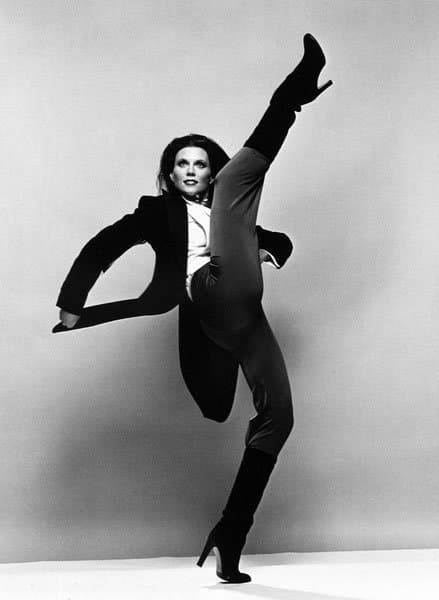
Ann Reinking
Legend of Dance
Why They Matter
Reinking’s legacy joins performance, choreographic authorship, and preservation. She was one of the clearest stage interpreters of Fosse’s aesthetic, then assumed responsibility for transmitting it to new casts and audiences. The longevity of the Chicago revival demonstrates the durability of that…
Styles Ann Reinking shaped
Each one links to the style’s own page — its origins, music, tempo and video.
Biography
Ann Reinking was a Broadway dancer, actor, singer, choreographer, and director whose career spanned from the original staging of classic musicals to the preservation and renewal of Bob Fosse's movement vocabulary. Born November 10, 1949, in Seattle, Washington, she studied dance from childhood, including summer study with San Francisco Ballet and training at the Joffrey Ballet in New York.
Reinking made her Broadway debut in *Cabaret* in 1969, beginning in the ensemble before moving into increasingly visible roles. Her 1970s stage work linked exceptional dancing with character performance. She appeared in *Pippin*, earned a Tony nomination for *Goodtime Charley* in 1975, replaced Donna McKechnie as Cassie in *A Chorus Line*, and in 1977 succeeded Gwen Verdon as Roxie Hart in the original Broadway production of *Chicago*. In 1978, her performance in Bob Fosse's *Dancin'* brought another Tony nomination.
Reinking's film work extended her reach beyond Broadway. She played a character partly modeled on herself in Fosse's *All That Jazz* (1979) and portrayed Grace Farrell in *Annie* (1982), balancing stage and screen projects throughout the 1970s and 1980s. Her professional connection to Fosse was consequential to her career's direction.
The decisive achievement of Reinking's later career was the 1996 Broadway revival of *Chicago*, directed by Walter Bobbie. She choreographed in the style of Bob Fosse and returned to the role of Roxie Hart. In 1997, she won the Tony Award for Best Choreography, establishing a production whose stripped-down staging placed the dancers' timing, shape, and attitude at its center. This revival became a sustained presence on Broadway, demonstrating the durability of both Fosse's vocabulary and Reinking's restaging work.
Reinking later co-created, co-directed, and co-choreographed *Fosse*, which opened on Broadway in 1999, extending her preservation work through a repertory revue. She also became an advocate for people with Marfan syndrome and related conditions, working with The Marfan Foundation on educational media and participating in the documentary *In My Hands*. Reinking died unexpectedly in December 2020 in Washington State at age 71.
Career Highlights
Made her Broadway debut in the original run of Cabaret. Masterworks Broadway
Appeared in the original Broadway production of Pippin. IBDB
Received a Tony nomination for her performance in Goodtime Charley. Tony Awards
Took over the role of Cassie in A Chorus Line. IBDB
Replaced Gwen Verdon as Roxie Hart in the original Broadway production of Chicago. IBDB
Earned a Tony nomination for performing in Dancin’. Television Academy
Appeared in Bob Fosse’s film All That Jazz. Masterworks Broadway
Played Grace Farrell in the film adaptation of Annie. Masterworks Broadway
Choreographed the Broadway revival of Chicago in the style of Bob Fosse and performed Roxie Hart. PBS
Won the Tony Award for Best Choreography for Chicago. Tony Awards
Co-created, co-directed, and co-choreographed the Broadway revue Fosse. IBDB
Gallery
Legacy & Impact
Reinking's legacy joins performance, choreographic authorship, and preservation. She was one of the clearest stage interpreters of Fosse's aesthetic, then assumed responsibility for transmitting it to new casts and audiences. The longevity of the *Chicago* revival demonstrates the durability of that work, but her contribution was not mechanical replication: she selected, clarified, rehearsed, and adapted a movement language for different bodies and a new production frame. For dancers today, Reinking's work shows how preservation can be creative stewardship rather than archival freezing.


Explore More Legends
Discover the dancers, teachers, choreographers, and cultural icons who shaped how the world moves.
Keep the thread going
Dance history, technique, and the occasional rabbit hole — in your inbox. Thoughtful, infrequent, unsubscribe anytime.
Free. No spam. One click to leave.