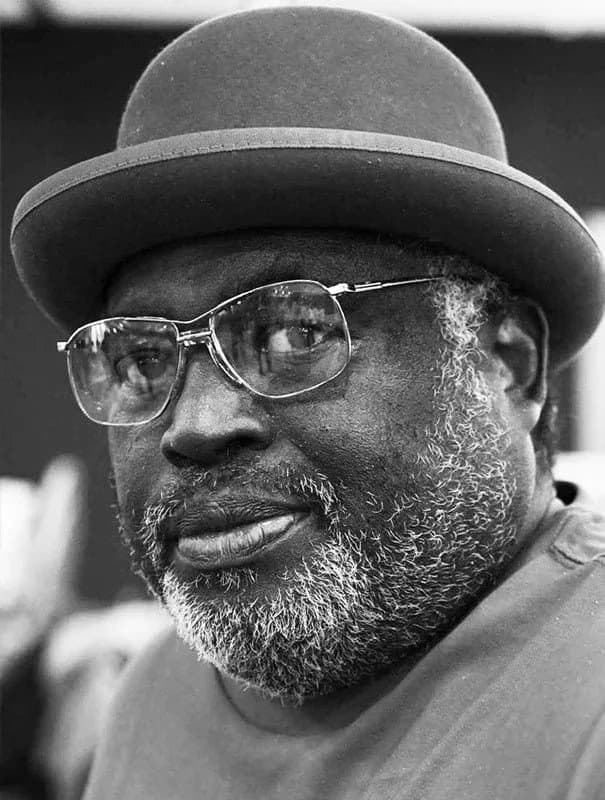
Innovator · Performer · Cultural Preserver
Don Campbell
Creator of Locking
Why They Matter
He created an entirely new dance vocabulary that influenced all of hip-hop dance and popular culture.
Styles Don Campbell shaped
Each one links to the style’s own page — its origins, music, tempo and video.
Watch
Don "Campbellock" Campbell on HHI's Real Talk
Hip Hop International
Campbell speaks within HHI’s 2017 Legends of Hip Hop panel, documenting his later role as a tradition bearer.
Biography
Donald Odell Campbell was born in St. Louis on January 8, 1951, and moved to Los Angeles with his family in the early 1960s, where he grew up in South Central. Before becoming a dancer, Campbell studied commercial art at Los Angeles Trade-Technical College—a background that shaped his approach to movement. He was visually inclined toward drawing faces, hands, trees and insects, a sensibility that would later define his dancing: shapes were made legible, interrupted, displayed and redirected toward an audience.
In 1970, while trying to reproduce a popular step called the Robot Shuffle at LA Trade Tech, Campbell stopped in a position that became The Lock. Rather than a single accident, his official timeline records a deliberate period of development: he tested and expanded the dance in clubs across Los Angeles and the San Fernando Valley, often entering several contests in a night. The form he developed was improvisational and centered on individual expression, with The Lock as its base—a charged contrast between continuous funk groove and a sudden, readable stop.
National visibility came through *Soul Train*. Campbell made his debut in October 1971, won a dance contest with Damita Jo Freeman and became a recurring member of the program's dance community. His rhythmic freezes, pointing gestures and extroverted performance persona became widely recognizable. In February 1972, billed as Don "SoulTrain" Campbell, he recorded "Campbell Lock" with producer Sonny Craver for Stanson Records, with both vocal and instrumental sides conceived to promote the dance.
Campbell's tenure on *Soul Train* ended in 1973 after he advocated for dancer compensation. That June, working with manager and choreographer Toni Basil, he assembled Campbellock dancers for an ABC television special backing Roberta Flack: Don Campbell, Basil, Leo Williamson, Bill Williams, Gregory Pope, Fawn Quinone, Fred Berry, Deney Terrio and Janet Lock appeared, with Adolfo "Shabba-Doo" Quiñones joining as a full member. The group appeared as a featured act on *The Carol Burnett Show* in November 1973.
In 1974, after a record-company dispute over the word "Campbellock," the troupe became The Lockers and the dance became widely known as locking. The professional act was collaborative: Campbell supplied its originating concept and unmistakable base move, Basil managed and staged the ensemble, and individual dancers brought distinct characters and steps. The Lockers' television and live appearances demonstrated that vernacular dancers could be presented as a named, paid specialty act rather than anonymous background labor.
After his principal touring years, Campbell continued as a teacher and ambassador. With his son Dennis Danehy, he offered "Creator's Classes," combining recorded history, questions and hands-on training, and traveled internationally to transmit both movement and authorship. On January 8, 2020—his sixty-ninth birthday—the City of Los Angeles named the intersection of Crenshaw Boulevard and Stocker Street Don "Campbellock" Campbell Square, connecting the honor to the South Los Angeles community where the dance matured. Campbell died of cardiac arrest at his Santa Clarita home on March 30, 2020. His first-person interviews, family archive and students remain essential because locking's history is oral, embodied and frequently flattened in secondary accounts.
Career Highlights
Donald Odell Campbell was born in St. Louis on January 8. Official timeline
His family moved to Los Angeles, where he was raised in South Central Los Angeles. USC obituary
At LA Trade-Technical College, Campbell created The Lock and began developing the Campbellock. Official timeline
He refined the dance through Los Angeles and San Fernando Valley club contests. Official timeline
Campbell made his Soul Train debut in October, competed with Damita Jo Freeman and became a recurring dancer. Official timeline
He recorded “Campbell Lock” with producer Sonny Craver for Stanson Records and toured to promote the dance. Official timeline
Campbell’s Soul Train tenure ended after he advocated compensation for dancers. USC obituary
With manager Toni Basil, he assembled Campbellock dancers for an ABC special backing Roberta Flack in June. Official timeline
The full Campbellock Dancers received a network feature on The Carol Burnett Show in November. Official timeline
The Campbellock Dancers became The Lockers and the public name of the dance became locking after a naming dispute. Official timeline
Los Angeles named Crenshaw Boulevard at Stocker Street Don “Campbellock” Campbell Square, with a dedication on January 8. NBC Los Angeles
Campbell died on March 30; dancers, teachers and institutions memorialized him as locking’s originator and a mentor. USC obituary
Legacy & Impact
Campbell matters because he made an interruption into a language. The Lock supplied a recognizable rhythmic and visual principle; his nightclub practice, *Soul Train* appearances, recording and troupe work turned that principle into a form other people could identify, elaborate and teach. Today locking circulates inside funk, street-dance and hip-hop settings worldwide. A responsible legacy account holds two truths together: Campbell is the documented originator of The Lock and Campbellock, and living traditions grow through communities whose members contribute steps, performance conventions and new interpretations.


Explore More Legends
Discover the dancers, teachers, choreographers, and cultural icons who shaped how the world moves.
Keep the thread going
Dance history, technique, and the occasional rabbit hole — in your inbox. Thoughtful, infrequent, unsubscribe anytime.
Free. No spam. One click to leave.