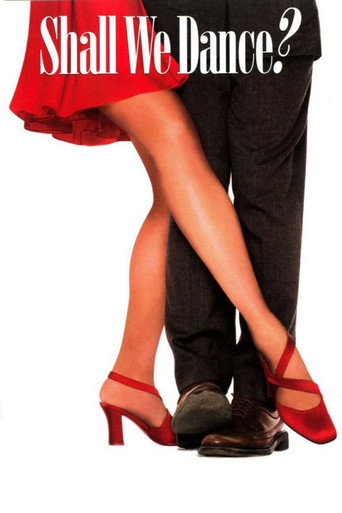
Dance in Film · 1996
Shall We Dance? (1996)
Japanese film about a businessman who secretly takes up ballroom dancing. The original that inspired the 2004 Hollywood remake.
Shall We Dance? is a 1996 dance feature film centred on American Rhythm, American Smooth, International Latin, International Standard, Ballet. For dancers, it's a chance to see these styles performed on screen — the phrasing, partnering, and musicality that the same dances carry onto a real floor.
Jump to the 17 dance sequences ↓
Dance styles featured
Where to watch: Streaming (various)
The dance sequences in Shall We Dance?
17 sequences — what is danced, by whom, and where to find it.
Amateur competition — Aoki and Toyoko's Paso Doble
International Paso DobleDanced by Naoto Takenaka; Eriko Watanabe · Choreography Toshio Watari (dance direction)
Aoki throwing away the wig and suddenly dancing the Paso Doble as himself instead of his imagined Latin idol.
After Toyoko tells him to take the wig off, Aoki returns bareheaded and attacks the floor with sharper torso opposition and larger Paso Doble shapes. The reveal lands because it is not merely cosmetic: removing the disguise releases a more direct performance that Toyoko and the spectators immediately recognize.
Stream or rental only — the timestamp is for when you have it playing.
Amateur competition — Aoki and Toyoko's Rumba
International RumbaDanced by Naoto Takenaka; Eriko Watanabe · Choreography Toshio Watari (dance direction)
Aoki trying to protect his theatrical wig through the Rumba while Toyoko struggles to keep them dancing as a pair.
Aoki enters the crowded amateur floor still policing his wig, and the headpiece becomes a competing partner while Toyoko drives the Rumba beside him. His distracted vanity breaks their shared timing, so the weak first heat is legible in the couple's bodies before Toyoko names the problem.
Stream or rental only — the timestamp is for when you have it playing.
Amateur competition — Sugiyama and Toyoko's Quickstep
International QuickstepDanced by Koji Yakusho; Eriko Watanabe · Choreography Toshio Watari (dance direction)
Sugiyama catching Toyoko after the Quickstep collision, accidentally tearing away her skirt while keeping her from hitting the floor.
The rehearsed sweep and chassés now carry Sugiyama and Toyoko through traffic at speed until his daughter's shout cuts across the music from the edge of the floor. His glance toward the audience causes the collision, and his instinctive move to shield Toyoko turns a technical failure into the clearest proof that he has learned partnership.
Stream or rental only — the timestamp is for when you have it playing.
Amateur competition — Sugiyama and Toyoko's Waltz
International WaltzDanced by Koji Yakusho; Eriko Watanabe · Choreography Toshio Watari (dance direction)
Sugiyama taking the competition Waltz's first huge step exactly as Mai taught him and carrying Toyoko cleanly into the traffic.
Sugiyama and Toyoko hold their opening pose while Mai's instruction about the first step plays in memory, and his decisive launch across the center finally converts months of hesitation into travel. When another couple crowds them, the shot stays wide enough to show Toyoko trusting his frame, making the recovery as important as the polished entrance.
Stream or rental only — the timestamp is for when you have it playing.
Aoki's private Rumba practice
International RumbaDanced by Naoto Takenaka · Choreography Toshio Watari (dance direction)
Aoki transforming from shy office worker into a wigged, extravagant Latin competitor the moment he starts moving.
Aoki throws a fully committed Latin body line across the small Kishikawa studio while Toyoko complains that his one-trick Rumba monopolizes the floor. The clash between his Donnie Burns imitation, conspicuous wig and absolute sincerity lets the comedy come from social vanity without treating the Rumba itself as a joke.
Stream or rental only — the timestamp is for when you have it playing.
Blackpool Tower Ballroom prologue
Danced by Blackpool Dance Festival competitors (not individually identified)
The Shakespeare line above Blackpool Tower Ballroom giving way to a floor full of competition couples.
A slow pan carries the Shakespeare inscription above Blackpool Tower Ballroom into a view of couples circulating across the floor beneath it. Suo makes the grand hall the visual opposite of Sugiyama's boxed-in commute, establishing ballroom as an expansive public world before the Tokyo story begins.
Stream or rental only — the timestamp is for when you have it playing.
Competition training — Quickstep floorcraft
International QuickstepDanced by Koji Yakusho; Eriko Watanabe; Reiko Kusamura · Choreography Toshio Watari (dance direction)
The tiny studio being mapped into a complete Quickstep route of scissors, chassés, a running finish and natural turn.
Tamura diagrams the route as an entrance sweep, alternating scissors, side chassé, running finish and natural turn, turning the little studio into an imagined competition floor. Sugiyama and Toyoko trace that prescribed path until the room's limited width becomes useful: floorcraft has to be learned before they face other couples at speed.
Stream or rental only — the timestamp is for when you have it playing.
Competition training — Waltz first step
International WaltzDanced by Koji Yakusho; Eriko Watanabe; Tamiyo Kusakari; Reiko Kusamura · Choreography Tetsuya Sakurada (choreography for Tamiyo Kusakari); Toshio Watari (dance direction)
Mai telling Sugiyama that the Waltz begins with a step taken from the heart, then demanding that he make it large enough to mean something.
Toyoko's impatience makes each failed lead visible, especially when Sugiyama cannot commit his first step and she barrels into his space. Mai changes the rehearsal when she asks him to stride from the heart; the enlarged right-foot action becomes a measurable bridge between timid salaryman posture and competition presence.
Stream or rental only — the timestamp is for when you have it playing.
Dance-hall social — Sugiyama and Toyoko
Danced by Koji Yakusho; Eriko Watanabe · Choreography Toshio Watari (dance direction)
Toyoko drafting the hesitant Sugiyama onto a real dance-hall floor to the song that gives the film its title.
Toyoko pulls Sugiyama away from watching at the edge and onto a crowded social floor just as the title song begins, denying him the safety of practicing alone. He keeps checking his feet while couples pass close on every side, so the hall turns simple partner timing into an exercise in occupying public space.
Stream or rental only — the timestamp is for when you have it playing.
Farewell-party final Waltz — Mai and Sugiyama
International WaltzDanced by Tamiyo Kusakari; Koji Yakusho · Choreography Tetsuya Sakurada (choreography for Tamiyo Kusakari); Toshio Watari (dance direction)
Mai crossing the floor to ask Sugiyama 'Shall we dance?' and choosing him for the farewell party's last Waltz.
Mai waits in the studio as the last number is announced, and Sugiyama's return transforms the window that first separated watcher from dancer into an invitation he can answer. Their settled Waltz frame and Mai's softened response make the familiar room feel shared, while the surrounding class witnesses the partnership instead of intruding on it.
Stream or rental only — the timestamp is for when you have it playing.
First beginner class — ballroom Blues warm-up
Danced by Koji Yakusho; Yu Tokui; Hiromasa Taguchi; Reiko Kusamura · Choreography Toshio Watari (dance direction)
Sugiyama trying to hide inside the beginner line while Tamura restarts the same basic Blues pattern.
Tamura keeps the three beginners in a line while Sugiyama repeatedly drops his gaze toward the polished floor, making every late weight transfer visible. Hattori's confidence and Tanaka's effort give Sugiyama two concrete bodies to measure himself against, so the Blues drill plays as public awkwardness rather than instant transformation.
Stream or rental only — the timestamp is for when you have it playing.
First Mambo lesson
Danced by Koji Yakusho; Yu Tokui; Hiromasa Taguchi; Reiko Kusamura · Choreography Toshio Watari (dance direction)
The three beginners chanting quick-quick-slow while their half turns keep falling out of time.
Tamura reduces Mambo to left-right-left and right-left-right before forcing the men into half turns and partner timing, and Sugiyama's errors remain visible instead of disappearing under montage. The repeated quick-quick-slow counts convert embarrassment into a learnable pattern, the film's first proof that his secret desire can become a physical skill.
Stream or rental only — the timestamp is for when you have it playing.
Mai and Kimoto's dance-hall exhibition
Danced by Tamiyo Kusakari; Masahiro Motoki · Choreography Tetsuya Sakurada (choreography for Tamiyo Kusakari); Toshio Watari (dance direction)
The dance-hall regulars parting so Mai and Kimoto can turn an ordinary social floor into an exhibition space.
The social dancers clear a pocket of floor for Mai and Kimoto, and their unbroken travel makes the same hall that crowded Sugiyama suddenly look broad and ordered. Watching Mai sustain a full partnership rather than stand as a silhouette in the studio window shifts Sugiyama's attention from romantic mystery to the craft he still lacks.
Stream or rental only — the timestamp is for when you have it playing.
Mai's substitute Waltz class
International WaltzDanced by Tamiyo Kusakari; Koji Yakusho; Yu Tokui; Hiromasa Taguchi · Choreography Tetsuya Sakurada (choreography for Tamiyo Kusakari); Toshio Watari (dance direction)
Sugiyama's fantasy of Mai collapsing into the awkward reality of taking Waltz hold under the class's eyes.
When Mai substitutes, the studio's teasing immediately tightens into closed hold, and Sugiyama has to place his body against the woman he had only watched through train glass. Suo keeps the other beginners nearby, puncturing the wished-for contact with missed weight changes and the practical discipline of a group Waltz class.
Stream or rental only — the timestamp is for when you have it playing.
Masako's first Waltz lesson at home
International WaltzDanced by Koji Yakusho; Hideko Hara · Choreography Toshio Watari (dance direction)
Masako asking to be taught and the couple's stiff quarter turns softening into an embrace in their own living room.
In the living room, Sugiyama teaches quarter turns with no tails, judges or studio mirrors, placing their careful footwork inside the house whose mortgage had defined his old life. The dance lands when counting gives way to his apology, allowing closed hold to become a conversation with Masako rather than another secret.
Stream or rental only — the timestamp is for when you have it playing.
Sugiyama's solo ballroom-practice montage
Danced by Koji Yakusho · Choreography Toshio Watari (dance direction)
Sugiyama quietly marking ballroom steps on the station platform and under his desk when he thinks nobody is watching.
Suo scatters Sugiyama's new rhythm across a train platform, a park, rain-soaked pavement and the space beneath his office desk, turning places built for waiting or work into rehearsal floors. The repeated footwork matters because the salaryman's body begins changing outside Kishikawa Dance Class, where nobody is present to praise the effort.
Stream or rental only — the timestamp is for when you have it playing.
Toyoko auditions Tanaka as a partner
Danced by Eriko Watanabe; Hiromasa Taguchi · Choreography Toshio Watari (dance direction)
Toyoko sizing up the least polished beginner as a potential competition partner and making him dance before he understands the proposal.
Toyoko presses Tanaka into an abrupt partner trial, using his broad frame as something to steer rather than a punch line seen from across the beginner class. His delayed realization that she means a competition partnership makes the steps a negotiation: her ambition is already moving faster than his confidence.
Stream or rental only — the timestamp is for when you have it playing.
More dance films
Poster artwork from TMDB.
 This site uses TMDB and the TMDB APIs but is not endorsed, certified, or otherwise approved by TMDB.