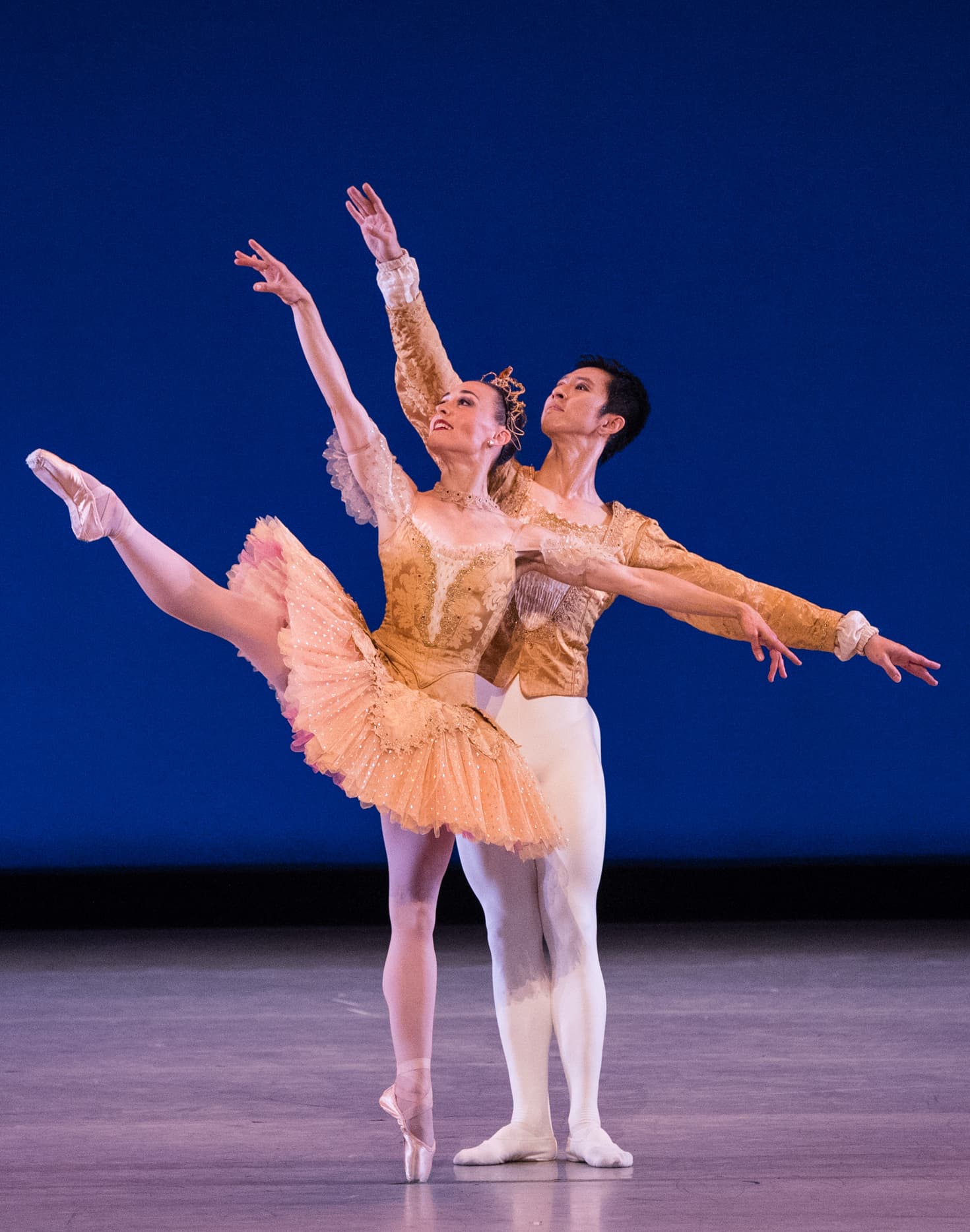
KCBalletMedia — https://www.flickr.com/photos/67555847@N06/34574346636/ · CC BY 2.0
Theme and Variations is a plotless, one-act ballet George Balanchine made for Ballet Theatre (now American Ballet Theatre), set to the final movement of Tchaikovsky's Orchestral Suite No. 3. It premiered on November 26, 1947, with Alicia Alonso and Igor Youskevitch as the lead couple, supported by four soloists and a corps de ballet, in designs by Woodman Thompson.
What it contains
- Balanchine Method · the lead couple's pas de deux material throughout the ballet — Balanchine reportedly directed the male lead away from dramatic, prince-like interpretation and toward the steps themselves, escalating technical complexity to suppress personal interpretation in favor of pure execution. Source: "but Balanchine wanted him to focus on the steps only"
- Classical Ballet · the entire ballet, for the lead couple, four soloists and corps de ballet — Choreography built explicitly as homage to Imperial Russian classical ballet and The Sleeping Beauty, with grand formal partnering for the principal couple and ensemble patterning for soloists and corps rather than dramatic pantomime. Source: "Balanchine made Theme and Variations as a tribute to the Imperial Russian ballet style, and he wrote that the ballet was intended "to evoke that great period in classical dancing when Russian ballet flourished with the aid of Tchaikovsky's music.""
- Neoclassical Ballet · the entire ballet — A plotless, abstract structure for principals, soloists and corps in which steps and musical structure replace narrative or characterization as the organizing principle. Source: "The ballet is plotless and abstract."
What is danced
The ballet has no story: a principal couple, four soloists and a corps de ballet dance in a construction the article describes as deliberately built 'to evoke that great period in classical dancing when Russian ballet flourished with the aid of Tchaikovsky's music' — an explicit tribute to Imperial Russian ballet and to The Sleeping Beauty. Balanchine is reported to have pushed his leads away from dramatic interpretation and toward pure execution: when Youskevitch wanted to dance 'like a prince from Swan Lake or Giselle,' Balanchine instead 'wanted him to focus on the steps only,' and gave the couple increasingly 'complex steps' in what Alonso understood as an attempt to strip out personal interpretation in favor of the choreography itself.
Context
The ballet arrived in 1947 as Balanchine, fifteen years into his American career, was still consolidating a reputation independent of the Ballets Russes lineage; Lincoln Kirstein's private letter to Stravinsky noting that Theme and Variations was not Balanchine's best work but 'appealed madly to the public' and marked the moment Balanchine had 'become recognized' captures how the piece functioned as a public breakthrough even among skeptical insiders. It sits alongside Ballet Imperial (later Tschaikovsky Piano Concerto No. 2) as one of Balanchine's deliberate homages to the vanished Imperial Russian ballet style he had trained in, made for a company, Ballet Theatre, that was not yet his own.
Staging history
The ballet moved quickly beyond its Ballet Theatre premiere: it reached Cuba within months, danced by Alonso, Youskevitch, Melissa Hayden and Fernando Alonso with members of Ballet Alicia Alonso (now Cuban National Ballet). Balanchine's own company, New York City Ballet, did not stage it until 1960, with Violette Verdy and Edward Villella and new Karinska costumes; in 1970 Balanchine folded its choreography into a new, full-suite ballet, Tschaikovsky Suite No. 3 (danced at that premiere by Villella and Gelsey Kirkland). The article also lists later stagings by The Royal Ballet, Kirov Ballet, San Francisco Ballet, Dutch National Ballet, Birmingham Royal Ballet, Boston Ballet, Pacific Northwest Ballet, Houston Ballet, Royal Danish Ballet and Les Grands Ballets Canadiens.
How to watch it
Watch the lead couple against the four soloists and corps for the way steps accumulate in difficulty without any pantomime or narrative cueing — the piece asks dancers to carry meaning through musicality and execution alone rather than character. The staging deliberately gestures toward The Sleeping Beauty and the grand manner of Imperial Russian ballet, so formal, presentational partnering and large ensemble patterning are the point, not a backdrop to a story.
Credits
- composer: Pyotr Ilyich Tchaikovsky
More from George Balanchine
Other staged works in the register connected to this one by author or lineage.
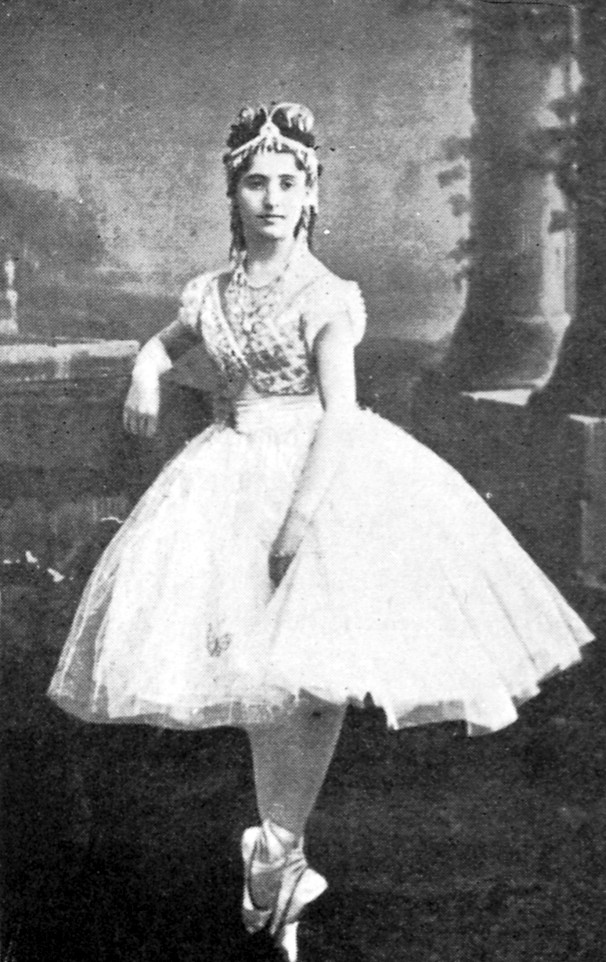 CoppéliaBallet · 1870Balanchine · video
 ApolloBallet · 1928Balanchine · video
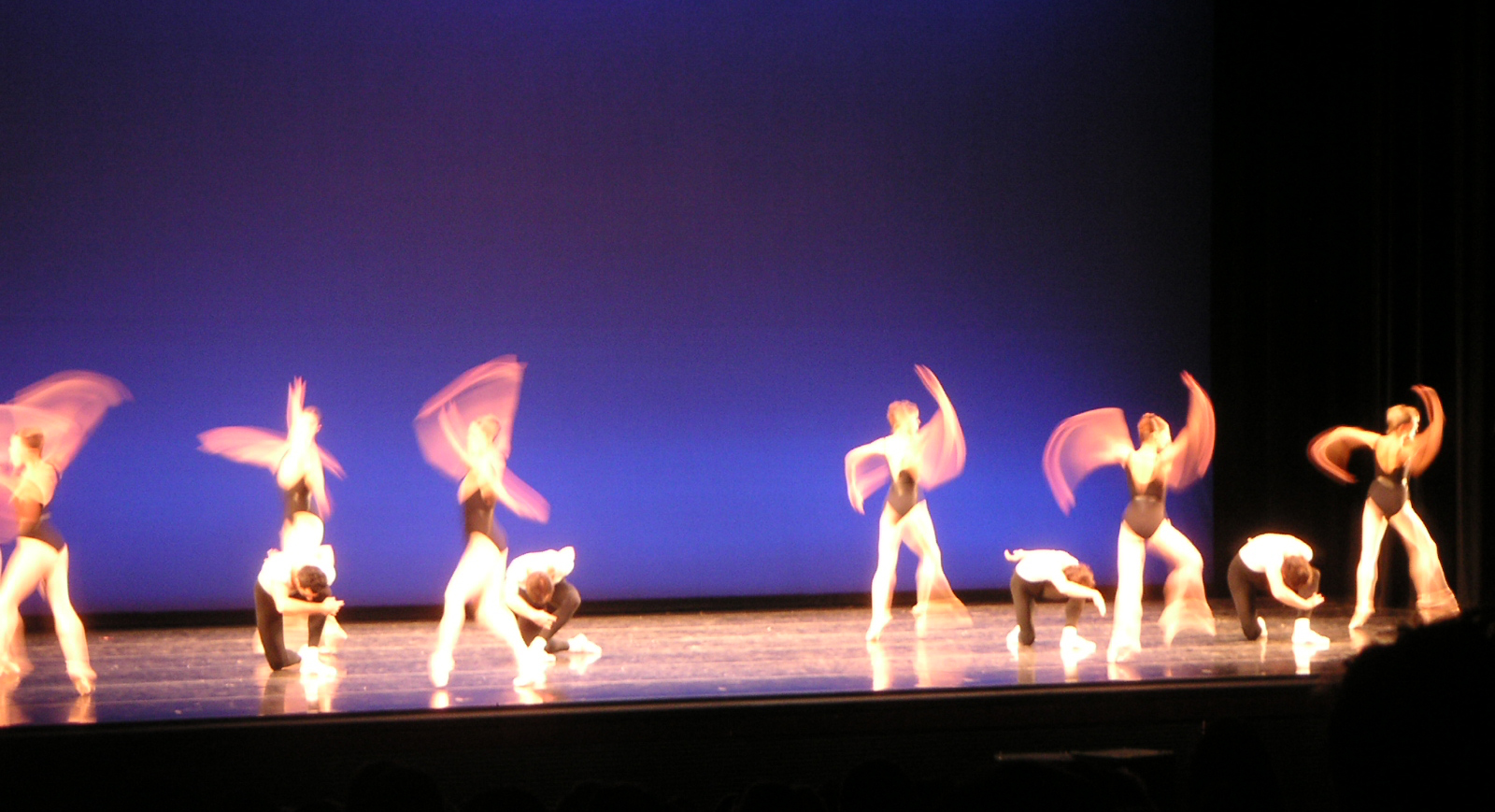 AgonBallet · 1957Balanchine · video
 Le chant du rossignolBallet · 1920Balanchine · video
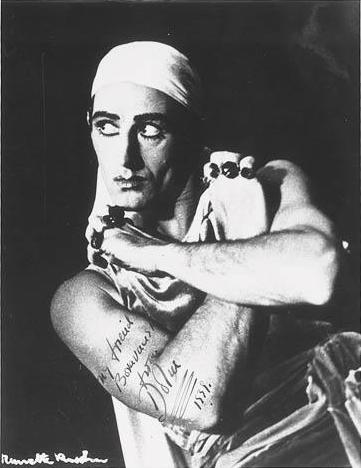 The Prodigal SonBallet · 1929Balanchine · video
 The Seven Deadly SinsBallet · 1933Balanchine · video
 Monumentum pro GesualdoBallet · 1960Balanchine · video
- Metastaseis and PithopraktaMetastaseis and PithopraktaBallet · 1968Balanchine