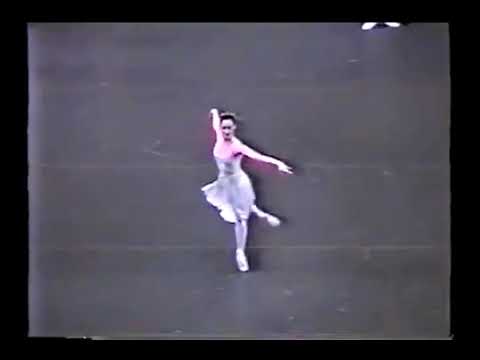
Tschaikovsky Piano Concerto No. 2 is George Balanchine's 1941 plotless ballet set to Tchaikovsky's Piano Concerto No. 2 (in the Siloti abridgement), made for the American Ballet Caravan's US-government-subsidized South American tour and first performed as Ballet Imperial at the Teatro Municipal, Rio de Janeiro. It was conceived as a demonstration piece: an American company proving it could sustain the grand classical tradition, built on Petipa's academic vocabulary rather than on a revived nineteenth-century warhorse.
What it contains
- Classical Ballet · The whole ballet, in both the Ballet Imperial and Tschaikovsky Piano Concerto No. 2 versions — Academic pointe-work vocabulary built explicitly on Petipa's classical steps, with a demanding first-ballerina role, a second ballerina for cadenza passages, and a corps performing soloist-level classical steps rather than serving as background. Source: "The choreography features academic steps inspired by Petipa."
- Neoclassical Ballet · The whole ballet, especially the 1973 retitled version — Plotless choreography made to run continuously against a symphonic concerto rather than a narrative score, with mime and pictorial allusion stripped out so that steps relate directly to the music alone. Source: "with the ballet now standing in relation to the music alone"
What is danced
The ballet has no plot; it is built entirely around dancing to a symphonic concerto rather than a numbered score, which the article notes Petipa himself would not have used. The structure centers on a first ballerina role (created for Marie-Jeanne) described as one of the most demanding in the Balanchine repertory, her male partner in a mostly supportive role, a second ballerina created specifically to handle cadenza passages no single dancer could cover alone, two men supporting her, two female demi-soloists, and a corps de ballet.
The corps is not decorative: the article stresses that unlike Petipa-era corps work, which was largely background to the soloists, this corps performs choreography as technically demanding as the principals' - an early instance of Balanchine treating the ensemble as an active dance force rather than a frame. In the 1941 Ballet Imperial version the partner role included a mime passage; when Balanchine reworked the piece in 1973 as Tschaikovsky Piano Concerto No. 2 he removed that mime passage along with the Imperial Russian designs, leaving pure academic dancing 'unencumbered' by narrative gesture, in his own words.
Context
The 1941 tour sat at a wartime cultural-diplomacy crossroads: Nelson Rockefeller, as Coordinator of Inter-American Affairs, funded the American Ballet Caravan explicitly to build American prestige in South America, and Balanchine and Kirstein chose to answer that brief not by importing Swan Lake or The Sleeping Beauty but by composing a new ballet in Petipa's academic language - an argument that American dancers could originate, not just inherit, the imperial classical tradition. The choice to set an entire ballet to a symphonic concerto rather than a ballet-specific score was itself a departure from Petipa-era practice.
The 1973 retitling and stripping of scenery and costume tracks Balanchine's later aesthetic position, articulated in his own writing, that audiences no longer needed pictorial and narrative scaffolding to read a ballet and that the music and the steps could carry meaning directly - a statement of the neoclassical, score-driven abstraction that came to define much of his later New York City Ballet output.
Staging history
The ballet premiered June 25, 1941 at the Teatro Municipal, Rio de Janeiro, after a preview at Hunter College, and toured nine South American countries with the American Ballet Caravan before that company disbanded. It was subsequently staged by the New Opera (1942), Ballet Russe de Monte-Carlo (1945, with Maria Tallchief), Sadler's Wells Ballet/Royal Ballet (1950, with Margot Fonteyn), and La Scala (1952), among others, with designs by Eugene Berman, Carl Toms, Rouben Ter-Arutunian and Karinska replacing the original Dobuzhinsky sets over the years. New York City Ballet first danced it, as Ballet Imperial, in 1964; Balanchine restaged and renamed it Tschaikovsky Piano Concerto No. 2 there in 1973, removing the Imperial Russian references. After Balanchine's death in 1983 several companies, including the Royal Ballet, reverted to performing it as Ballet Imperial with Imperial Russian designs restored, and companies today - among them American Ballet Theatre, Paris Opera Ballet, Mariinsky Ballet, and Pacific Northwest Ballet - continue to hold the rights to either version.
How to watch it
Watch for the corps de ballet dancing at the same technical level as the soloists rather than framing them - a marker of Balanchine departing from strict Petipa-era hierarchy even while quoting his vocabulary. The two-ballerina structure exists because the concerto's cadenza passages demand more stamina and virtuosity than one dancer can sustain, so watch how the material is divided between the first ballerina's sustained, taxing role and the second ballerina's more soloistic cadenza work. If the production is billed as Ballet Imperial, expect tutus, a crowned lead ballerina, and Imperial-Russia-evoking scenery; if billed as Tschaikovsky Piano Concerto No. 2, expect a plain cyclorama, chiffon dresses, and no mime passage.
Credits
- composer: Pyotr Ilyich Tchaikovsky
More from George Balanchine
Other staged works in the register connected to this one by author or lineage.
 CoppéliaBallet · 1870Balanchine · video
 ApolloBallet · 1928Balanchine · video
 AgonBallet · 1957Balanchine · video
 Le chant du rossignolBallet · 1920Balanchine · video
 The Prodigal SonBallet · 1929Balanchine · video
 The Seven Deadly SinsBallet · 1933Balanchine · video
 Les RendezvousBallet · 1933Same lineage · video
 Union JackBallet · 1976Balanchine · video