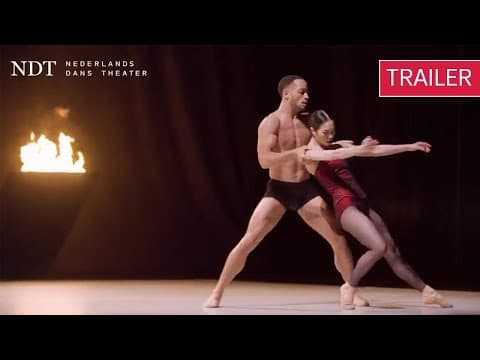
Bella Figura (1995)
Bella Figura is a contemporary ballet made by Jiří Kylián in 1995 for Nederlands Dans Theater, commissioned by the newspaper NRC Handelsblad for its 25th anniversary. Our record credits only Giuseppe Torelli as composer and leaves choreographer and premiere date unrecorded, but the score is in fact a compilation drawing on Torelli alongside Foss, Pergolesi, Marcello and Vivaldi, used as one layer in a work built as much from lighting and costume as from steps.
What it contains
- Contemporary Ballet · Whole work; danced by the full cast of nine throughout — upper bodies sharply torsioned, arms cleaving space, leg-lines racily hyperextended, presented as a sequence of sharply defined images rather than continuous narrative movement Source: "The dance itself is a series of flicker-book images with every page impeccable – upper bodies sharply torsioned, arms cleaving space, leg-lines racily hyperextended."
What is danced
The ballet is danced by nine performers (five women, four men) and is described by critics as a sequence of sharply defined tableaux rather than a continuous narrative line: 'a series of flicker-book images with every page impeccable – upper bodies sharply torsioned, arms cleaving space, leg-lines racily hyperextended.' This is contemporary ballet vocabulary pushed toward extremes of torsion and extension, built for dancers with a classical base but freed from strict alignment and turnout logic.
Staging elements are inseparable from the dance content here: a moving curtain is used to frame and reshape the stage, to drape across dancers mid-movement, and to echo the choreographic line itself, so the curtain functions almost as a partner or extension of the corps. Lighting, designed by Kylián and realised by Tom Bevoort, is built around Caravaggio-derived chiaroscuro, meaning the dancers are frequently seen half-lit, which the choreography is shaped to exploit (torsion and profile read strongly against strong side or top light).
Costuming is part of the vocabulary rather than decoration: in some passages both men and women wear long red skirts while topless, a choice Kylián intended to equalise the sexes rather than eroticise them; elsewhere the company wears leotards, tights and mesh in red, flesh tone and black. The article notes some venues or dancers substitute skin-coloured coverings for the topless sections, which affects how the piece reads in performance but does not change the steps.
The article gives no scene-by-scene breakdown or named divertissements, so beyond the description above there is no further structural detail to draw on.
Context
Kylián made Bella Figura in 1995 while artistic director of Nederlands Dans Theater, a company he had already shaped into a leading centre for what is now called contemporary ballet — work that keeps a classical ballet base but abandons narrative convention, strict period style and, often, pointe-centred vocabulary. The piece is characteristic of his mid-1990s output in explicitly quoting the Baroque (in music, in the chiaroscuro lighting derived from Caravaggio, and in choreographic reference) while presenting that quotation through a distinctly late-twentieth-century movement language of torsion and hyperextension rather than any reconstructed period step.
Staging history
The ballet premiered on 12 October 1995 at the AT&T Danstheater in The Hague with Nederlands Dans Theater. It has since entered the repertories of several major companies, including the Paris Opera Ballet, Boston Ballet, the Australian Ballet, Les Ballets de Monte-Carlo, Royal Swedish Ballet, Zürich Ballet and Finnish National Ballet, making it one of Kylián's more widely toured works outside NDT.
How to watch it
Watch how the moving curtain is choreographed as if it were a tenth dancer, framing, draping and revealing bodies rather than simply marking scene changes. Pay attention to the interplay of the chiaroscuro lighting with the torsion in the upper body and hyperextended leg lines described by critics, since the piece is built for that light rather than lit incidentally around finished choreography. Note also that the red-skirted, topless costuming is deliberately non-gendered in Kylián's intent, worth watching for rather than reading as spectacle.
Credits
- composer: Giuseppe Torelli
In the same lineage
Other staged works in the register connected to this one by author or lineage.
 West Side StoryMusical theatre · 1957Same lineage · video
 SylviaBallet · 1876Same lineage · video
 Carmen SuiteBallet · 1967Same lineage · video
 Swan LakeBallet · 1995Same lineage · video
 Middle DuetBallet · 1998Same lineage · video
 The Car ManBallet · 2000Same lineage · video
 The CageBallet · 1951Same lineage · video
 Moon WaterBallet · 1998Same lineage · video