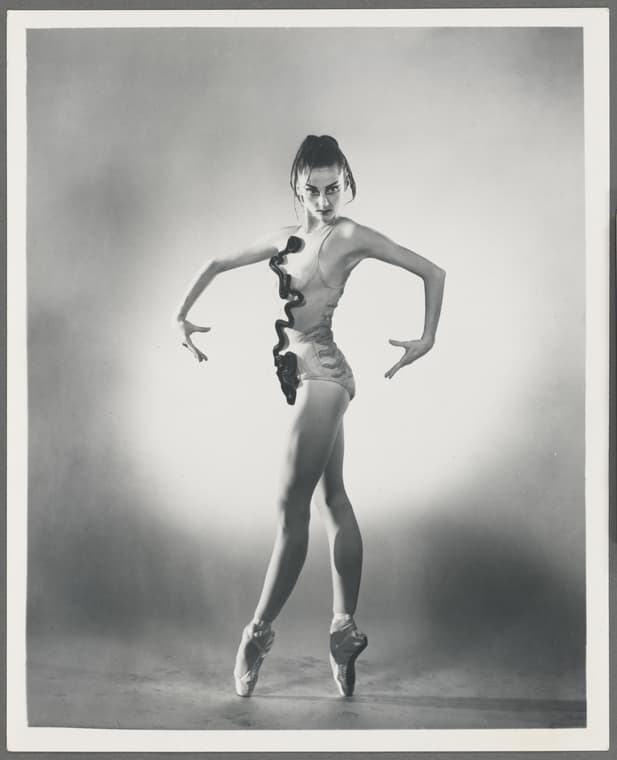
Unknown author · Public domain
The Cage (1951)
The Cage is a one-act ballet made by Jerome Robbins for the New York City Ballet in 1951, set to Stravinsky's Concerto in D. It tells of a female insect tribe that ritually kills its male intruders, with a newly initiated 'Novice' who falls for a male intruder before her instincts overcome her and she kills him too. It belongs to the catalogue as one of the defining dramatic ballets of the postwar American repertory, and as a work whose choreography deliberately abandons balletic prettiness for something closer to animal and cult ritual.
What it contains
- Contemporary Ballet · The whole ballet, corps and lead roles alike — Choreography deliberately built to look non-human and unbeautiful: contorted, insect-derived corps shapes and a lead performance played as blank and animal rather than balletic. Source: "The corps de ballet took some time to understand how they are supposed to be ugly and contorted."
What is danced
The article gives little in the way of step-by-step choreographic description, but it is specific about the intent behind the movement: Robbins wanted a vocabulary that did not read as human. He researched a book about spiders, studied human cult rituals and animal and insect societies, and observed tigers at the zoo before building the corps's shapes, and he also drew on Thai and Balinese court dancing that he had studied while working on The King and I. The corps de ballet had to be taught to be, in the company's own account, 'ugly and contorted' -- a departure from classical line that reportedly took them time to absorb before Robbins felt they 'went ahead like wildfire.'
Context
The article situates The Cage within the New York City Ballet's Stravinsky-ballet lineage: up to that point, nearly all of the company's Stravinsky works had been made by Balanchine, and Robbins's original concept -- an Amazon myth meant to sit alongside Balanchine's Apollo and Orpheus -- was explicitly conceived as extending that trilogy. Robbins abandoned the mythological frame partway through and rebuilt the piece around insect and ritual behavior instead, a shift the article frames as a deliberate move away from 'human beings moving in a way that we know is human.' The result, per contemporary criticism quoted in the article (John Martin calling it 'angry, sparse, unsparing... decadent in its concern with misogyny and its contempt for procreation'), was received as a provocation within the genteel postwar ballet repertory, and it drew attempts at censorship on tour.
Staging history
The ballet premiered at City Center of Music and Drama on June 10, 1951, with Nora Kaye as the Novice. On the New York City Ballet's 1952 European tour, Dutch officials attempted to ban a Hague performance after a critic called it 'pornographic'; the ban was lifted after Robbins threatened to withdraw all his works from the tour and Kaye threatened not to perform. The ballet entered the repertory of Robbins's own company, Ballets: USA, in 1961, and was revived by New York City Ballet for the 1972 Stravinsky Festival marking the composer's death. The article also notes later stagings by Birmingham Royal Ballet, San Francisco Ballet, the Australian Ballet and English National Ballet, and a 1980 television filming for NBC's Live from Studio 8H with Heather Watts as the Novice.
How to watch it
Watch for the corps de ballet's insect posture -- angular, contorted shapes that Robbins insisted be 'ugly' rather than beautiful -- against Jean Rosenthal's rope-web set, and for the Novice's shift from reflexive violence in her first kill to conflicted tenderness and then relapse into instinct in her second. The role has traditionally been read as a performance of unreadable, animal blankness rather than dramatic expressiveness; Robbins himself praised Nora Kaye for playing it 'with a beetle's eyes & no expression' rather than as a conventional ballerina role.
Credits
- composer: Igor Stravinsky
More from Igor Stravinsky
Other staged works in the register connected to this one by author or lineage.
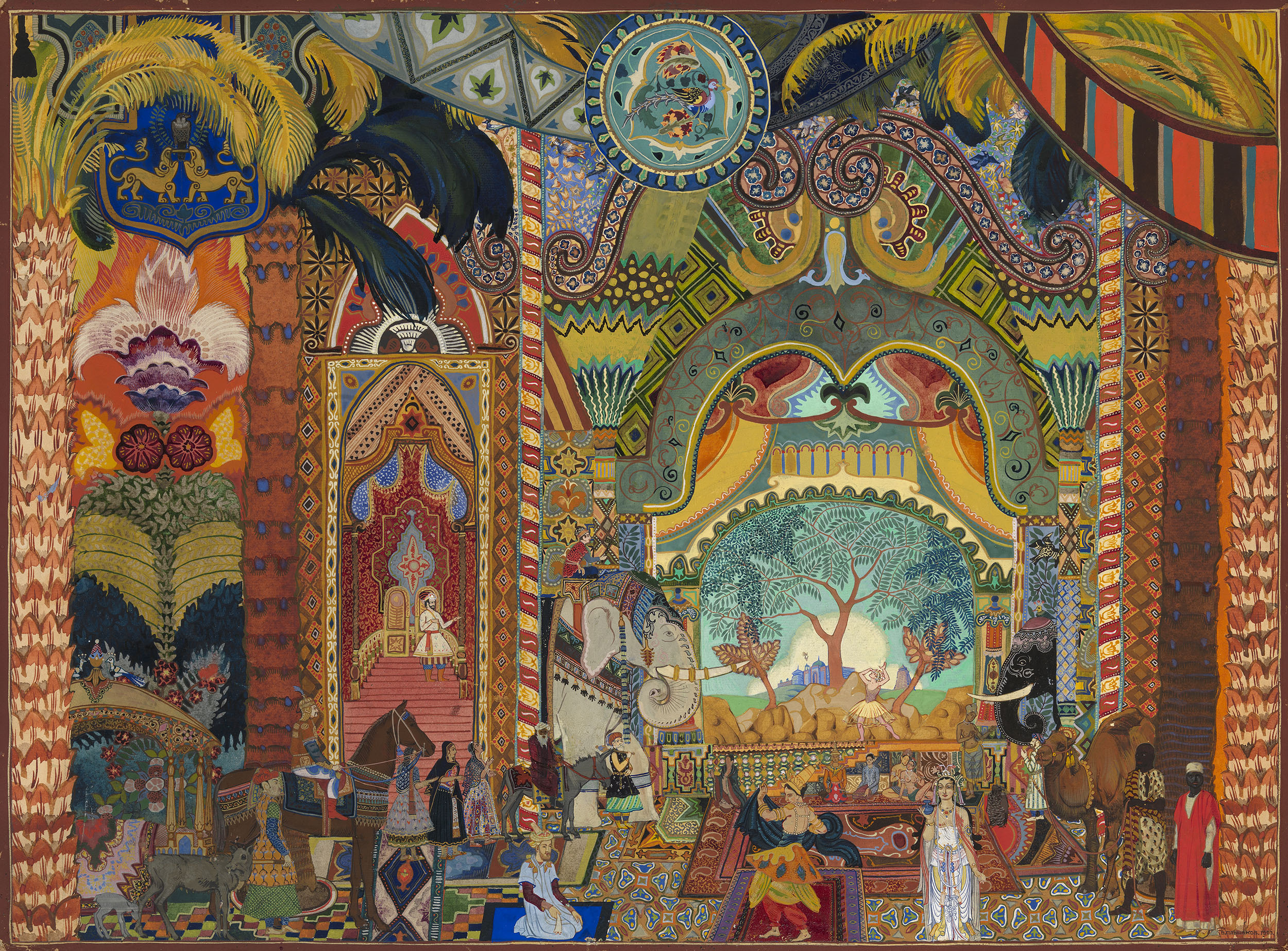 The FirebirdBallet · 1910Music by Stravinsky · video
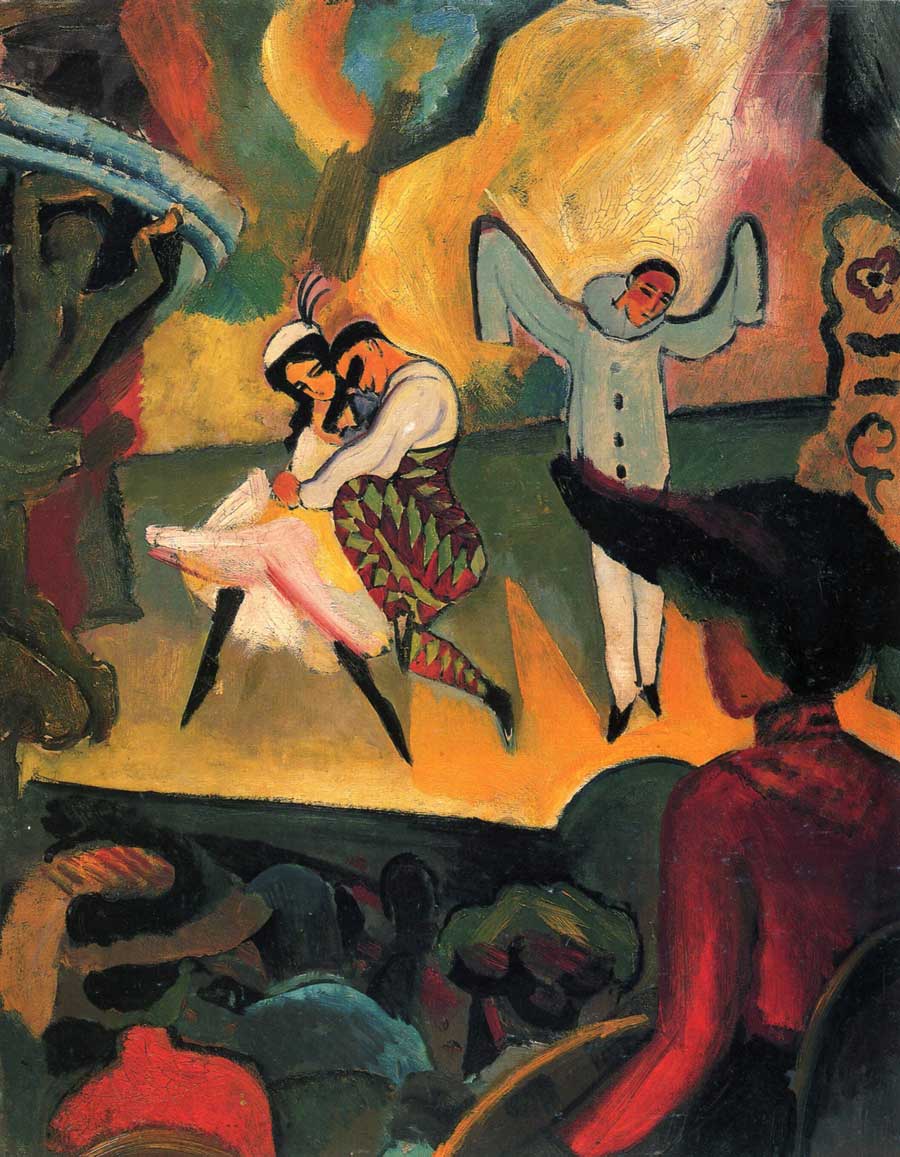 PetrushkaBallet · 1911Music by Stravinsky · video
 PulcinellaBallet · 1920Music by Stravinsky · video
 Les nocesBallet · 1923Music by Stravinsky · video
 Histoire du soldatBallet · 1918Music by Stravinsky · video
 ApolloBallet · 1928Music by Stravinsky · video
 IvesianaBallet · 1954Same lineage · video
 Moon WaterBallet · 1998Same lineage · video