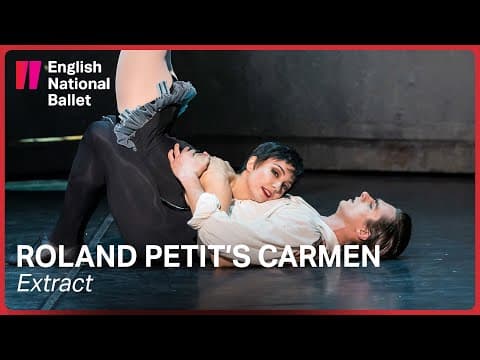
Carmen is Roland Petit's 1949 dance-drama version of Bizet's opera, made for his own company Les Ballets de Paris and built around the sexual charge of its two leads. It compresses Mérimée's story into five scenes of fast, physical, theatrical dance-theatre rather than a conventional full-length classical narrative ballet, and it became one of the most-performed Bizet-derived ballets in the world.
What it contains
- Classical Ballet · Whole ballet — Partnering, lifts and a formal pas de deux structure sit alongside mime and Spanish-idiom footwork, per the article's own description of the blend. Source: "represents a striking admixture of classical ballet, Spanish-style movement, mime, and freshly invented dramatic dance action"
- Classical Ballet · Carmen's bedroom scene (scene 3) — A duet built as a formal pas de deux, i.e. classical partnering vocabulary (lifts, supported turns) rather than mime. Source: "After a passionate pas de deux, three of Carmen's friends come in and invite her to go outside"
- Zapateado · Tavern scene (scene 2), Don José's solo — A footwork-driven Spanish solo (zapateado) performed by Don José to the habanera melody from Bizet's score. Source: "Don José enters and dances a zapateado to the music of the habanera"
What is danced
The choreography is described in the article as 'a striking admixture of classical ballet, Spanish-style movement, mime, and freshly invented dramatic dance action' — so the base vocabulary is danse d'école (lifts, pas de deux partnering) overlaid with Spanish-inflected steps and passages of mime rather than a single codified technique run through the whole work. The most specific dance moment named is Don José's solo in the tavern scene: he 'dances a zapateado to the music of the habanera', a footwork-driven Spanish solo performed to Bizet's habanera. Carmen's own entrance dance in that scene ends with her at Don José's feet before he lifts her, and scene three centres on 'a passionate pas de deux' between the two before the mood turns violent with a staged robbery and knife-work built into the choreography (Carmen hands Don José the dagger he uses to stab a passer-by). The final scene stages a danced fight to the death between Don José and Carmen rather than a mimed death alone, which is unusual for the period and central to the ballet's reputation for physical, unsentimental drama.
Context
Petit made Carmen for his own recently founded company, Les Ballets de Paris, at a moment (1949, London) when postwar European ballet was pushing narrative ballet toward frank psychological and sexual material and away from Romantic-era mime conventions. The casting of Zizi Jeanmaire, later Petit's wife, in a role the article calls 'scandalously and brilliantly...fabulously sexy' marked the ballet as an early vehicle for a dancer-as-star, sex-appeal-driven mid-century dance-drama, distinct from both the surviving 19th-century repertory and from Balanchine-style plotless neoclassicism developing in parallel in the US.
Staging history
The article states the ballet 'has entered the repertory of ballet companies in France and around the world' and that over 5,000 performances were given in its first fifty years, making it, per the article, the most frequently staged ballet drawn from Bizet's opera. Filmed recordings cited include two featuring the original Carmen, Zizi Jeanmaire — one from 1960 with Petit himself as Don José, another from 1980 with Mikhail Baryshnikov in that role — and a 2005 Paris recording with Clairemarie Osta and Nicolas Le Riche.
How to watch it
Watch for the shift in register between the classical pas de deux passages (scene three) and the sharply rhythmic zapateado solo danced to the habanera (the tavern scene) — the ballet deliberately alternates danse d'école partnering with Spanish-character footwork rather than blending them into one uniform style. The final scene stages the killing as a full physical fight rather than a mimed collapse, which is the ballet's signature departure from older narrative-ballet convention.
Structure
- Scene 1In a Seville street, Carmen fights a girl until Don José intervenes; he is drawn to Carmen and arranges to meet her later.
- Scene 2In the tavern that evening Don José dances a zapateado to the habanera; Carmen dances and the two go upstairs together, then rejoin the dancing customers.
- Scene 3In Carmen's bedroom the two dance a passionate pas de deux before her friends draw them out into the street.
- Scene 4At night in the street, Carmen, Don José and her friends rob a passer-by; Don José stabs the man with a dagger Carmen has given him.
- Scene 5Outside the bull-ring, the toreador is fascinated by Carmen's indifference; Don José confronts and kills her in a fight to the death as the crowd's hats fall around him.
Structure read from an encyclopaedia article, not from a libretto or score we hold. Confirm against a programme before treating the numbering as authoritative.
Credits
- composer: Georges Bizet
Related works
Other staged works in the register connected to this one by author or lineage.
 Le jeune homme et la mortBalletPetit · video
 Symphony in CBallet · 1947Music by Bizet · video
 The Car ManBallet · 2000Music by Bizet · video
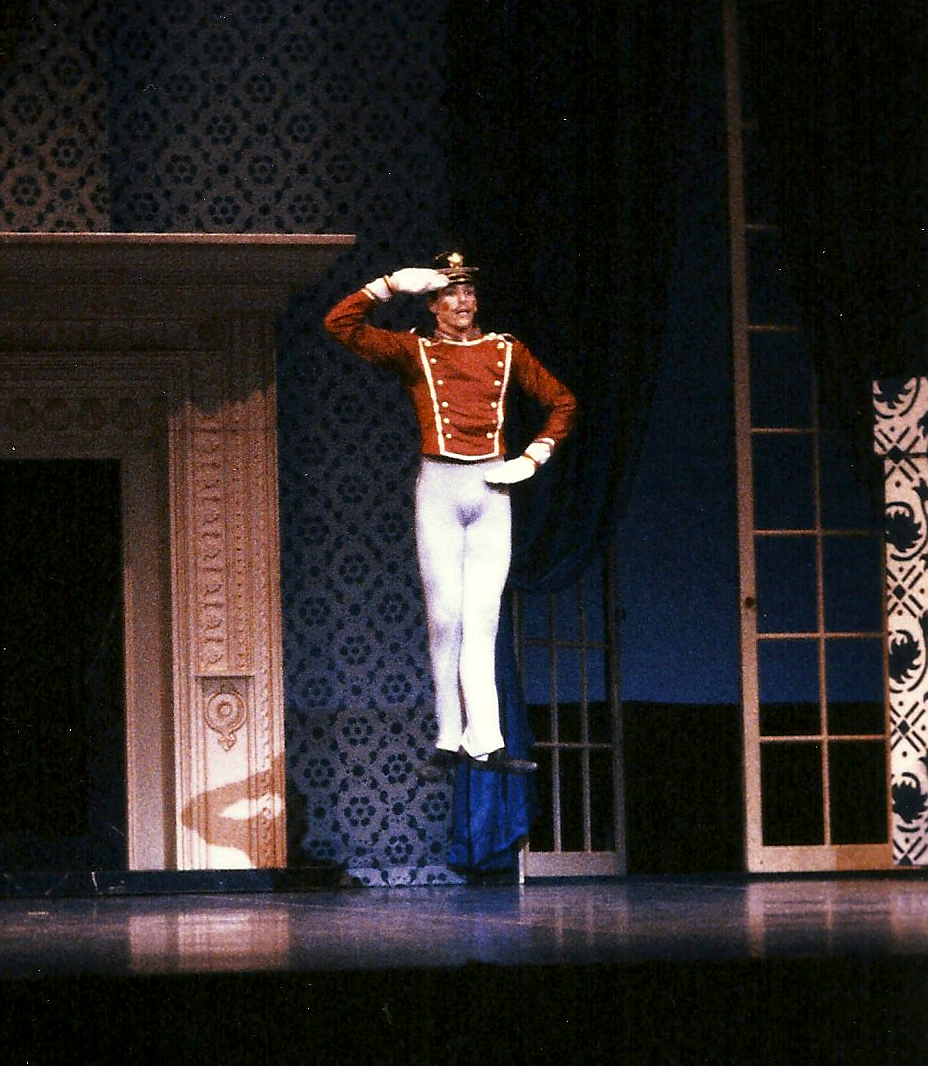 The Steadfast Tin SoldierBallet · 1975Music by Bizet · video
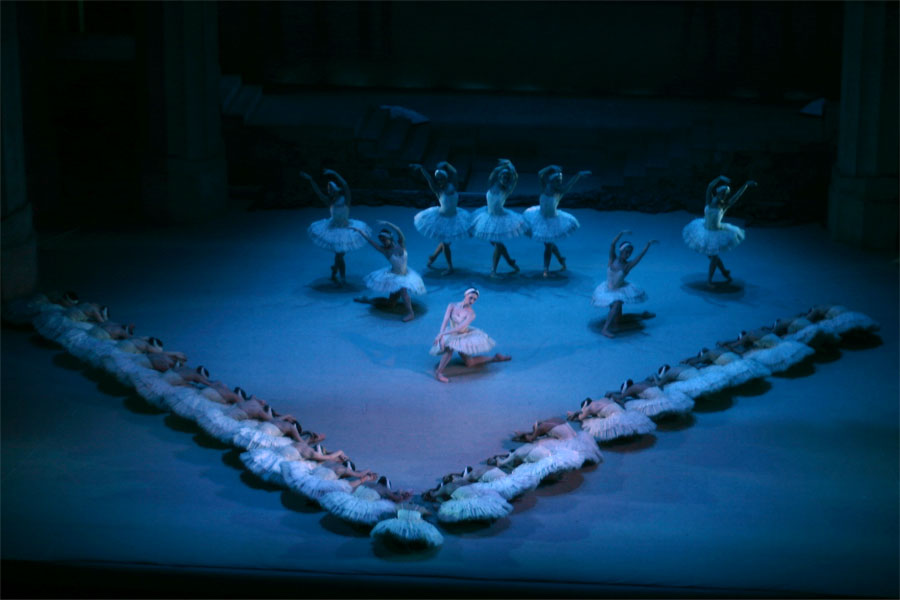 Swan LakeBallet · 1877Same lineage · video
 The NutcrackerBallet · 1892Same lineage · video
 The Magic PillsBallet · 1886Same lineage
 MovesBallet · 1959Same lineage · video