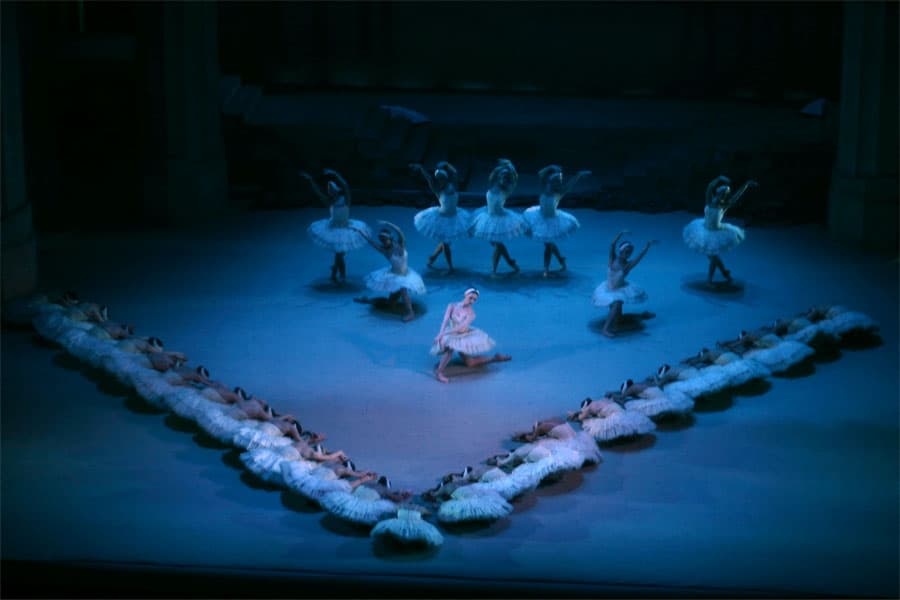
Peter Gerstbach (User PeterGerstbach on de.wikipedia) — Originally from de.wikipedia; description page is (was) here 14:56, 9. Okt 2004 PeterGerstbach 900 x 600 (85.610 Byte) · CC BY-SA 3.0
Swan Lake is Tchaikovsky's first ballet score, commissioned in 1875 for the Bolshoi Theatre and first staged by Julius Reisinger in 1877 to a mixed and largely hostile reception. The work that dancers and companies actually perform today is not that original production but the 1895 Mariinsky revival, choreographed jointly by Marius Petipa (Acts I and III) and Lev Ivanov (Acts II and IV) after Tchaikovsky's death, with the score revised by Riccardo Drigo and the libretto reworked by the composer's brother Modest.
What it contains
- Classical Ballet · Whole work — the 1895 Petipa–Ivanov choreography retained across later stagings — Corps de ballet patterning for the swans, formal pas de deux/pas de trois/pas de six architecture for the court scenes, and soloist variations make up the ballet's core academic vocabulary, kept intact even as scenario and ending are altered by different companies. Source: "while still maintaining much of the traditional choreography for the dances, which is regarded as virtually sacrosanct"
- Classical Ballet — Dances of the Swans · Act II, Dances of the Swans — the Allegro moderato number later famous as the Dance of the Little Swans: four swans in a linked line, hands crossed, dancing tightly synchronised petit allegro in unison, the repertoire's best-known test of corps precision. Source: "Allegro moderato (later the famous Dance of the Little Swans)"
- Classical Ballet — Pas de deux pour Mme. Anna Sobeshchanskaya · Act III, Appendix I — Pas de deux pour Mme. Anna Sobeshchanskaya — A standard pas de deux classique built from entrée, grand adagio, individual solo variations for each dancer, and a virtuosic coda — the core structural unit of academic ballet partnering and display. Source: "The piece was a standard pas de deux classique consisting of a short entrée, the grand adage, a variation for each dancer individually, and a coda."
- Mazurka — Mazurka · Act III, No. 23 — Mazurka, in the ballroom divertissement sequence — A character mazurka danced by the ball guests, set to a marked 'Tempo di mazurka', interpolated among the national divertissements presented to Siegfried. Source: "No. 23 Mazurka: Tempo di mazurka"
What is danced
The ballet alternates between two danced worlds. The lakeside acts (II and IV) are built on the corps de ballet of swan-maidens moving in unison and in the linked, patterned formations that became the template for later 'white acts': the Dances of the Swans sequence includes the Allegro moderato number that 'later' became known as the Dance of the Little Swans, one of the most recognisable set pieces of unison corps precision in the classical repertoire. Against this, the court scenes (Acts I and III) carry the ballet's formal set numbers — a Pas de trois and a Pas de deux in Act I, and in Act III a full Pas de six for the six princess-candidates, plus a run of national/character divertissements at the ball: a Hungarian Csárdás, a bolero-tempo Spanish dance, a Neapolitan dance, and a Mazurka, culminating in the extracted classical Pas de deux composed for Anna Sobeshchanskaya (entrée, grand adagio, individual variations, coda) — the standard structural unit of nineteenth-century ballet partnering, later revived independently as Balanchine's Tschaikovsky Pas de Deux.
Context
Swan Lake was written when ballet scores were expected to be light, danceable and structurally modest, produced by 'specialist' composers such as Pugni and Minkus; Tchaikovsky's more symphonic, Wagner-inflected score was initially attacked by Moscow critics as 'too noisy, too Wagnerian and too symphonic' and Reisinger's choreography as 'unimaginative'. The 1895 Petipa–Ivanov revival, made after Tchaikovsky's death with Drigo's revised orchestration, reframed the ballet's dramaturgy (Odette's stepmother became the sorcerer von Rothbart, the ending changed to a double suicide and apotheosis) and fixed the choreographic vocabulary — corps patterning for the swans, formal pas de deux/pas de six architecture for the court — that nearly every later staging retains even while altering scenario and ending.
Staging history
After its rocky 1877 premiere (still given 41 times over six years), the ballet was revised by Joseph Hansen in Moscow (1880, 1882) before being dropped; it was effectively remade for St Petersburg in 1895 by Petipa and Ivanov, and it is this version — not Tchaikovsky's original four-act 1877 score — that most companies use today. It reached Western and non-Russian stages only slowly: Finnish National Ballet gave the first complete European staging outside Russia and Czechoslovakia in 1922, and San Francisco Ballet gave the first complete American staging in 1940. Twentieth-century restagings by Konstantin Sergeyev (1950, with a Soviet-mandated happy ending), Rudolf Nureyev (Vienna 1964, Paris 1984), and Yury Grigorovich for the Bolshoi (1969 happy ending, revised to tragic in 2001) show how the traditional Petipa–Ivanov choreography has been kept while the story's resolution — and Rothbart's fate — has been rewritten differently by nearly every company.
How to watch it
Watch how the same ballerina is asked to differentiate Odette's soft, held upper body and phrasing from Odile's harder-edged, exhibitionist bravura in the Act III pas de deux — the ballet's central technical and dramatic test. Track the corps de ballet's unison work in the lake scenes, especially the four-dancer Dance of the Little Swans, against the run of court set pieces in Act III (Pas de six, Csárdás, Spanish, Neapolitan, Mazurka), and note that the ending you see — happy, tragic, or ambiguous — is a company-specific choice layered onto largely shared choreography.
Structure
- Act ISiegfried celebrates his coming-of-age with peasants and friends; his mother insists he choose a bride; he and Benno spot a flock of swans and set off to hunt them.
- Act I · Pas de troisA formal classical pas de trois for supporting dancers during the Act I festivities.
- Act I · Pas de deux for Two Merry-makersA demi-caractère pas de deux, later refashioned into material used for the Black Swan Pas de Deux.
- Act IIAt the lakeside Siegfried encounters Odette, a princess cursed to become a swan by night; the swan maidens surround them and Rothbart intervenes before dawn returns Odette to swan form.
- Act II · Dances of the SwansThe main corps de ballet sequence for the swan maidens, including the Allegro moderato number later known as the Dance of the Little Swans.
- Act IIIAt the ball, candidate princesses are presented; Rothbart's daughter Odile, disguised as Odette, dances with Siegfried, who pledges to marry her before seeing the real Odette's warning.
- Act III · Pas de sixA formal suite (entrée, variations, grand coda) for the six princesses presented as marriage candidates.
- Act III · Pas de deux pour Mme. Anna SobeshchanskayaA classical pas de deux inserted for ballerina Anna Sobeshchanskaya, later the basis for Balanchine's Tschaikovsky Pas de Deux.
- Act III · Hungarian Dance: CzardasA national character divertissement at the ball.
- Act III · Danse EspagnoleA bolero-tempo Spanish character divertissement at the ball.
- Act III · Danse NapolitaineA Neapolitan character divertissement at the ball.
- Act III · MazurkaA mazurka danced by the ball guests among the national divertissements.
- Act IVOdette, betrayed, is comforted by the swan maidens; Siegfried returns, she forgives him, and the lovers choose death together, breaking Rothbart's power.
Structure read from an encyclopaedia article, not from a libretto or score we hold. Confirm against a programme before treating the numbering as authoritative.
Credits
- composer: Pyotr Ilyich Tchaikovsky
On screen
- Swan Lake (1981)
- The Swan Princess (1994)
- The Swan Princess III: The Mystery of the Enchanted Treasure (1998)
- Barbie of Swan Lake (2003)
- Swan Lake/Loch na hEala (2016)
Related works
Other staged works in the register connected to this one by author or lineage.
 The NutcrackerBallet · 1892Ivanov · video
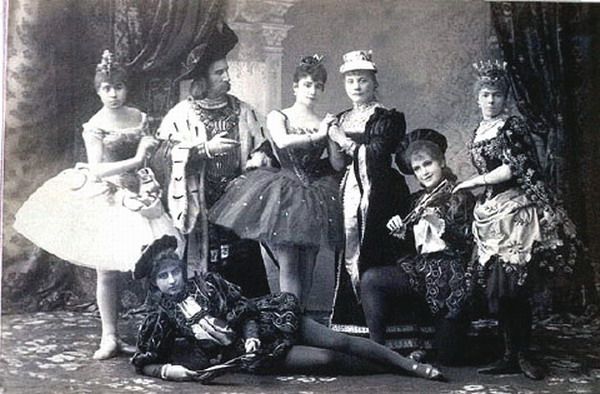 The Sleeping BeautyBallet · 1890Petipa · video
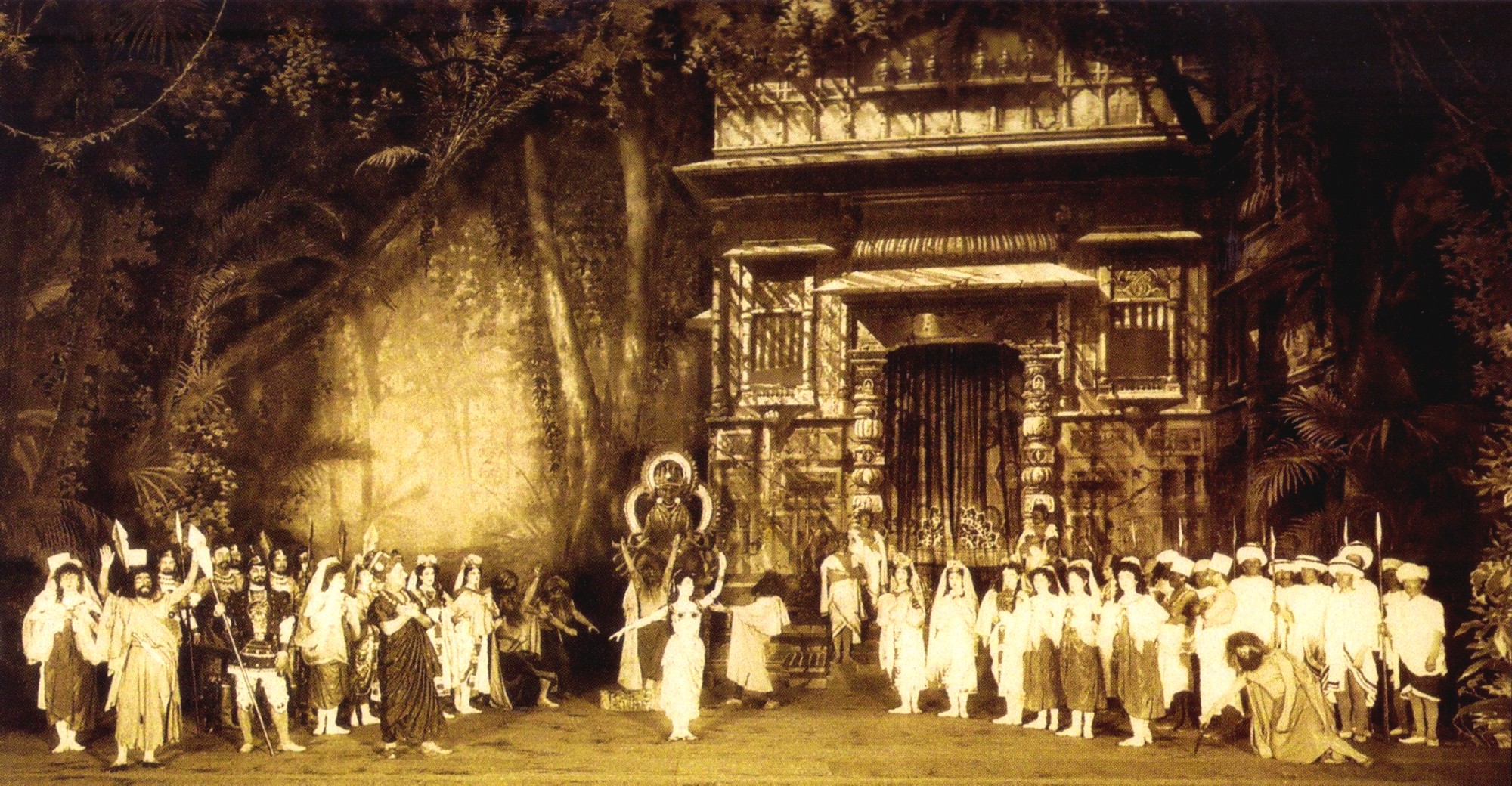 La BayadèreBallet · 1877Petipa · video
 Don QuixoteBallet · 1869Petipa · video
 RaymondaBallet · 1898Petipa · video
 PaquitaBallet · 1846Petipa · video
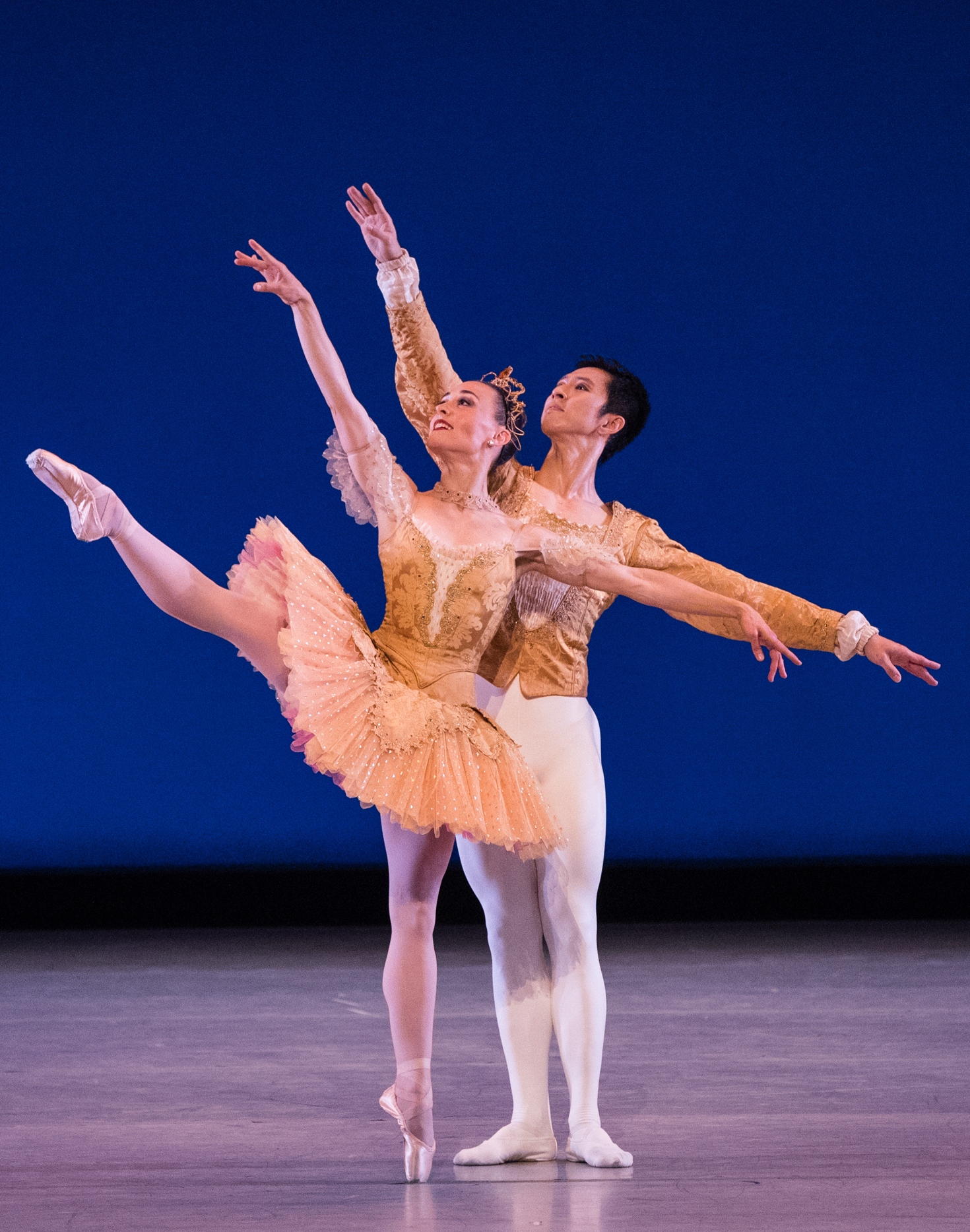 Theme and VariationsBallet · 1947Music by Tchaikovsky · video
 Arabian NightsBallet · 1979Same lineage · video