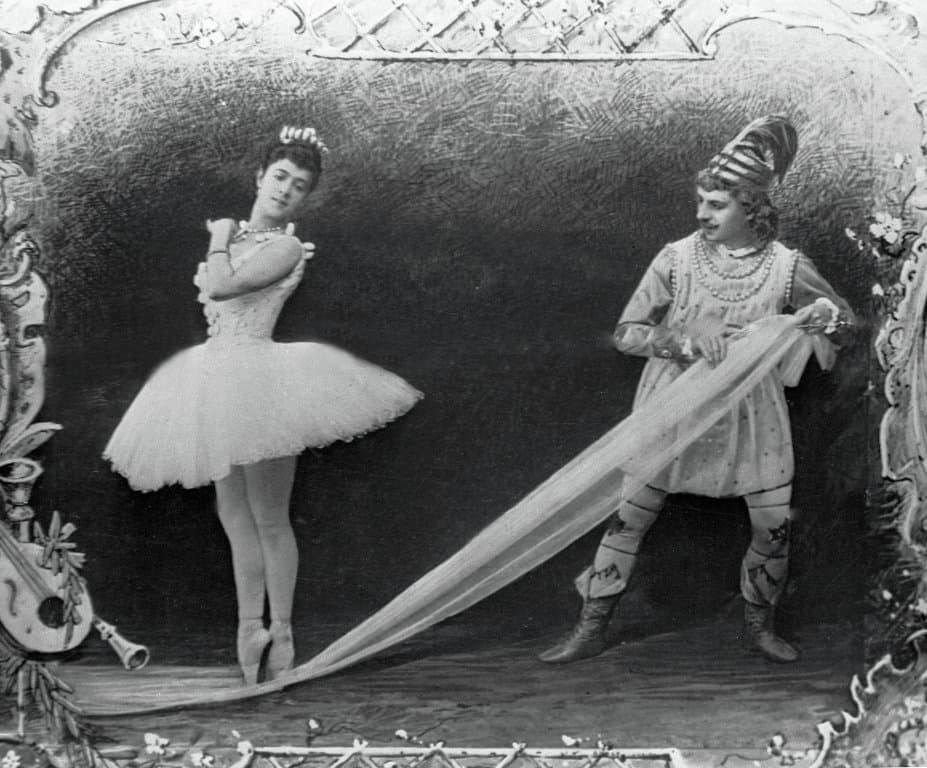
anonymous Russian 19th century photographer — http://cyclowiki.org/wiki/%D0%A4%D0%B0%D0%B9%D0%BB:Scelkun1892.jpg · Public domain
The Nutcracker is a two-act ballet-féerie composed by Pyotr Ilyich Tchaikovsky to a libretto by Marius Petipa after Alexandre Dumas's retelling of E.T.A. Hoffmann's The Nutcracker and the Mouse King. It premiered at the Imperial Mariinsky Theatre in Saint Petersburg in December 1892 on a double bill with Tchaikovsky's opera Iolanta, with choreography credited to Petipa and his assistant Lev Ivanov after Petipa fell ill during the making of it. Its first reception was mixed to poor, and the standalone concert suite Tchaikovsky drew from it was, for decades, far better known than the staged ballet.
Its place in the catalogue rests less on its 1892 reputation than on what it became afterward: the article traces how successive choreographers (Gorsky, Vainonen, Sergeyev, Balanchine and many since) reworked the libretto, the casting of the two leads as children or adults, and even the ending, until it became, especially in North America from the 1950s onward, the single most performed and most commercially important classical ballet in the repertory.
What it contains
- Classical Ballet · The whole ballet, both acts — Petipa-Ivanov Imperial Mariinsky choreography built on classical corps formations, mime-driven storytelling, and a culminating Grand Pas de Deux (adagio-variations-coda) for the ballerina and premier danseur. Source: "an 1892 two-act classical ballet"
- Classical Ballet — The Land of Sweets · Act II, the Grand Pas de Deux of the Sugar Plum Fairy and her Cavalier — Virtuoso pointe work for the ballerina in a classical pas de deux structure, singled out by contemporary reviewers of the role's originator. Source: "some critics praised Dell'Era on her pointework as the Sugar Plum Fairy"
What is danced
The ballet's vocabulary is Imperial-era classical ballet built around a child's-eye storybook frame: a domestic party scene, a nocturnal battle mimed and danced by children, toy soldiers and mice, a transformation, a journey, and a full-scale divertissement suite in the second act. The article's synopsis (drawn from Petipa's 1892 libretto) gives the structural set pieces a choreographer or dancer would recognise: the dance of the four lifelike dolls Drosselmeyer brings as gifts; the battle of the gingerbread and tin soldiers against the Mouse King's army; the transformation of the Nutcracker into a prince; and the corps dance of snowflakes in the pine forest that closes Act I.
Act II is a chain of discrete numbers rather than continuous narrative dance: divertissements for chocolate (Spain), coffee (Arabia), tea (China) and candy canes (Russia), a Marzipan shepherdesses' number built around flute-like phrasing, Mother Ginger's Polichinelles emerging from beneath her hoop skirt, a corps Waltz of the Flowers, and finally the Grand Pas de Deux for the Sugar Plum Fairy and her Cavalier, followed by a closing waltz for the full company. Contemporary reviews single out the Sugar Plum Fairy's pointework at the 1892 premiere ('some critics praised Dell'Era on her pointework'), confirming the role's technical centre of gravity is virtuoso pointe work within a classical adagio-variation-coda pas de deux structure — the Grand Pas de Deux is also the number the article credits with Tchaikovsky's one-octave-scale compositional anecdote.
The article does not give step-level detail beyond this — it describes plot and reception, not counts or enchaînements — so a dancer preparing a role would need a staging-specific score/répétiteur rather than this article for technical specifics of any single production's choreography.
Context
The Nutcracker followed Tchaikovsky and Petipa's earlier success with The Sleeping Beauty (1890) and belongs to the late Imperial Russian classical tradition centred on the Mariinsky under Ivan Vsevolozhsky. Its original staging drew immediate criticism for structural choices later choreographers would revise — most pointedly, that child performers (rather than the featured ballerina) carried the narrative for most of the ballet, delaying the Grand Pas de Deux until near midnight in the original program. Alexander Gorsky's 1919 restaging, giving adult dancers the Clara and Prince roles and folding the Sugar Plum Fairy's dances into theirs, set a precedent later followed by Vasili Vainonen (1934) and adopted widely thereafter.
Its wider historical significance is as a repertory phenomenon rather than an innovation in vocabulary: the article credits George Balanchine's 1954 New York City Ballet staging, and Maria Tallchief's Sugar Plum Fairy, with turning an initially unsuccessful ballet into an annual American institution that now generates roughly 40% of major US companies' ticket revenue — a commercial dependency later critics (Sarah Kaufman in 2009) argued has made American ballet programming conservative.
Staging history
The 1892 premiere at the Mariinsky was choreographed under Petipa's supervision but completed by Lev Ivanov after Petipa's illness, and attribution between the two is still debated in scholarship the article cites. Major subsequent stagings noted in the article include Gorsky (1919, Bolshoi), Ede Brada's abridged version (Budapest, 1927, first outside Russia), Nicholas Sergeyev's staging after Petipa (England, 1934, the first complete performance outside Russia), Vainonen (1934), Alexandra Fedorova's Ballet Russe de Monte Carlo version (New York, 1940), Willam Christensen's San Francisco Ballet production (1944, first complete US performance, still performed via Ballet West), and George Balanchine's New York City Ballet version (1954), which the article treats as the turning point for the work's popularity.
Later named stagings include Rudolf Nureyev (Royal Ballet, 1963), Yury Grigorovich (Bolshoi), Mikhail Baryshnikov (American Ballet Theatre), Fernand Nault (Les Grands Ballets Canadiens, 1964), Kent Stowell (Pacific Northwest Ballet, 1983) and Peter Wright (Royal Ballet/Birmingham Royal Ballet), alongside revisionist versions by Mark Morris, Matthew Bourne, Mikhail Chemiakin and Maurice Béjart that depart from the original plot and characters.
How to watch it
Watch for how a given production handles the two structural cruxes the article flags: whether Clara and the Prince are children or adults (Gorsky's 1919 change versus the original), and where the ballerina's technical showcase, the Grand Pas de Deux, falls in the evening. The Act II divertissements (Spanish, Arabian, Chinese, Russian) are stylised character numbers within classical vocabulary rather than authentic folk or national dance, and many companies have altered their staging and costuming in response to criticism the article documents in detail.
Structure
- Act I · Scene 1 · The Stahlbaum HomeAt a Christmas Eve party Drosselmeyer gives the children four lifelike dolls that dance, then a nutcracker doll Clara loves and Fritz breaks; that night mice and gingerbread/tin soldiers fight, and Clara's slipper throw lets the Nutcracker defeat the Mouse King.
- Act I · Scene 2 · A Pine ForestThe Nutcracker turns into a prince and leads Clara through a moonlit pine forest where dancing snowflakes accompany them toward his kingdom.
- Act II · The Land of SweetsA divertissement of national dances (Spanish chocolate, Arabian coffee, Chinese tea, Russian candy canes), Marzipan shepherdesses, Mother Ginger's Polichinelles, a Waltz of the Flowers, and the Grand Pas de Deux for the Sugar Plum Fairy and her Cavalier, closing with a waltz for the full company.
Structure read from an encyclopaedia article, not from a libretto or score we hold. Confirm against a programme before treating the numbering as authoritative.
Credits
- composer: Pyotr Ilyich Tchaikovsky
Related works
Other staged works in the register connected to this one by author or lineage.
 Swan LakeBallet · 1877Ivanov · video
 The Sleeping BeautyBallet · 1890Petipa · video
 La BayadèreBallet · 1877Petipa · video
 Don QuixoteBallet · 1869Petipa · video
 RaymondaBallet · 1898Petipa · video
 PaquitaBallet · 1846Petipa · video
 Square DanceBallet · 1957Same lineage · video
 Tschaikovsky Suite No. 3Ballet · 1970Music by Tchaikovsky · video