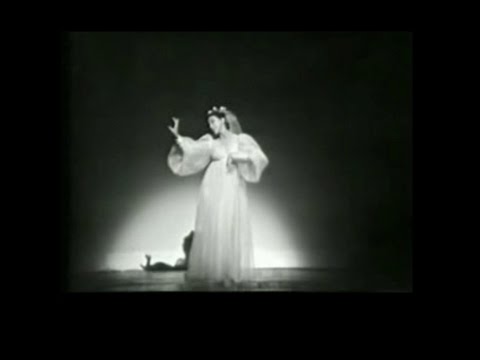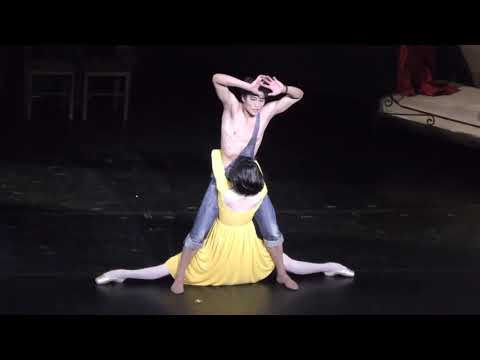
Le Jeune Homme et la Mort is a one-act dramatic ballet made by Roland Petit in 1946 to Bach's Passacaglia and Fugue in C Minor, BWV 582, from a libretto by Jean Cocteau. It stages the suicide of a young man abandoned by a faithless lover, with designs by Georges Wakhévitch and costumes variously credited to Karinska, Cocteau or Tom Keogh depending on the production.
What is danced
The article gives no scene-by-scene breakdown and does not describe steps, holds or technique, so nothing about the actual vocabulary danced can be sourced from it directly. What can be drawn from the article is structural: the ballet is a one-act piece for essentially two roles, performed as a pair across every documented staging — Babilée and Philippart at the 1946 premiere, Nureyev and Jeanmaire in the 1966 film, Baryshnikov in the 1975 ABT revival and the 1985 film White Nights. This pattern points to a work organised around a single sustained duet/confrontation rather than an ensemble structure, but the specific movement language (lines, lifts, use of the set) is not stated in the source and should not be asserted from it.
Context
The ballet dates from 1946, the immediate postwar moment in Paris when Roland Petit was working with a circle of writers and designers — here Cocteau on the libretto, Wakhévitch on sets — to push ballet toward theatrical, literary drama rather than divertissement. Setting a suicide narrative to an existing Bach concert work rather than a commissioned ballet score was itself an unusual choice for the period, aligning the piece with the era's taste for stark, condensed, psychologically charged one-act ballets.
Staging history
After its 25 June 1946 premiere at the Théâtre des Champs-Élysées, Petit staged it at American Ballet Theatre in 1951 and filmed it in 1966 with Nureyev and Jeanmaire. Mikhail Baryshnikov revived it at ABT in 1975 and later performed Petit's arrangement of it on film in White Nights (1985). It entered the Paris Opera Ballet repertoire in 1990 (first danced there by Kader Belarbi) and has since been staged by the Ballet National de Marseille, Berlin Opera Ballet, Boston Ballet, the Bolshoi Ballet, the Mariinsky Ballet and English National Ballet.
How to watch it
Watch how the entire ballet is carried by two performers across a single unbroken movement of Bach, with almost no scenic complication beyond the young man's garret — the drama has to be built through the duet itself rather than through crowd or set-piece choreography. Because the central role has been remade by successive male stars (Babilée, Nureyev, Baryshnikov), it is worth comparing how each interpreter handles the same choreographic text rather than expecting variation between productions.
Credits
- composer: Johann Sebastian Bach
Related works
Other staged works in the register connected to this one by author or lineage.