
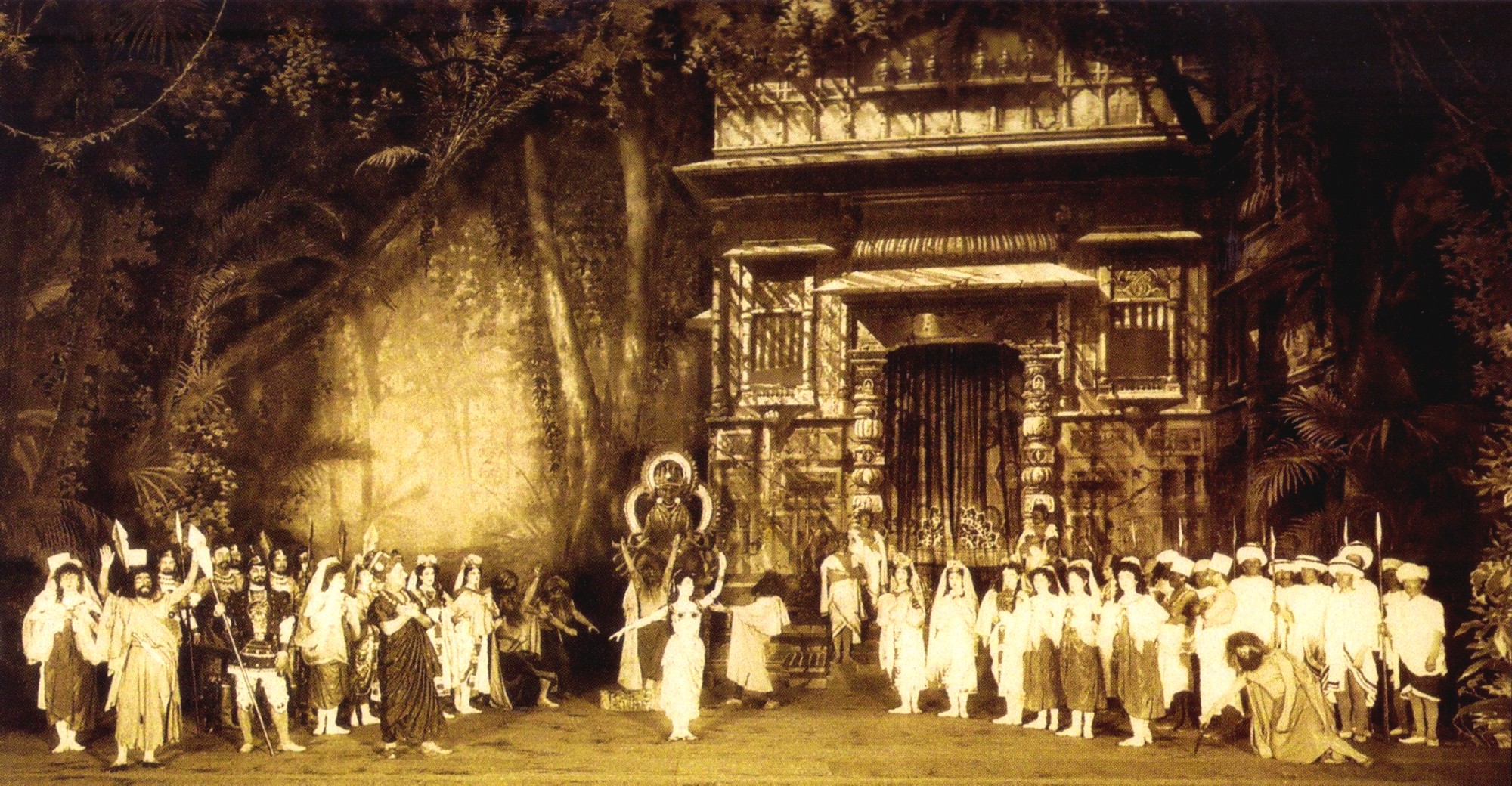
Unknown photographer of the Imperial Mariinsky Theatre. St. Petersburg, Russian Empire. — Мариус Петипа. Материалы. Воспоминания. Статьи, Л., 1971. ("Marius Petipa. Materials, Recollections, Articles"). · Public domain
The Magic Pills (1886)
The Magic Pills (Les Pilules magiques) is a three-act, thirteen-scene ballet-féerie choreographed by Marius Petipa to a score by Ludwig Minkus, first given by the Imperial Ballet on 21 February 1886. Its premiere doubled as the inauguration of the Imperial Mariinsky Theatre as the company's permanent home — it was the first ballet ever performed on that stage.
What it contains
- Classical Ballet · Whole work — three acts, thirteen scenes — Constructed act by act as chains of dance numbers (games in Act II, national 'lace' dances in Act III) under Petipa's choreography for the Imperial Ballet, the house style of which was classical ballet built from soloist variations and corps ensembles. Source: "The plot of the ballet was sparse and created purely as a vehicle for displaying entertaining sets of dances."
What is danced
The article gives no technical description of steps or positions, only the dramaturgical shape of the piece: a sparse plot used, in its own words, 'purely as a vehicle for displaying entertaining sets of dances.' Act I is set among sorceresses in a cave; Act II turns games and pastimes — croquet, bingo, billiards, a spinning top, draughts, cards — into allegorical numbers danced by different performers; Act III, the 'Kingdom of the Laces,' is described as the most extravagant sequence, presenting laces of different nationalities (Russian, French, Spanish, Italian) as a suite of national-style dances. This act-by-act, divertissement-driven structure is characteristic of the ballet-féerie form Petipa was commissioned to supply, and it implies a program built from a chain of demi-caractère and character numbers rather than a through-danced dramatic ballet.
Context
By the mid-1880s the ballet-féerie — spectacle-driven, thin on drama, heavy on fantastical stagecraft — had become a European vogue following the success of Manzotti and Marenco's Excelsior (Milan, 1881) and its successors abroad, including Voyage à la Lune, in which Virginia Zucchi had debuted in St. Petersburg the previous year. Ivan Vsevolozhsky, admiring this fashion, commissioned Petipa to produce several such works despite Petipa's own distaste for the genre's lack of dramatic and artistic substance. The Magic Pills was one of the earliest full-length ballets-féeries mounted in Russia, and the article notes that Petipa's version was deliberately less overtly theatrical than its European models, folding the genre's conventions into his own vocabulary — an approach that reportedly carried over into his later ensemble writing, as in Le Roi Candaule.
How to watch it
Watch for the piece's episodic, revue-like construction: each act is organised around a single conceit (sorcery, parlour games, national laces) rather than a continuous narrative, so individual numbers should be read as self-contained divertissements. The Act III 'Kingdom of the Laces' is the evening's showpiece, staging a sequence of stylised 'national' dances (Russian, French, Spanish, Italian) in the manner typical of imperial-era grand-ballet finales.
Structure
- Act ISet in a cave inhabited by several sorceresses.
- Act IIVarious games — croquet, bingo, billiards, a spinning top, draughts, cards, and others — are allegorically played by various dancers.
- Act III · Kingdom of the LacesPresents a large variety of laces made by different nationalities, including Russian, French, Spanish, and Italian, in a series of dances.
Structure read from an encyclopaedia article, not from a libretto or score we hold. Confirm against a programme before treating the numbering as authoritative.
Credits
- composer: Ludwig Minkus
More from Ludwig Minkus
Other staged works in the register connected to this one by author or lineage.
 La BayadèreBallet · 1877Music by Minkus · video
 Don QuixoteBallet · 1869Music by Minkus · video
 PaquitaBallet · 1846Music by Minkus · video
 La sourceBallet · 1866Music by Minkus · video
 CamargoBallet · 1872Music by Minkus · video
- Les Aventures de PéléeLes Aventures de PéléeBallet · 1876Music by Minkus
 Ballo della ReginaBallet · 1978Same lineage · video
 Arabian NightsBallet · 1979Same lineage · video