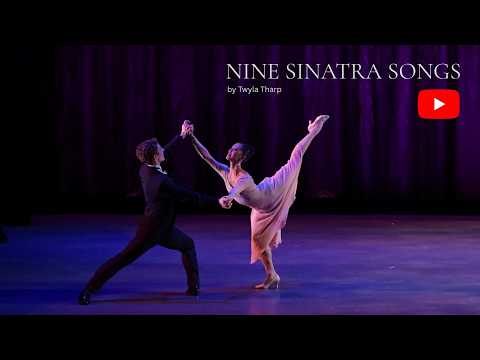
Nine Sinatra Songs is a plotless-narrative ballet by Twyla Tharp, made for her own company, Twyla Tharp Dance, and premiered on October 14, 1982, at the Queen Elizabeth Theatre in Vancouver. Seven couples move through a sequence of duets set to recordings of Frank Sinatra, each pair sketching a different stage or temper of a romantic relationship, from courtship to weariness to reconciliation.
What it contains
- Contemporary Ballet · Whole work, across all seven couples' duets — Partnered ballet vocabulary - lifts, extension, controlled line - fused throughout with ballroom holds, weight-sharing and footwork; women dance in heels rather than pointe, per Tharp's crossover technique. Source: "The ballet is danced by seven couples, portraying different stages of romantic relationships, with ballroom dancing incorporated into the choreography."
What is danced
The ballet is built as a suite of couple dances rather than a plotted story: seven pairs, each given a song, work through partnered material that fuses classical ballet's line and lift vocabulary with the holds, weight-sharing and footwork of social ballroom dance. Tharp had the women dance in heels rather than pointe shoes, a deliberate choice that pulls the couples' weight and phrasing toward the ballroom idiom even as the partnering retains ballet's extension and control. The choreography grew directly out of Tharp's research into ballroom technique - she had studied the dance team of Vernon and Irene Castle while preparing the 1981 film Ragtime - and that research is folded into the duets rather than quoted as pastiche.
The song sequence runs Softly, as I Leave You; Strangers in the Night; One for My Baby (and One More for the Road); My Way; Somethin' Stupid; All the Way; Forget Domani; That's Life; and a reprise of My Way, sung to a different, later live recording that Tharp chose specifically for its more worn, mature vocal quality. Beyond that structural sequence and the general couple-partnering, the article does not describe individual steps or set pieces for each number, so a full number-by-number breakdown of vocabulary cannot be given from this source.
Context
Tharp made the ballet at a point when she was moving fluently between ballet companies, her own modern-dance-trained troupe, and Hollywood - Ragtime (1981) fed directly into this piece's ballroom research. It followed an earlier, poorly received Sinatra experiment, One More Frank (1976), made for Mikhail Baryshnikov at American Ballet Theatre, which the article notes was booed for lacking the bravura audiences expected of him; Nine Sinatra Songs can be read as a more considered, company-scaled return to the same material.
Staging history
Tharp later drew on the same score and some of the same duets to make Sinatra Suite (1983) for American Ballet Theatre, danced by Baryshnikov and Elaine Kudo, which kept four of the songs and turned One for My Baby into a male solo. In 2010 she folded numbers from Nine Sinatra Songs into her Sinatra revue Come Fly Away, with three numbers used intact. The ballet itself has since entered the repertory of American Ballet Theatre, Pacific Northwest Ballet, Washington Ballet, Ballet West, Hubbard Street Dance Chicago, and Birmingham Royal Ballet.
How to watch it
Watch how each couple's duet shifts register with its song - the same partnering vocabulary is asked to carry courtship, exhaustion, and reconciliation in turn, so the emotional colour is built through phrasing and touch rather than mime. Notice the women's footwear: heels rather than pointe shoes change the couples' weight, pacing and floor contact throughout, and the tuxedo-and-gown costuming by Oscar de la Renta reinforces the ballroom, rather than tutu, frame of reference.
Structure
- Softly, as I Leave YouFirst of the couples' songs; no further movement detail given in the source.
- Strangers in the NightA couple's number; also later reused in Sinatra Suite.
- One for My Baby (and One More for the Road)A couple's number; reworked as a male solo in the later Sinatra Suite.
- My WayA couple's number, later reprised at the close of the ballet in a different recording.
- Somethin' StupidA couple's number; no further movement detail given in the source.
- All the WayA couple's number; also later reused in Sinatra Suite.
- Forget DomaniA couple's number; no further movement detail given in the source.
- That's LifeA couple's number; also later reused in Sinatra Suite.
- My Way (reprise)Closing reprise using a later live Madison Square Garden recording chosen for its more mature vocal quality.
Structure read from an encyclopaedia article, not from a libretto or score we hold. Confirm against a programme before treating the numbering as authoritative.
More from Twyla Tharp
Other staged works in the register connected to this one by author or lineage.
 Brahms/HandelBallet · 1984Tharp · video
 West Side StoryMusical theatre · 1957Same lineage · video
 SylviaBallet · 1876Same lineage · video
 Carmen SuiteBallet · 1967Same lineage · video
 Swan LakeBallet · 1995Same lineage · video
 Middle DuetBallet · 1998Same lineage · video
 The CageBallet · 1951Same lineage · video
 IvesianaBallet · 1954Same lineage · video