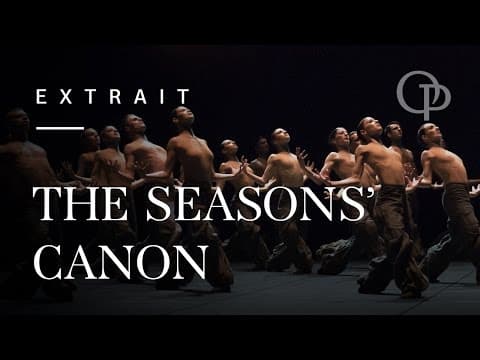
The Seasons' Canon is a contemporary ballet made by Crystal Pite for the Paris Opera Ballet, set to Max Richter's recomposition of Vivaldi's The Four Seasons. It premiered at the Palais Garnier in September 2016 as Pite's first commission for the company, and won her the Prix Benois de la Danse for Best Choreographer.
What it contains
- Contemporary Ballet · the whole ballet — massed blocks of movement and sculptural tableaux across a 54-dancer ensemble, punctuated by short duets, choreographed for a classical ballet company but described by critics as far from pas de deux-centric convention Source: "Pite has created massed blocks of movement that focus on large-scale patterning to often thrilling effect,"
What is danced
The work is built for a large ensemble — the article states it is performed by 54 dancers — and its choreography is organised around what critics described as sculptural tableaux and massed blocks of movement rather than the pas de deux-centric structure typical of repertory ballet evenings. Pite's stated conceptual source was tectonic movement: the choreography is inspired by the movements of tectonic plates, which suggests large group formations shifting and colliding rather than isolated virtuoso turns. Within that mass patterning the article notes a series of short duets, and reviewers linked the musicality and grounded articulation of the piece to the influence of Jiří Kylián, with the overall effect compared to Maurice Béjart's large-ensemble spectacle.
Dancers work in costumes designed by Nancy Bryant — khaki trousers, bare-chested men, sheer tops for the women, and throats painted blue-green — details that point to a stripped-back, unified visual language across the corps rather than distinct principal costuming, consistent with the emphasis on group patterning over individual display. The article gives no scene-by-scene breakdown of steps or named divertissements, so specifics of vocabulary (turns, lifts, floor work) beyond 'massed blocks,' 'sculptural tableaux,' and 'short duets' cannot be drawn from it.
Context
By 2016 Crystal Pite was an established contemporary choreographer, largely through her own company Kidd Pivot, but was still new to French audiences and to a classical company at the scale of the Paris Opera Ballet. The commission itself was contested from the start: artistic director Benjamin Millepied invited her but resigned before the premiere, leaving Aurélie Dupont to see the work through, and Pite was given only four weeks to make it. The piece is notable in her output as a rare foray into working with dancers trained in classical technique rather than her usual contemporary company, and she described the negotiation between her own choreographic values and the Opera's dancers' 'different skill set and vocabulary' as a central challenge of the process.
Staging history
The ballet premiered at the Palais Garnier on 24 September 2016. It was later taken up by other companies, with Pacific Northwest Ballet debuting it in November 2022 and Boston Ballet in October 2024, indicating the work has moved into wider repertory beyond its originating company.
How to watch it
Watch for the shift between full-company massed formations and the short duets embedded within them — the tension between individual and collective is the organising idea, echoing the tectonic-plate concept behind the choreography. Note the unified, minimal costuming (bare chests, sheer tops, painted throats) which flattens hierarchy among dancers despite some étoiles being cast, and listen for how Max Richter's recomposed Vivaldi score is matched to grounded, musically articulated ensemble movement rather than conventional pointe-and-partnering set pieces.
More from Crystal Pite
Other staged works in the register connected to this one by author or lineage.
 Flight PatternBallet · 2017Pite · video
 West Side StoryMusical theatre · 1957Same lineage · video
 SylviaBallet · 1876Same lineage · video
 Carmen SuiteBallet · 1967Same lineage · video
 Swan LakeBallet · 1995Same lineage · video
 Middle DuetBallet · 1998Same lineage · video
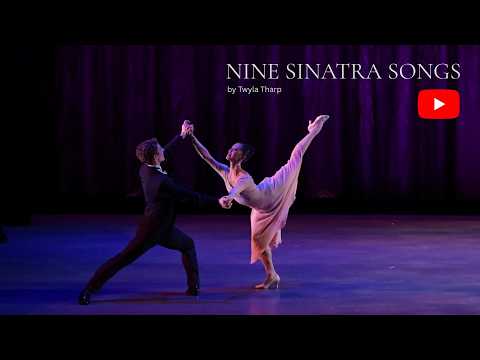 Nine Sinatra SongsBallet · 1982Same lineage · video
 Moon WaterBallet · 1998Same lineage · video