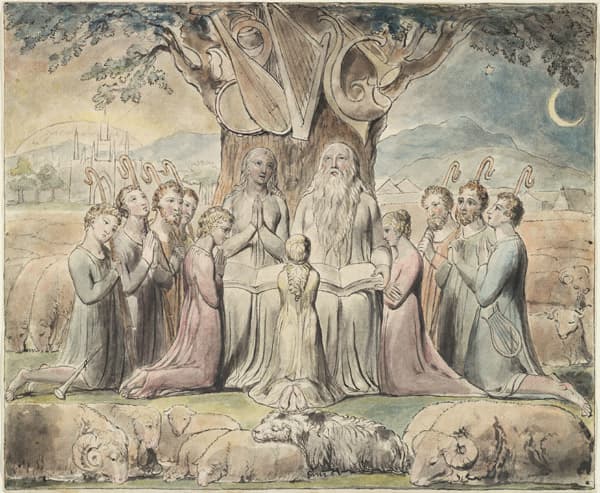
William Blake — The William Blake Archive · Public domain
Job: A Masque for Dancing (1931)
Job: A Masque for Dancing is a 1931 one-act ballet on the Book of Job, with scenario by the Blake scholar Geoffrey Keynes, choreography by Ninette de Valois, designs originally by Gwen Raverat, and music by Ralph Vaughan Williams. It was built directly from eight of William Blake's illustrations to Job and staged first by the Camargo Society before passing into the repertoire of the Vic-Wells Ballet and its successor companies.
What it contains
- Galliard — Pavane of the Sons of the Morning · Scene VIII, the Galliard of the Sons of the Morning — The Sons of the Morning dance a galliard, a livelier paired Renaissance court dance, as part of the ballet's joyful closing sequence. Source: "Galliard of the Sons of the Morning"
- Minuet — Minuet of the Sons of Job and Their Wives · Scene III, the Minuet of the Sons of Job and Their Wives — The destruction of Job's household is marked by a formal minuet for the sons and daughters, a courtly-form number rather than mime alone. Source: "Scene III: "Minuet of the Sons of Job and Their Wives" ("There came a great wind and smote the four corners of the house and it fell upon the young men and they are dead.")"
- Pavane — Elihu's Dance of Youth and Beauty · Scene VII/VIII, the Pavane of the Heavenly Host and the closing Altar Dance and Heavenly Pavane — The Heavenly Host is given a pavane, a slow processional court dance, both before and again as part of the ballet's final celebratory dances. Source: "Pavane of the Heavenly Host"
- Sarabande — Saraband of the Sons of God · Scene I, the Saraband of the Sons of God — The opening scene is structured and titled as a saraband, staging the Sons of God in a stylised courtly dance rather than free classical invention. Source: "Scene I: "Saraband of the Sons of God" ("Hast thou considered my servant Job?")"
What is danced
The article does not give step-by-step choreographic detail, but the ballet's own structure is danced through nine named scenes, several of which are explicitly cast as historical court dance forms rather than free invention: a 'Saraband of the Sons of God' opens the piece, a 'Minuet of the Sons of Job and Their Wives' marks the death of Job's children, and the closing scenes present a 'Pavane of the Heavenly Host' and a 'Galliard of the Sons of the Morning' alongside an 'Altar Dance and Heavenly Pavane'. This use of sarabande, minuet, pavane and galliard as literal scene titles signals a deliberate stylisation toward Renaissance and Baroque courtly dance vocabulary layered onto a classical-ballet framework, appropriate to a work modelled on eighteenth-century masque conventions.
Other scenes are dramatic-mime set pieces rather than named dance forms: 'Satan's Dance of Triumph', 'Job's Dream' with its 'Dance of Plague, Pestilence, Famine and Battle', the 'Dance of the Three Messengers', 'Dance of Job's Comforters' with 'Job's Curse' and 'A Vision of Satan', and 'Elihu's Dance of Youth and Beauty'. These read as narrative/character numbers built around a solo Satan figure (created by Anton Dolin, later famously danced by Robert Helpmann) rather than a display of virtuosic classical technique — consistent with Vaughan Williams's own insistence that the piece be billed as a masque, not a ballet, and his stated dislike of pointe work, which suggests a production leaning away from conventional tutu-and-pointe classicism toward a more pictorial, tableau-based, Blake-derived stage language.
Because the source article is a musicological and production history rather than a danced synopsis, no description of actual step vocabulary, footwear, or partnering is given beyond these scene titles, and this entry should be read with that limitation in mind.
Context
Job was made in 1930–31, just as British ballet was assembling its own institutional identity independent of the Ballets Russes: Diaghilev had rejected the scenario as 'too English and too old-fashioned', and the eventual production — funded by the Camargo Society and staged with an all-British creative team of Keynes, de Valois, Raverat and Vaughan Williams — was explicitly noted as the first ballet ever produced by an entirely British team. It fed directly into the founding repertoire of what became the Royal Ballet, giving de Valois an early large-scale narrative work distinct from imported Franco-Russian classicism.
Staging history
After its Camargo Society premiere at the Cambridge Theatre on 5 July 1931 (repeated the next day and at Oxford's ISCM festival), the ballet entered the Old Vic programme that September and was revived by the Camargo Society in 1932, touring to Copenhagen. From 1932 it stayed in the Vic-Wells/Sadler's Wells Ballet repertoire, moving to the large Covent Garden stage in 1948 with new John Piper designs replacing Raverat's originals (judged unsuitable for that stage) and with Robert Helpmann as Satan in a cast including John Cranko, Julia Farron, Alexander Grant and Nadia Nerina. It continued through the 1950s and was revived by Birmingham Royal Ballet in the 1990s, including a 1993 performance in Coventry Cathedral; a separate concert performance of the score was given by the Royal College of Music Junior Department in 2024. An adapted version was also staged in New York in 1931 by Ted Shawn, who himself danced Satan.
How to watch it
Watch for the shift in idiom between the named historical-dance scenes — saraband, minuet, pavane, galliard — which stage the Sons of God and the Heavenly Host in a stylised courtly register, and the more mimetic, character-driven scenes built around Satan, Job's dream, and the comforters. The role of Satan carries the ballet's dramatic weight and is traditionally played as a virtuoso character part rather than a classical danseur noble role; the biblical captions the composer attached to each scene (quoted in the score) are a useful guide to what each number is dramatising.
Structure
- Scene I · Saraband of the Sons of GodIntroduction and Pastoral Dance lead to Satan's Appeal to God and a Saraband of the Sons of God, framed by the biblical line 'Hast thou considered my servant Job?'
- Scene II · Satan's Dance of TriumphSatan departs from the presence of the Lord and dances his triumph.
- Scene III · Minuet of the Sons of Job and Their WivesA great wind destroys Job's house, killing his sons and daughters, marked by a minuet.
- Scene IV · Job's DreamJob's Dream is followed by a Dance of Plague, Pestilence, Famine and Battle.
- Scene V · Dance of the Three MessengersThree messengers arrive in turn to bring Job news of his misfortunes.
- Scene VI · Dance of Job's ComfortersJob's comforters dance, followed by Job's Curse and a Vision of Satan.
- Scene VII · Elihu's Dance of Youth and BeautyElihu dances youth and beauty before Job, followed by a Pavane of the Heavenly Host.
- Scene VIII · Pavane of the Sons of the MorningA Galliard of the Sons of the Morning and an Altar Dance and Heavenly Pavane celebrate the Sons of God shouting for joy.
- Scene IX · EpilogueThe Lord blesses the latter end of Job more than his beginning.
Structure read from an encyclopaedia article, not from a libretto or score we hold. Confirm against a programme before treating the numbering as authoritative.
Credits
- composer: Ralph Vaughan Williams
In the same lineage
Other staged works in the register connected to this one by author or lineage.
 Don QuixoteBallet · 1869Same lineage · video
 Les Indes galantesBallet · 1735Same lineage · video
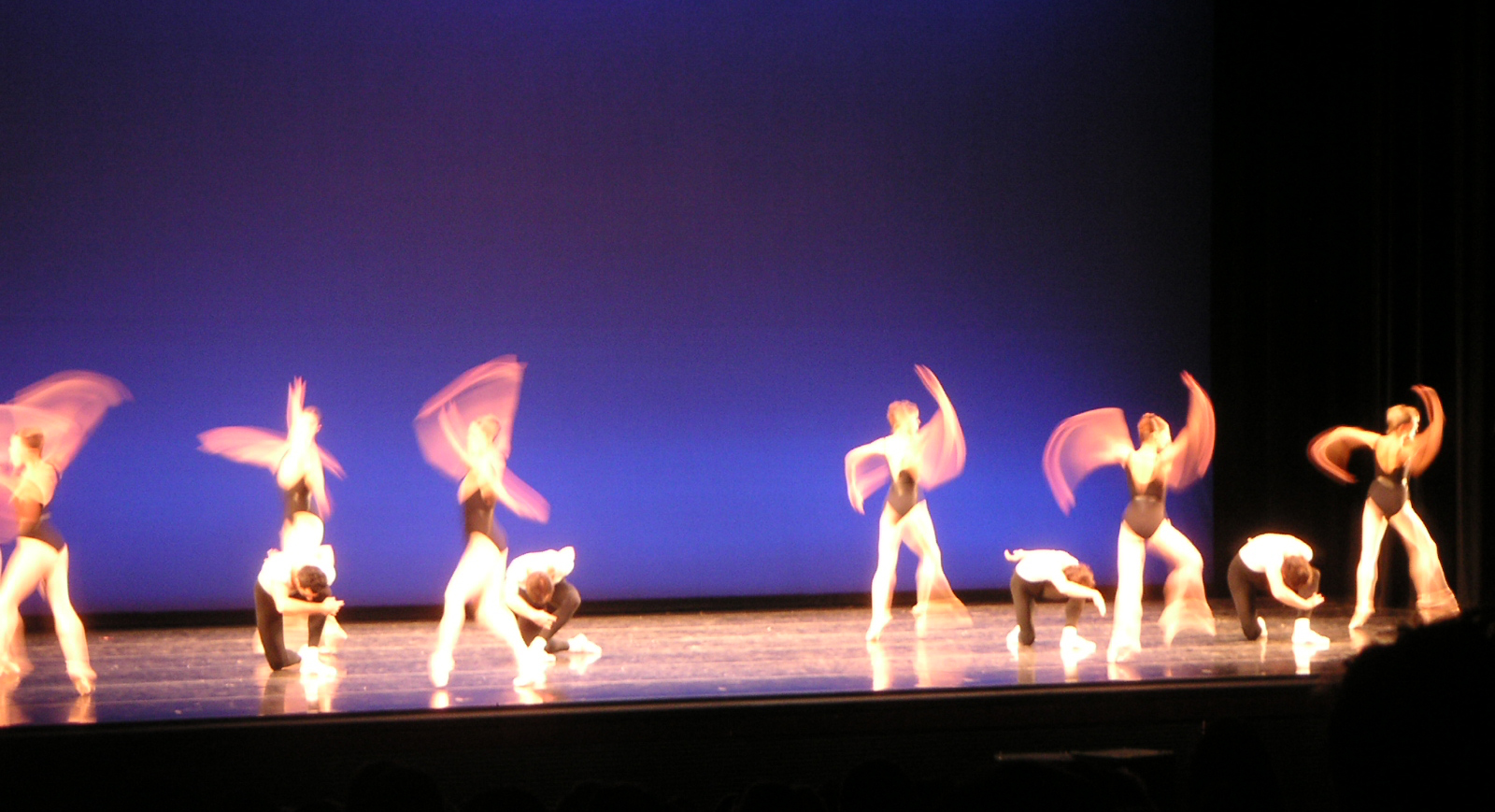 AgonBallet · 1957Same lineage · video
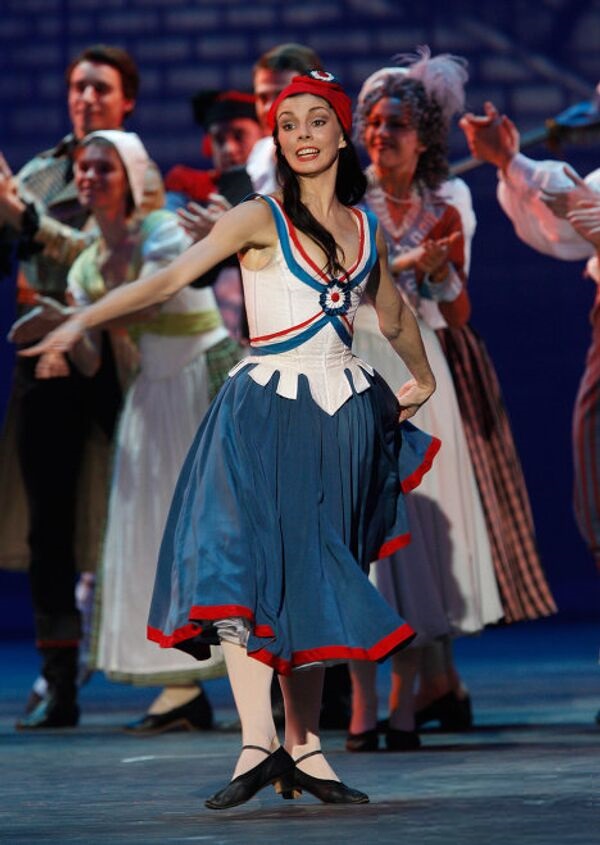 Flames of ParisBallet · 1932Same lineage · video
 Il ballo delle ingrateBallet · 1608Same lineage · video
- KhammaKhammaBallet · 1947Same lineage
- The Incredible FlutistThe Incredible FlutistBallet · 1938Same lineage
- Le Petit Elfe Ferme-l'œilLe Petit Elfe Ferme-l'œilBallet · 1924Same lineage