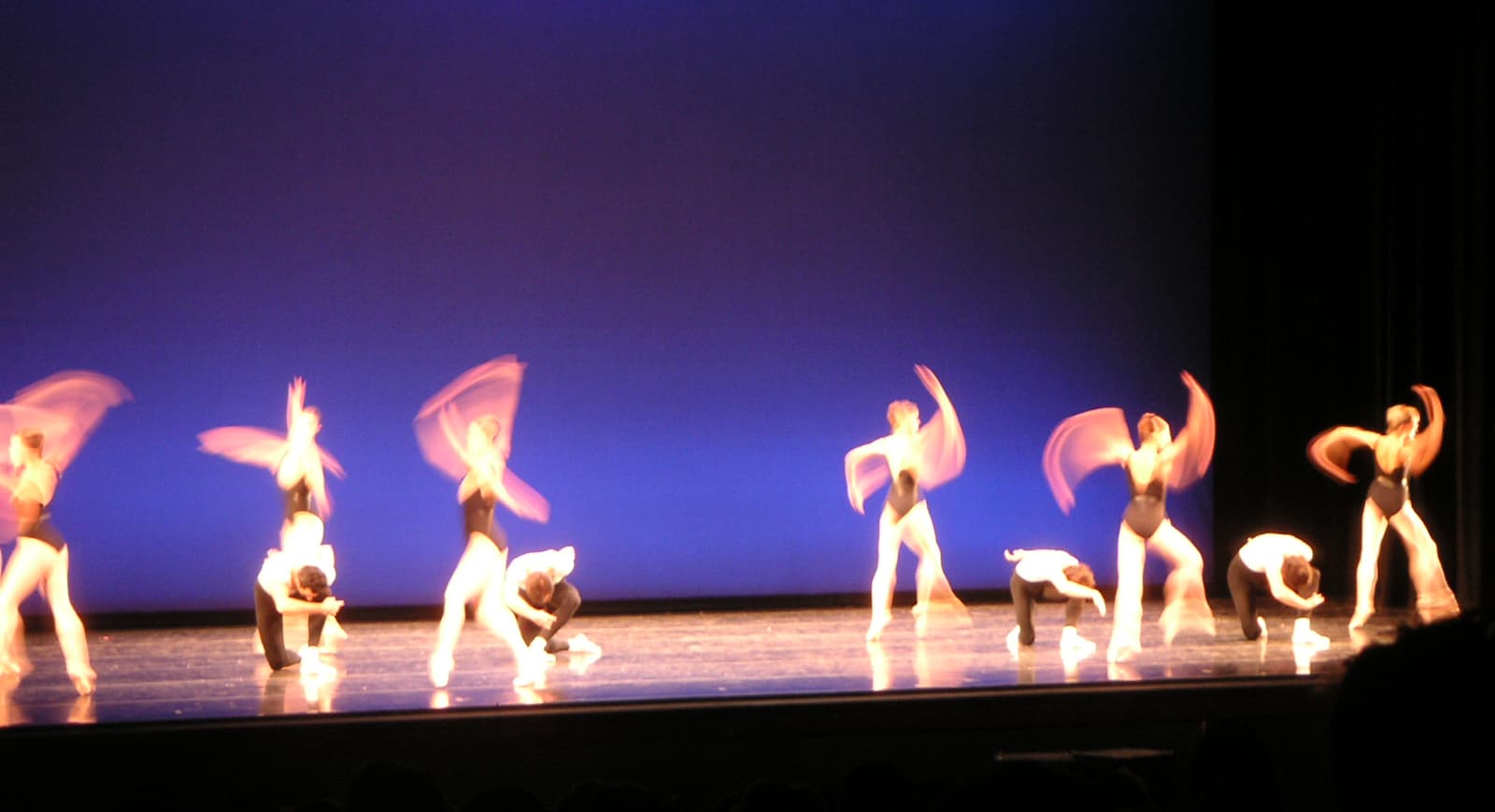
snickclunk — balanchine's agon · CC BY 2.0
Agon is a plotless, 22-minute ballet for twelve dancers made by George Balanchine to a score by Igor Stravinsky, the composer's first work to introduce a full twelve-tone row after a long gestation (begun December 1953, interrupted, finished April 27, 1957). The music premiered in concert at UCLA's Royce Hall on June 17, 1957 under Robert Craft, with Stravinsky himself conducting the first recording sessions the next day; the staged ballet followed with the New York City Ballet at the City Center of Music and Drama on December 1, 1957.
What it contains
- Neoclassical Ballet · The whole ballet — A plotless structure of twelve dances in which groups of dancers of varying size interact in pairs, trios and quartets, replacing narrative pantomime with abstract, musically-driven ensemble patterning. Source: "The ballet has no story, but consists of a series of dance movements in which various groups of dancers interact in pairs, trios, quartets, etc."
- Branle — Bransle simple · Part III, the Bransle simple, Bransle gay and Bransle double forming the second pas-de-trois — A sequence of three dances built on the bransle: a duet for two men, a solo for one woman, and a trio combining all three, mirroring the score's separate then combined hexachords. Source: "A number of the movements are based on 17th-century French court dances – saraband, galliard and bransle."
- Galliard — Gaillarde · Part II, the Gaillarde within the first pas-de-trois — A duet for two female dancers named for and modeled on the galliard, one of the named court dances underlying the ballet's structure. Source: "A number of the movements are based on 17th-century French court dances – saraband, galliard and bransle."
- Sarabande — Sarabande-step · Part II, the Sarabande-step within the first pas-de-trois — A solo variation for one male dancer named for and structurally derived from the 17th-century sarabande, recast in extended balletic line. Source: "A number of the movements are based on 17th-century French court dances – saraband, galliard and bransle."
What is danced
Agon has no story. It is built as twelve numbered dances arranged in four large sections of three dances each, with a prelude and two interludes threaded between them, so that the choreography maps directly onto Stravinsky's musical form: Pas-de-quatre (four men), Double pas-de-quatre (eight women) and Triple pas-de-quatre (all twelve) open the work; a first pas-de-trois (one man, two women) contains a solo 'Sarabande-step' for the man, a 'Gaillarde' duet for the two women, and a closing Coda; a second pas-de-trois (two men, one woman) is built from a 'Bransle simple' for the two men, a 'Bransle gay' solo for the woman, and a 'Bransle double' that reunites all three; the final section runs from a central Pas-de-deux through Four Duos to Four Trios for the full ensemble. Balanchine draws this scheme from named seventeenth-century French court dances — sarabande, galliard and bransle — but recasts their steps and floor patterns in an extended, off-balance classical vocabulary of pairs, trios and quartets rather than reconstructing period choreography.
Context
The ballet falls at the hinge of Stravinsky's move from a diatonic idiom to twelve-tone technique, and the article notes evidence of a seventeen-tone row and hexachord relationships worked out across the two Bransles before the twelve-tone row proper appears at the second coda. Balanchine's response was to match that abstraction with a plotless structure of shifting small ensembles rather than narrative pantomime, an approach that placed a modern, serial score inside forms borrowed from Renaissance and Baroque court dance.
Staging history
Agon was created for and premiered by the New York City Ballet on December 1, 1957 at the City Center of Music and Drama, following the concert premiere of the score itself in Los Angeles earlier that year. It remained in the company's repertory into the following decades and was danced as part of City Ballet's 1982 Stravinsky Centennial Celebration. The article also records a 1965 Italian performance notable for Stravinsky's enthusiastic reaction to mandolinist Giuseppe Anedda, indicating the work traveled internationally with its distinctive small-ensemble orchestration intact.
How to watch it
Watch how the size and gender balance of each group (four men, then eight women, then all twelve; a man alone, then two women; two men, then one woman) tracks the orchestration, since no passage in the score uses the full orchestra at once and the choreography is scaled the same way, number by number. Pay attention to the three named 'historical' dances — Sarabande-step, Gaillarde, and the three Bransles — where the steps gesture toward court dance shapes while being stretched into extended, angular classical lines rather than performed as reconstruction.
Structure
- Act I · Pas-de-quatreAn ensemble dance for four male dancers opens the ballet.
- Act I · Double pas-de-quatreEight female dancers perform a matching ensemble dance.
- Act I · Triple pas-de-quatreThe four men and eight women combine into a full twelve-dancer ensemble.
- Act I · PreludeA transitional passage bridging the opening section and the first pas-de-trois.
- Act II · Sarabande-stepA solo variation for one male dancer, part of the first pas-de-trois, named for the sarabande.
- Act II · GaillardeA duet for two female dancers named for the galliard.
- Act II · CodaThe man and two women reunite to close the first pas-de-trois.
- Act II · InterludeA transitional passage leading into the second pas-de-trois.
- Act III · Bransle simpleTwo male dancers perform a duet built on the bransle.
- Act III · Bransle gayA solo female variation, also built on the bransle, follows the men's duet.
- Act III · Bransle doubleThe two men and the woman combine, the hexachords stated separately in the preceding two dances now combined into one twelve-tone row.
- Act III · InterludeA second transitional passage precedes the final section.
- Act IV · Pas-de-deuxThe central duet for one male and one female dancer.
- Act IV · Four DuosFour couples dance in parallel duets.
- Act IV · Four TriosFour men and eight women close the ballet in a series of trios.
Structure read from an encyclopaedia article, not from a libretto or score we hold. Confirm against a programme before treating the numbering as authoritative.
Credits
- composer: Igor Stravinsky
More from George Balanchine
Other staged works in the register connected to this one by author or lineage.
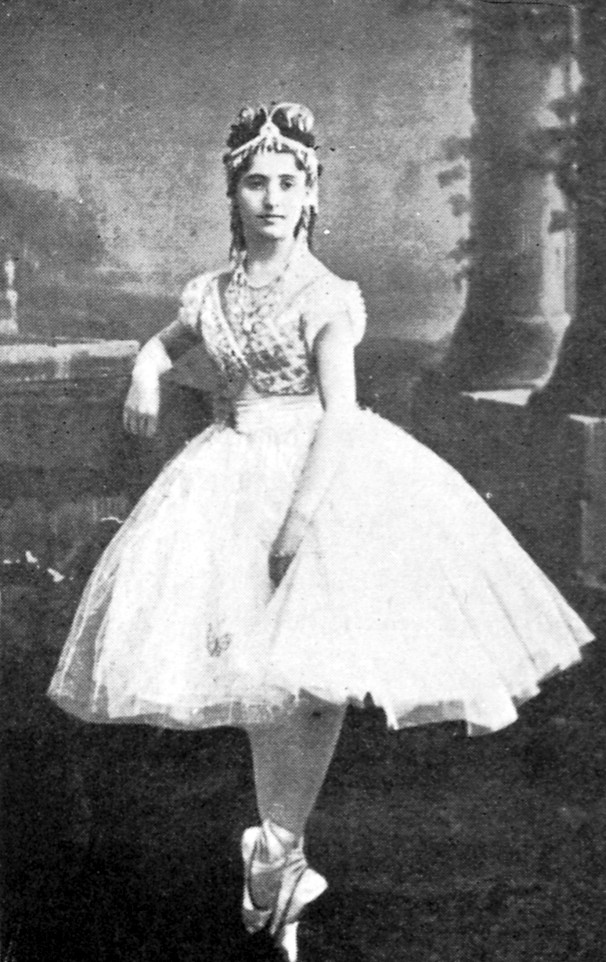 CoppéliaBallet · 1870Balanchine · video
 ApolloBallet · 1928Balanchine · video
 Le chant du rossignolBallet · 1920Balanchine · video
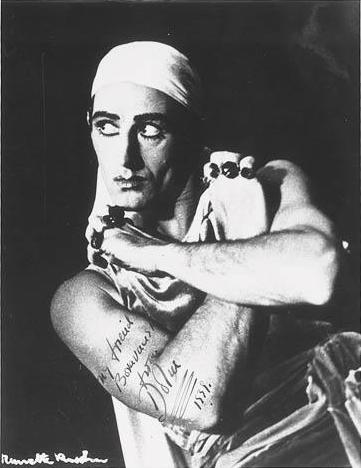 The Prodigal SonBallet · 1929Balanchine · video
 The Seven Deadly SinsBallet · 1933Balanchine · video
 Circus PolkaBallet · 1942Balanchine · video
 Robert Schumann's DavidsbündlertänzeBallet · 1980Balanchine · video
 Liebeslieder WalzerBallet · 1960Balanchine · video