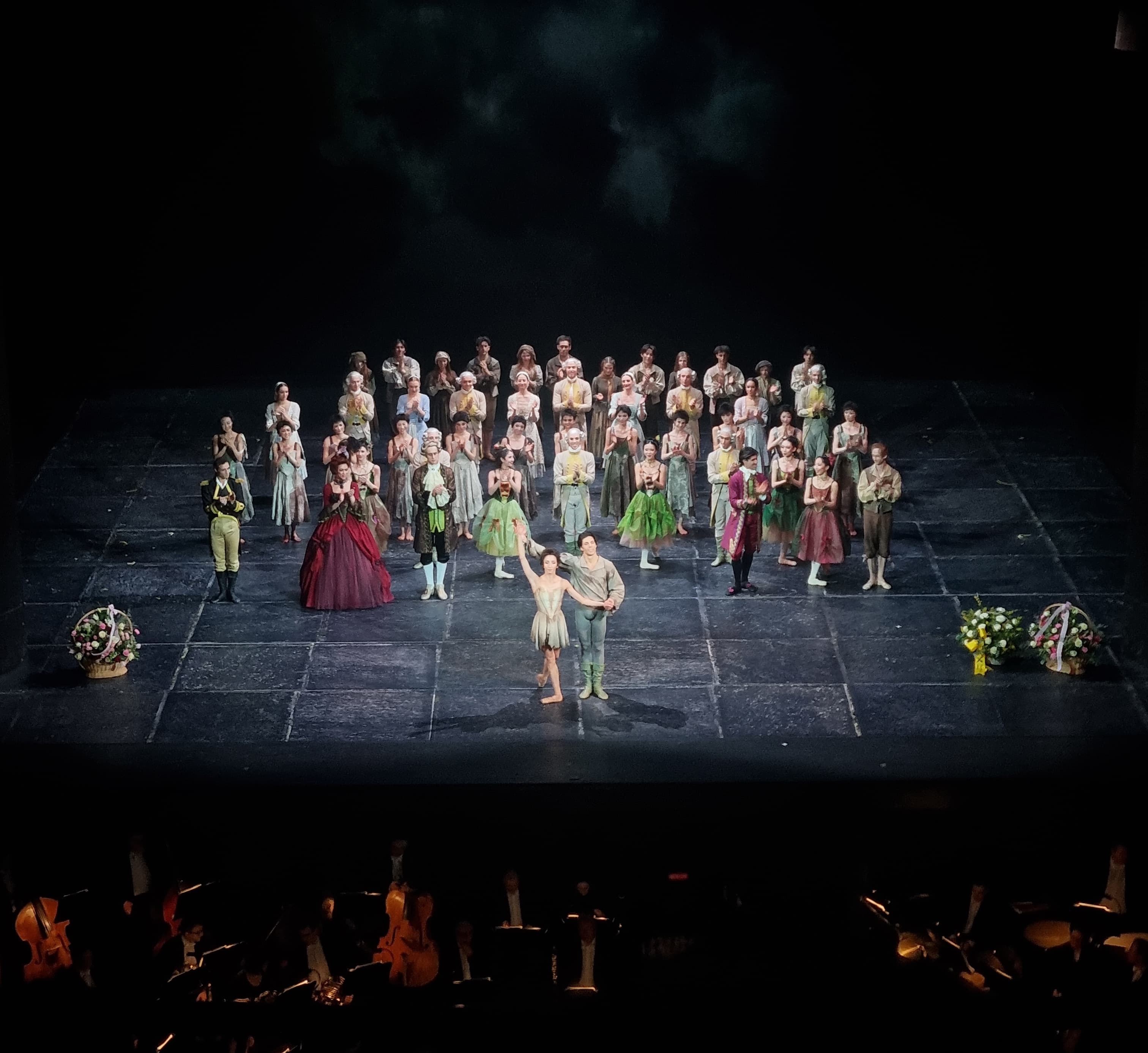
FabriceValserradelDongo — Own work · CC0
L'histoire de Manon is a three-act narrative ballet made by Kenneth MacMillan for The Royal Ballet, premiered at Covent Garden on 7 March 1974 with Antoinette Sibley and Anthony Dowell creating the leads. It adapts Abbé Prévost's 1731 novel Manon Lescaut, tracing its heroine from a convent-bound girl to a deported prostitute dying in the Louisiana swamp, and was built by MacMillan as a companion piece to his earlier Romeo and Juliet, using the same courtship-through-pas-de-deux dramaturgy on a larger, opera-scaled canvas.
What it contains
- Classical Ballet · Throughout all three acts, in the sequence of duets for Manon and Des Grieux — The relationship is built through 'a series of pas de deux' rather than divertissement, structured like MacMillan's Romeo and Juliet, implying classical partnering vocabulary carrying the emotional and dramatic development of the two leads. Source: "The ballet's narrative structure is based on that of MacMillan's earlier Romeo and Juliet, with hero and heroine meeting each other as young innocents and their love being revealed through a series of pas de deux."
What is danced
The article's clearest statement on the choreography is structural rather than step-by-step: the narrative is carried through 'a series of pas de deux' that trace the couple from 'young innocents' to their tragic end, mirroring the design MacMillan had used in Romeo and Juliet. This places the emotional and technical weight of the ballet on a sequence of duets for Manon and Des Grieux across all three acts, rather than on divertissement or set showpieces, and implies a through-composed dramatic-ballet structure rather than a numbers ballet.
Context
MacMillan made Manon three years into his tenure as artistic director of The Royal Ballet, explicitly wanting 'a large-scale operatic ballet' that would give both principals and the corps de ballet substantial roles - a statement of ambition for a director trying to expand the company's full-evening dramatic repertory beyond Romeo and Juliet. The designs by Nicholas Georgiadis were built around the 'precarious division between opulence and degradation,' situating the ballet's visual and dramatic world in the same vein of gritty, psychologically driven narrative ballet MacMillan had pursued since the 1960s.
Staging history
The score was originally arranged and partially orchestrated by Leighton Lucas with help from Royal Ballet pianist Hilda Gaunt, drawing on thirteen Massenet operas, two oratorios, orchestral suites, songs and piano works rather than Massenet's own opera Manon; it was re-orchestrated by conductor Martin Yates in 2011. A second cast, Jennifer Penney and Wayne Eagling, took over the leads later in the same month as the premiere, and the article notes the work 'continues to be performed and recognised internationally.'
How to watch it
Follow the pas de deux across the three acts as the emotional spine of the piece - the article frames the whole ballet as built from this duet sequence rather than from divertissement. Note the deliberate contrast Georgiadis's designs draw between glittering party scenes and squalid settings (the inn courtyard, the gaoler's room, the swamp), since the choreography and staging together are meant to track Manon's descent from courted girl to condemned prostitute.
Structure
- Act I · Scene 1At an inn courtyard near Paris, Manon meets des Grieux and they fall in love and flee with money she has stolen; Lescaut bargains with a wealthy old gentleman and then Monsieur GM over Manon.
- Act I · Scene 2At des Grieux's lodgings, Manon declares her love, then yields to Monsieur GM's advances while des Grieux is persuaded by Lescaut to sanction the liaison for wealth.
- Act II · Scene 1At a party given by Monsieur GM, Manon is torn between wealth and love; des Grieux is caught cheating at cards and the pair flee.
- Act II · Scene 2Manon and des Grieux reaffirm their love before Monsieur GM arrives with police; Manon is arrested and Lescaut is killed in the struggle.
- Act III · Scene 1At a New Orleans port, deported convict Manon arrives with des Grieux posing as her husband; the gaoler takes an interest in her.
- Act III · Scene 2The gaoler offers Manon rewards to leave des Grieux; des Grieux breaks in and kills the gaoler.
- Act III · Scene 3In the swamp, fleeing pursuers, Manon renounces her ambitions and dies in des Grieux's arms.
Structure read from an encyclopaedia article, not from a libretto or score we hold. Confirm against a programme before treating the numbering as authoritative.
Credits
- composer: Jules Massenet
More from Kenneth MacMillan
Other staged works in the register connected to this one by author or lineage.
 MayerlingBallet · 1978MacMillan · video
 Winter DreamsBallet · 1991MacMillan · video
 AnastasiaBallet · 1967MacMillan · video
 Romeo and JulietBallet · 1965MacMillan · video
- La Fin du jourLa Fin du jourBalletMacMillan
 ConcertoBallet · 1966MacMillan · video
 Liebeslieder WalzerBallet · 1960Same lineage · video
 The Green TableBallet · 1932Same lineage · video