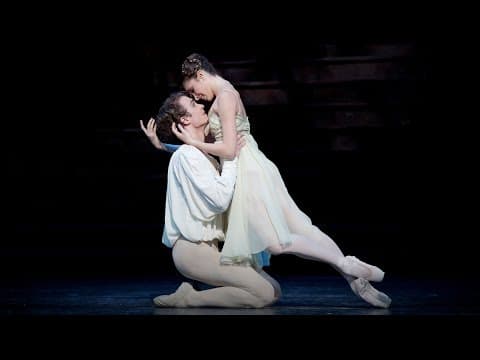
This is Kenneth MacMillan's full-length narrative ballet to Sergei Prokofiev's score, made for the Royal Ballet and first given at the Royal Opera House, Covent Garden on 9 February 1965. It exists because the Soviet Union refused to let Leonid Lavrovsky's Bolshoi production tour to London, leaving the Royal Ballet without a Romeo and Juliet for a planned American tour; MacMillan, who had already choreographed the balcony pas de deux for television with Lynn Seymour and Christopher Gable, was given five months to build a full evening's ballet around it.
What it contains
- Classical Ballet · the ballet as a whole, planned around the lead couples' duets — The ballet was structured around a sequence of pas de deux for the principal characters, with the balcony duet as its choreographic and dramatic core, in the classical narrative ballet idiom of the Royal Ballet. Source: "They envisioned Juliet as the headstrong character, making decisions, while Romeo was "swept off his feet by love"."
What is danced
The article gives little step-by-step technical detail, but it is explicit that the ballet was built outward from a series of pas de deux rather than from set classical divertissements: MacMillan, Seymour and Gable 'planned the ballet around the characters and their pas de deuxs', casting Juliet as the one who drives the choices and Romeo as swept along by her. The balcony scene, choreographed first (for television, before the rest of the ballet existed), functioned as the structural spine of the whole work and was made in only three rehearsals according to Seymour - a sign of how tightly the duet's shape was already worked out in MacMillan's head before the surrounding acts were built.
Alongside the central pas de deux, the market/town-square scenes carry a crowd of 'rowdy harlots', a piece of stage business MacMillan borrowed directly from John Cranko's Stuttgart production - suggesting an ensemble, character-inflected vocabulary distinct from the leads' danced duets, though the article does not describe its steps. Nicholas Georgiadis's monumental sets were designed to dwarf the dancers physically, reinforcing Romeo and Juliet's vulnerability against their society - a scenic choice that shapes how the pas de deux reads in the theatre even though it is not itself choreography.
Because the source material is a historical account rather than a synopsis or score breakdown, it does not describe individual variations, mime passages, or the ballroom and duel scenes in technical terms, so no act-by-act breakdown can be responsibly reconstructed from it here.
Context
The production emerged in 1965 in a very particular gap: the Royal Ballet needed a full-length dramatic ballet for an American tour and could not access the Soviet 'classic' version, forcing an in-house commission from a choreographer still relatively new to full-length work. MacMillan made it with Frederick Ashton's blessing, and drew explicitly on Quattrocento painting and architecture, Shakespeare, Franco Zeffirelli's 1960 stage production, and John Cranko's own Romeo and Juliet - situating the work at a crossroads of British ballet's move toward psychologically dramatic, cinematically-influenced narrative choreography in the 1960s.
Staging history
The premiere cast was originally intended to be Lynn Seymour and Christopher Gable, for whom the ballet was built, but 'bureaucratic reasons' and the American impresario Sol Hurok's insistence on box-office names put Margot Fonteyn and Rudolf Nureyev in the opening-night roles instead; the substitution reportedly contributed to MacMillan's and Seymour's later departures from the company and to Gable's move away from dancing. Seymour and Gable danced the second cast to strong reviews. MacMillan subsequently restaged the ballet for the Royal Swedish Ballet, American Ballet Theatre, and Birmingham Royal Ballet (the last with new designs by Paul Andrews), and it has been filmed repeatedly: a 1966 Paul Czinner cinema release with the original Fonteyn/Nureyev cast, a 2012 recording with Lauren Cuthbertson and Federico Bonelli directed by Ross MacGibbon, and a 90-minute 2020 BBC abridgment for PBS Great Performances.
How to watch it
Watch how the balcony pas de deux, choreographed before the rest of the ballet existed, carries the emotional argument of the whole evening - it was built first and the ballet was assembled around it. Notice the deliberate mismatch of scale between the two lovers and Georgiadis's oversized architectural sets, meant to make them look small and helpless against their world, and watch the market-scene crowd (including the 'rowdy harlots' borrowed from Cranko's staging) for how it frames the lovers' private duets against public, communal choreography.
More from Kenneth MacMillan
Other staged works in the register connected to this one by author or lineage.
 L'histoire de ManonBallet · 1974MacMillan · video
 MayerlingBallet · 1978MacMillan · video
 Winter DreamsBallet · 1991MacMillan · video
 AnastasiaBallet · 1967MacMillan · video
- La Fin du jourLa Fin du jourBalletMacMillan
 ConcertoBallet · 1966MacMillan · video
 Theme and VariationsBallet · 1947Same lineage · video
 Liebeslieder WalzerBallet · 1960Same lineage · video