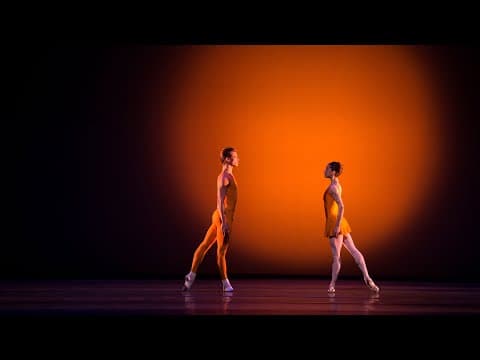
Concerto is a plotless, one-act ballet in three movements that Kenneth MacMillan made in 1966 for the Deutsche Oper Ballet, set to Shostakovich's Second Piano Concerto. It belongs to the mid-1960s vein of 'symphonic' or abstract ballet-made without narrative, structured directly on the musical form, and built to showcase ensemble unison work alongside two contrasting pas de deux/solo set pieces.
What it contains
- Neoclassical Ballet — Second movement (pas de deux) · Second movement, the central pas de deux — The male partner is choreographed to function as a literal ballet barre, holding positions for the woman to balance against and stretch from, rather than performing conventional lifts and turns. Source: "The man acts as a "barre" for the female dancer."
- Neoclassical Ballet · The whole ballet, structured across its three movements — A plotless, non-narrative ballet whose choreography is generated directly from a concerto's musical structure rather than from a libretto, the hallmark of mid-century abstract/symphonic ballet-making. Source: "The ballet is plotless and consists of three movements."
- Classical Ballet · Corps de ballet passages across the work — A large ensemble of women and men dances in strict unison, a classical corps-de-ballet convention of aligned, drilled group patterning. Source: "The ballet also includes a corps de ballet, that dances in unison, originally 16 women and 8 men."
What is danced
The ballet maps its choreography onto the concerto's three movements rather than onto a story. The first movement, credited to Didi Carli and Falco Kapuste as originating cast, is danced by a corps de ballet of (originally) sixteen women and eight men moving in unison, giving the movement its ensemble, drill-like character. The second movement is the ballet's best-known passage: a pas de deux originated by Lynn Seymour and Rudolf Holz in which MacMillan translated the idea of ballet-class barre work directly into partnering, with the male dancer functioning as a literal 'barre' that supports and frames the woman's extensions and balances rather than lifting or turning her in conventional pas de deux fashion. The third movement was designed as a light, 'playful' pas de deux, but a late injury to the male dancer forced MacMillan to rework it into a solo for the woman before the premiere, so the movement as first performed, and largely since, is a solo display piece rather than a duet.
Context
Made for a German company in 1966, in the middle of MacMillan's career and at a moment when plotless, score-driven ballet (the mode most associated internationally with Balanchine) was being tested by choreographers working in narrative-heavy European houses. Concerto shows MacMillan working in that abstract register: no libretto, no characters, movement generated from the concerto's own structure and, in the second movement, from a piece of ballet-class ritual (the barre) turned into stage vocabulary. Its rapid adoption by American Ballet Theatre and by the Royal Ballet organisation within a year of the premiere shows how quickly the piece was recognised as a portable, company-friendly repertory work outside its city of origin.
Staging history
Lucia Chase of American Ballet Theatre asked to acquire the ballet immediately after seeing the 1966 premiere, and ABT gave its first performance in Jacksonville, Florida in 1967, staged by Georgina Parkinson and Wendy Walker. Frederick Ashton brought it into the Royal Ballet Touring Company (now Birmingham Royal Ballet) the same year at the Royal Opera House, with the main Royal Ballet company adding it in 1970. It has remained current repertory for these companies since: Birmingham Royal Ballet performed it in the 2017 'Kenneth MacMillan: A National Celebration' programme, the Royal Ballet extracted the second-movement pas de deux for an online broadcast in 2020, and full performances were filmed for DVD in 2010 and again in 2019.
How to watch it
Watch the second movement for the barre conceit itself: the man holds positions that a ballet barre would hold, and the woman uses him for balance, stretch and support rather than being partnered in the usual lifted, turned sense. In the first and third movements, note the contrast MacMillan sets up between corps unison (first movement) and solo display (third movement, originally meant as a second duet). The original Jürgen Rose designs use a yellow backdrop with orange and russet costumes, a plain, non-narrative palette appropriate to a plotless work.
Structure
- First movementA plotless ensemble movement, originated by Didi Carli and Falco Kapuste, danced by a corps de ballet moving in unison.
- Second movement (pas de deux)A pas de deux originated by Lynn Seymour and Rudolf Holz, inspired by Seymour's own barre warm-up, with the male dancer used as a supporting 'barre' for the woman.
- Third movementConceived as a playful pas de deux but reworked into a solo for the woman, danced first by Silvia Kesselheim, after the male dancer's injury before the premiere.
Structure read from an encyclopaedia article, not from a libretto or score we hold. Confirm against a programme before treating the numbering as authoritative.
Credits
- composer: Dmitri Shostakovich
More from Kenneth MacMillan
Other staged works in the register connected to this one by author or lineage.
 L'histoire de ManonBallet · 1974MacMillan · video
 MayerlingBallet · 1978MacMillan · video
 Winter DreamsBallet · 1991MacMillan · video
 AnastasiaBallet · 1967MacMillan · video
 Romeo and JulietBallet · 1965MacMillan · video
- La Fin du jourLa Fin du jourBalletMacMillan
 Homage to the QueenBallet · 1953Same lineage · video
 Stravinsky Violin ConcertoBallet · 1972Same lineage · video