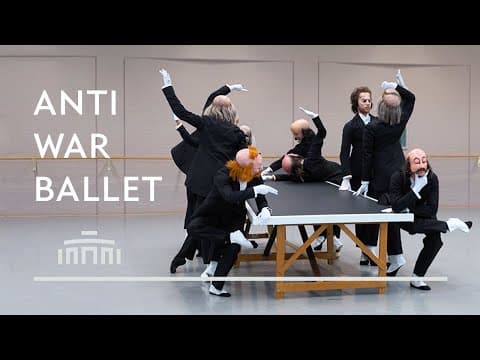
The Green Table is Kurt Jooss's 1932 dance-theatre work, subtitled "A dance of death in eight scenes," made for and winning the Concours international de chorégraphie in Paris. It restages the medieval Totentanz (Dance of Death) tradition as a contemporary anti-war allegory: a ring of masked diplomats argue, draw pistols, and declare war, and the scenes that follow show the human cost while Death, danced as a relentless mechanical skeleton, claims every character in turn.
What it contains
- Classical Ballet · Throughout, as the technical substrate beneath every scene — Turn-out, demi-pointe, extensions, turns and arabesques are used as vocabulary throughout, though pointe work and formal display are deliberately excluded in favour of expressive intent. Source: "It uses elements of classical ballet, such as turn-out, demi-pointe, extensions, turns, arabesques, and other ballet steps."
What is danced
The vocabulary is built from classical ballet elements — turn-out, demi-pointe, extensions, turns, arabesques — but stripped of pointe work and of the "gracefulness, elegance, ethereal quality" the article says define ballet proper. Steps are used for expressive content rather than formal display: hands are held as stretched palms and fists rather than the relaxed wrists of classical training, and dancers' focus is directed toward the drama at centre stage rather than out to the audience. Death is given a distinct movement signature — "sharp, direct, strong, and angular movements, cutting through space, advancing or pacing with clockwork regularity" — set against the Profiteer's curved back, indirect focus and multidirectional pathways, so the eight scenes each stage a different physical characterisation built on the same underlying technique.
The opening and closing scenes (the Gentlemen in Black around the table) use repetitive, caricatured gesture — pacing, gesticulating while talking — set ironically against a "playful tango," while the intervening scenes (Farewells, Battle, Partisan, Refugees, Brothel, Aftermath) each work a variation on the same danse macabre theme, ending in The Aftermath with victims forming a linear processional line behind Death, echoing the medieval Totentanz imagery directly.
Context
Made in 1932, between the two world wars and on the eve of the Nazi period, the piece belongs to the German Ausdruckstanz milieu alongside contemporaries such as Mary Wigman, Valeska Gert and Anita Berber, but the article stresses that Jooss, unlike them, worked directly from the pictorial vocabulary of the Danse Macabre tradition (the Lübeck Totentanz) rather than more abstract treatments of mortality. It also situates the work within the German Gesamtkunstwerk idea — choreographer, composer (Frederic/Frederick Cohen) and designer (Hein Heckroth) building a single dramatic conception from a libretto, following Wagner and, before him, Noverre — and links its cutting irony and caricature to Expressionism and to contemporaries in visual art (George Grosz) and theatre (Erwin Piscator).
Staging history
Jooss staged the work himself worldwide throughout his career with his own company, Ballet Jooss, founded after he left his post at the Folkwangschule and Essen Opera. After his death in 1979 his daughter Anna Markard took over stagings, and after her death in 2010 that role passed to former Dutch National Ballet principal Jeanette Vondersaar. The article records one specific staging: in 1971 Joffrey Ballet principal Christian Holder was personally trained by Jooss for a revival, and on Jooss's death in 1979 the Joffrey gave an impromptu performance with Holder dancing Death.
How to watch it
Watch for the absence of virtuoso display — no pointe work, no steps performed for their own formal beauty — and for how the same eight-scene structure recurs as a closed loop, since the final scene repeats the opening exactly to make the point that the diplomats learn nothing. Pay attention to Death's mechanical, clockwork regularity against the more idiosyncratic effort qualities given to each other archetype (the Profiteer's indirection, the soldier's directness), and to how masks and props (a flag, a red dress and white scarf) carry symbolic rather than naturalistic meaning.
Structure
- Scene 1 · The Gentlemen in Black (opening)Diplomats argue around a green-covered table, then draw pistols and fire into the air to declare war.
- Scene 2 · The FarewellsSeparation from loved ones as soldiers depart for war.
- Scene 3 · The BattleWar itself is enacted.
- Scene 4 · The PartisanWar continues through the figure of the partisan.
- Scene 5 · The RefugeesLoneliness and misery among displaced civilians.
- Scene 6 · The BrothelThe emotional void and forced entertainment of wartime.
- Scene 7 · The AftermathDeath leads the psychologically beaten survivors in a processional line, echoing the medieval Totentanz, as they fall beneath a blue-stained white flag.
- Scene 8 · The Gentlemen in Black (closing)The diplomats resume their negotiations exactly as at the start, indifferent to the war's cost.
Structure read from an encyclopaedia article, not from a libretto or score we hold. Confirm against a programme before treating the numbering as authoritative.
Credits
- composer: Frederic Cohen
In the same lineage
Other staged works in the register connected to this one by author or lineage.
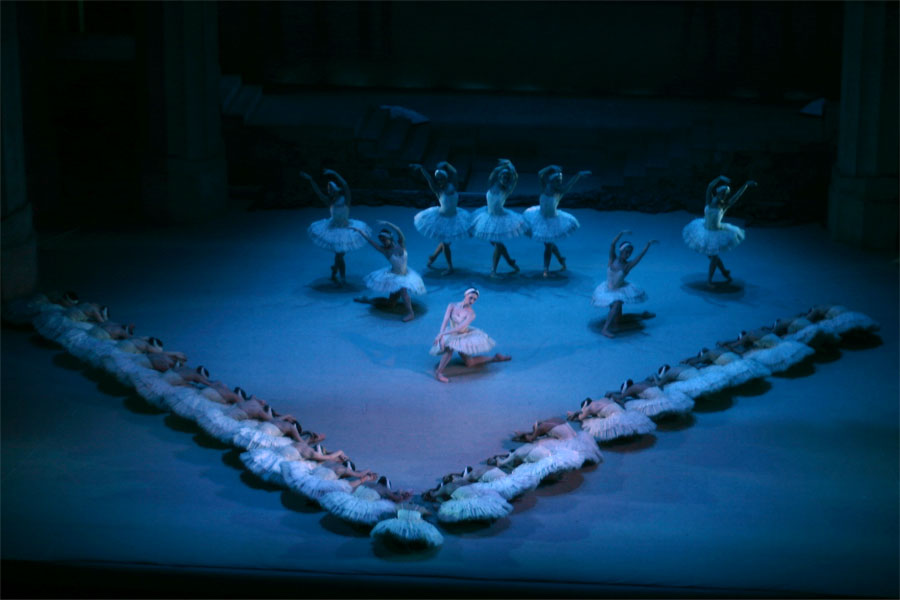 Swan LakeBallet · 1877Same lineage · video
 The NutcrackerBallet · 1892Same lineage · video
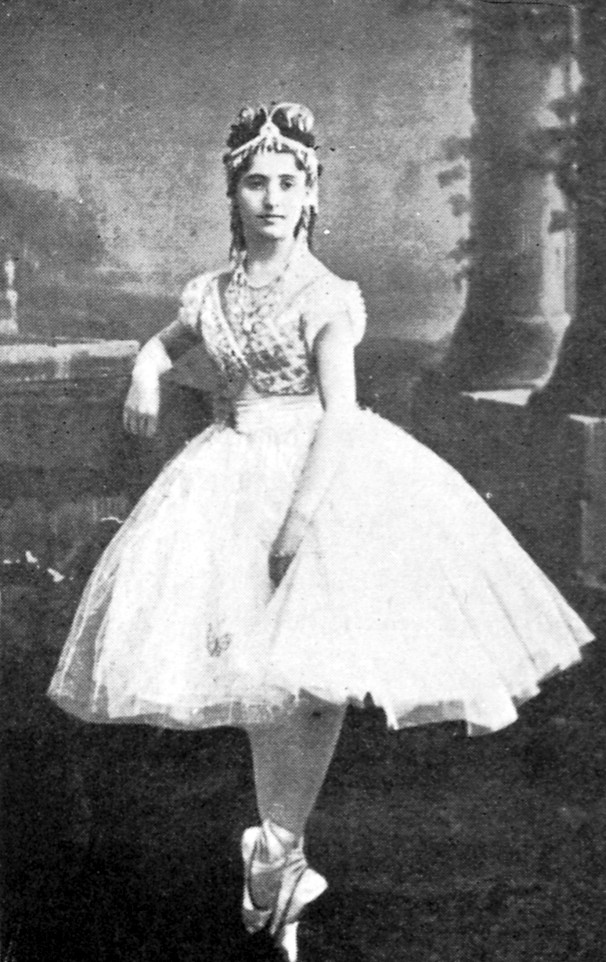 CoppéliaBallet · 1870Same lineage · video
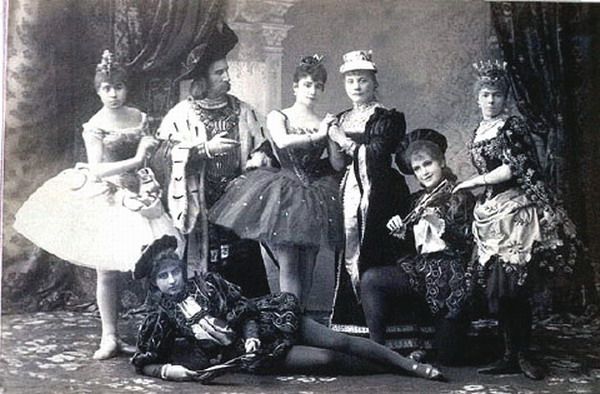 The Sleeping BeautyBallet · 1890Same lineage · video
 The FirebirdBallet · 1910Same lineage · video
 PetrushkaBallet · 1911Same lineage · video
 The Whims of the ButterflyBallet · 1889Same lineage
 Square DanceBallet · 1957Same lineage · video