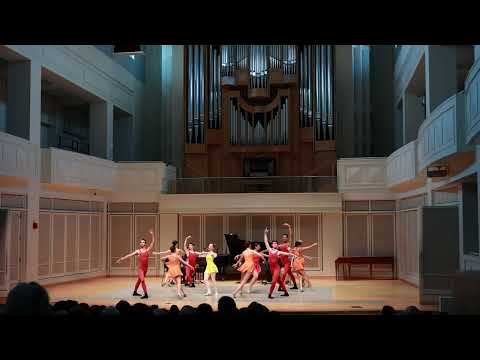
La Revue de Cuisine (1927)
La Revue de cuisine is a one-act comic ballet by Bohuslav Martinů, written in 1927 for a six-piece jazz-inflected ensemble (clarinet, bassoon, trumpet, violin, cello, piano) and premiered in Prague that November. Commissioned as a curtain-raiser, it became Martinů's first popular success: a mock domestic drama in which kitchen utensils (Pot, Lid, Twirling Stick, Dishcloth, Broom) are personified and act out a farcical romance, betrayal and reconciliation.
What it contains
- Vernacular Jazz — Duel (Tempo di Charleston) · The Duel movement (no. 6 in the ballet's ten-movement structure) — A comic confrontation between Dishcloth and Broom set explicitly to Charleston rhythm, the period's signature vernacular-jazz social dance, per the score's own tempo marking. Source: "Duel (Poco a poco allegro. Tempo di Charleston)"
What is danced
The ballet unfolds in ten short, contrasting movements that each carry the plot forward through a distinct dance-number: a Prologue and march-tempo Introduction set the kitchen scene; a 'Danse du moulinet autour du caudron' and 'Danse du chaudron et du couvercle' stage the courtship and marriage of Pot and Lid; a Tango, subtitled 'Danse d'amour', is the seduction number in which Pot succumbs to Twirling Stick's advances; a Duel movement, marked 'Tempo di Charleston', stages the confrontation between Dishcloth and Broom; a lament for the cauldron, a Marche funèbre, a 'Danse radieuse' and a closing 'Fin du drame' carry the story to its comic resolution and final pairings-off.
Context
Made in 1927, the ballet sits at the point where European concert and theatre music was absorbing American jazz idiom -- muted trumpet, pizzicato cello standing in for double bass, and metrically unstable rhythm (2/4, 3/8, 4/8 shifting 'in an almost unpredictable fashion') borrowed from period jazz bands. Naming a movement after the Charleston and another after the tango places the ballet inside the vogue for social/popular dance idioms entering theatrical works of the later 1920s, alongside comparable jazz-age ballets of the period.
Staging history
The article records only the 1927 Prague premiere of the ballet and a separate 1930 Paris premiere of the four-movement concert suite Martinů extracted from it (Prologue, Tango, Charleston, Final). The full ballet score itself was lost and only rediscovered in the early 1990s in the Paul Sacher Foundation's archive in Basel, receiving publication in Paris in 2004 -- meaning that for most of the twentieth century the work was known to audiences chiefly through the orchestral suite rather than as a staged ballet.
How to watch it
Listen for the shift from mock-heroic march and courtly duet writing into openly jazz-inflected numbers -- the muted-trumpet Tango and the Charleston-tempo Duel are the two places the anthropomorphic comedy turns explicitly into period social dance. Because the piece is built as a sequence of short character numbers rather than sustained classical variations, attention should go to how each utensil-character is given a distinct rhythmic profile rather than to virtuosic display.
Structure
- Tango (Danse d'amour)The seduction number in which, per the scenario, Pot succumbs to Twirling Stick's flattery.
- Duel (Tempo di Charleston)Dishcloth is challenged to a duel by Broom after making eyes at Lid.
- Entracte (Lamentation du chaudron)Pot tires of Twirling Stick and longs for Lid, who cannot be found.
- Fin du dramePot and Lid reconcile with a kiss while Twirling Stick pairs off with Dishcloth.
Structure read from an encyclopaedia article, not from a libretto or score we hold. Confirm against a programme before treating the numbering as authoritative.
Credits
- composer: Bohuslav Martinů
More from Bohuslav Martinů
Other staged works in the register connected to this one by author or lineage.
 AnastasiaBallet · 1967Music by Martinů · video
- ŠpalíčekŠpalíčekBallet · 1933Music by Martinů
 The Red PoppyBallet · 1927Same lineage · video
 Concerto BaroccoBallet · 1941Same lineage · video
 Black and BlueMusical theatre · 1989Same lineage · video
- High YellowHigh YellowBallet · 1932Same lineage
 West Side Story SuiteBallet · 1995Same lineage · video