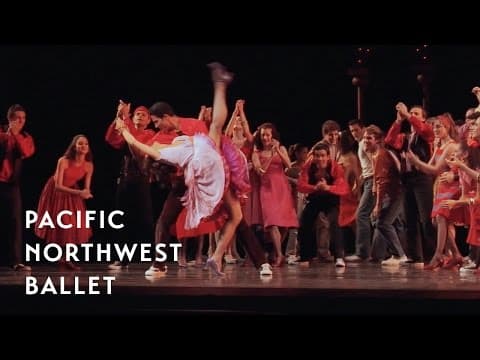
West Side Story Suite (1995)
West Side Story Suite is a 1995 ballet made by Jerome Robbins for the New York City Ballet, compressing his own choreography for the 1957 musical West Side Story (as revised for the 1989 revue Jerome Robbins' Broadway) into a seven-number theatrical suite, with Peter Gennaro credited as co-choreographer. It sits in the catalogue as a rare case of a Broadway show score and staging being repatriated into a classical ballet company's active repertory, with spoken introductions and formal bows inserted between numbers to mark it explicitly as a suite rather than a narrative ballet.
What it contains
- Vernacular Jazz · the suite as a whole, across its seven numbers — Robbins describes the piece as requiring ballet-trained dancers to 'jive' and move their bodies through the vernacular social-dance range of the original musical rather than classical steps alone Source: "They can jive as well as anybody else can jive, so they can move their bodies in all those different ways. They just have to push the right buttons and release them."
What is danced
The article does not describe step-by-step choreography for individual numbers, but it is explicit that the piece requires NYCB's classically trained dancers to work outside balletic vocabulary: Robbins is quoted saying the company's dancers 'can jive as well as anybody else can jive, so they can move their bodies in all those different ways,' contrasting this with the 1950s dancers who 'couldn't dance it then.' This places the demand on the performers as vernacular social-dance and stage-jazz movement carried over from the original Broadway staging, danced by ballet-trained bodies rather than replaced with balletic steps.
Context
The article frames the work's origin partly in NYCB politics: co-founder Lincoln Kirstein pushed Robbins to make it in 1994, explicitly comparing the company's ageing repertory and audience to The Royal Ballet's success with Romeo and Juliet, and hoping a West Side Story ballet would give NYCB comparable stability. Robbins himself noted that when he made the 1957 musical he assumed ballet-trained dancers of that era could not have performed it, and that only by the 1990s had ballet dancers' training absorbed enough vernacular movement range to take it on -- a marker of how far ballet technique and Broadway jazz vocabulary had cross-pollinated over four decades.
Staging history
The premiere cast mixed NYCB dancers (Robert La Fosse as Tony, Jock Soto as Bernardo, Nikolaj Hübbe as Riff) with guest Broadway singer-performers brought in for the singing-heavy roles of Anita and Rosalia; within a few years NYCB moved to casting its own dancers in those singing parts instead of outside Broadway actors, while retaining offstage vocalists for other lines. The work has since travelled beyond its originating company: the National Ballet of Canada became the first other company to stage it in 2007, requiring a vocal coach to assess and train dancers across the ranks for the singing roles, and San Francisco Ballet, Pacific Northwest Ballet and Houston Ballet have also performed it. Any company acquiring it must separately obtain permission from Stephen Sondheim, Arthur Laurents and the Robbins and Bernstein estates, which is why singing auditions are a standing condition of licensing it.
How to watch it
Watch for the seams Robbins deliberately leaves visible: a spoken introduction opens the piece and formal bows are taken between numbers, underlining that this is a suite of extracted numbers rather than a continuous narrative ballet. Note which vocal lines are delivered live onstage by the dancer-performers themselves (as Hübbe did with 'Cool') versus dubbed by offstage singers or a singer in the orchestra pit (as with Tony's lines in 'Something's Coming' and the female solo in 'Somewhere') -- the balance of live-sung versus dubbed roles has shifted across different castings and companies.
Structure
- PrologueOpening number of the suite as listed in the programme; the article gives no further detail on its staging.
- Something's ComingAdded by Robbins beyond the six excerpts drawn from Jerome Robbins' Broadway; Tony's singing part is delivered by a singer in the orchestra pit while the role is danced onstage.
- The Dance at the GymOriginal cast member Jock Soto included this scene in his 2005 farewell performance.
- AmericaThe number's vocal lines for three chorus girls are sung from the pit rather than by the dancers onstage.
- CoolOriginally sung live onstage by Nikolaj Hübbe as Riff despite his lack of vocal training; he later performed it again in his 2008 farewell performance.
- The RumbleListed as a number in the suite; no further staging detail is given in the source.
- SomewhereThe female solo is sung by a singer in the orchestra pit rather than by the onstage dancer.
Structure read from an encyclopaedia article, not from a libretto or score we hold. Confirm against a programme before treating the numbering as authoritative.
Credits
- composer: Leonard Bernstein
More from Leonard Bernstein
Other staged works in the register connected to this one by author or lineage.


