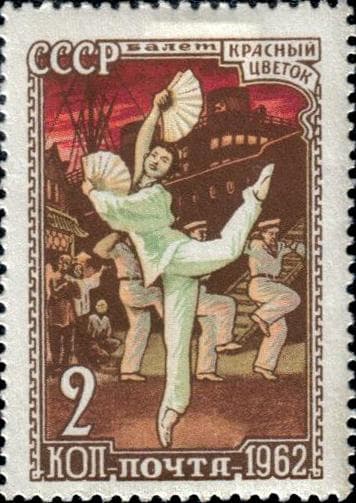
StampsUSSR_CPA2645-2646.jpg: Processed by A. Sdobnikov derivative work: KirGlobal — StampsUSSR_CPA2645-2646.jpg · Public domain
The Red Poppy (1927)
The Red Poppy is a three-act, eight-tableau Soviet ballet with a score by Reinhold Glière and libretto by Mikhail Kurilko, billed as the first Soviet ballet built on a contemporary revolutionary subject: Chinese dockworkers, a cruel harbourmaster, an exploited dancer-heroine and a rescuing Soviet ship's captain. It premiered in 1927 at what was then Moscow's "First People's State Theatre for Opera and Ballet" (the Bolshoi), choreographed by Lev Lashchiline for the first and third acts and Vasily Tikhomirov for the second.
What it contains
- Classical Ballet · Act II, Third to Fifth Tableaux — Taï-Choa's opium-dream sequence — A full academic grand-pas sequence embedded in a fantastical dream vision: a Grand Adagio, a solo Poppy Dance, a Phoenix Variation with a solo instrumental accompaniment, and a closing bravura Coda — the standard adagio/variation(s)/coda architecture of classical ballet pas de deux and ensemble writing. Source: "No. 32 Grand Adagio in E Major No. 33 Poppy Dance No. 34 Phoenix Variation No. 35 Taï-Choa's Variation (Xylophone Solo) No. 36 Dance of the Chinese Saltimbanque No. 37 Coda"
- Vernacular Jazz — Charleston · Act III, Sixth Tableau, No. 40 Charleston — A named Charleston number interpolated into the ballet's entertainment scene, using the popular 1920s social-dance form rather than academic ballet steps; the article gives only the title, not the steps performed. Source: "Sixth Tableau No. 39 Introduction No. 40 Charleston"
What is danced
Structurally the ballet is built on the same load-bearing joints as any late Imperial grand ballet: named divertissement numbers strung through crowd scenes, and a full academic grand pas sequence at its centre. The Third to Fifth Tableaux of Act II stage Taï-Choa's opium-induced vision — Four Goddesses, a Phoenix, a Sword Dance, a Butterfly and Lotus Dance — culminating in a conventional Grand Adagio, a solo Poppy Dance, a Phoenix Variation, a xylophone-accompanied heroine's variation, and a closing Coda: the adagio–variation(s)–coda architecture of classical pas de deux/ensemble writing, transplanted into an exoticised dream-ballet setting comparable in function to the shades or sweets scenes of the standard repertoire.
Framing this classical core is a run of demi-caractère and national numbers typical of grand-ballet convention: a restaurant Fan Dance for the heroine, a Dance of the Malaysian Women, Dance of the Golden Thimbles, and — inside a staged "Chinese Theatre" in Act III — a sequence of herald-announced turns (Demon's Dance, Dance with Scarves, Umbrella Dance, Ribbon Dance). Interpolated into this same theatrical-within-theatrical scene are two markedly non-balletic, of-the-moment social dances: a Charleston and a Boston Waltz (the latter reprised later in Act III), signalling the ballet's self-conscious use of 1920s popular dance as local colour for the modern Chinese seaport setting.
The single number the article identifies as the ballet's most enduring is the sailors' dance that closes Act I, credited in the score and libretto as the "Dance of the Sailors from the Soviet Ship" and set to the folk song "Yablochko" ("Little Apple"); this became known in performance as the "Russian Sailors' Dance" and is the passage for which Glière is best remembered, frequently excerpted on its own outside the full ballet.
Nothing in the article describes actual step vocabulary, use of pointe, or named technique/method for any of this — the evidence is structural and titular (number names, tableau order, the adagio-variation-coda pattern) rather than descriptive of what the body does, so any technique attribution beyond "classical ballet convention" is inference from that structure, not direct testimony.
Context
1927 sits at the hinge between the spectacle-driven Imperial grand ballet Glière and his collaborators had trained in and the emerging demand, under Soviet cultural policy, for ballets on contemporary and ideologically legible subjects. The Red Poppy answers that demand by keeping the old machinery — corps scenes, a fantastical dream-ballet centrepiece, a suite of national/character divertissements — and pouring a class-struggle plot (exploited coolies, a heroic Soviet captain, a self-sacrificing heroine) into it, making it a frequently cited first case of that grafting rather than a technical innovation in movement vocabulary itself.
Staging history
The original Lashchiline/Tikhomirov production ran up its 100th Moscow performance by December 1928 and was subsequently mounted across the Soviet Union (Sverdlovsk, Saratov, Leningrad, Gorky, Baku, and by the Kirov Ballet), with the Leningrad staging adding extra dances. Outside Russia it was cut to one act by Igor Schwezoff for the Ballet Russe de Monte Carlo in 1943, with the villain's nationality altered from Chinese to Japanese and the sailors made international, a wartime political adjustment to the plot rather than the choreography. The work was substantially recomposed twice more: Leonid Lavrovsky's 1949 version added a new character (Ma Lichen) and a new scenario by Aleksey Yermolayev, and in 1957 Tikhomirov and Kurilko expanded it from 8 to 13 tableaux and renamed it The Red Flower specifically to shed the opium association of the original title. Two further, unrelated new productions appeared in 2010 alone — Nikolay Androsov's for Teatro dell'Opera di Roma (introducing the goddess Nüwa, danced by Carla Fracci) and Vladimir Vasiliev's for the Krasnoyarsk Ballet and Opera Theater — indicating that no single choreographic text has been treated as authoritative; only Glière's score is the constant across all versions.
How to watch it
Watch for the seam between the academic grand-pas machinery (adagio, solo variations, coda) staged as Taï-Choa's opium dream, and the frankly popular, of-the-decade dances — a Charleston, a Boston Waltz — planted inside the diegetic "Chinese Theatre" scene in Act III; the contrast is the ballet's own commentary on old form versus new content. Because the choreography has been substantially rewritten at least four times (1927, 1949, 1957, 2010 x2) while the Glière score stayed fixed, it is worth checking which production's steps, rather than which score, is actually being watched.
Structure
- Act I · Scene First TableauShips dock at a Chinese seaport; the harbourmaster brutalises coolie dockworkers while Taï-Choa dances for the sailors (including a Fan Dance) and gives the Soviet captain a red poppy after seeing him defend the coolies.
- Act I · Scene First Tableau · Dance of the Sailors from the Soviet Ship — Russian Song: YablochkoThe Soviet sailors dance to the folk tune "Yablochko"; described in the article as possibly the ballet's most famous number, often known as the Russian Sailors' Dance.
- Act II · Scene Third to Fifth TableauxUnder opium's influence, Taï-Choa dreams a fantastical vision of Four Goddesses and a Phoenix, culminating in a Grand Adagio, Poppy Dance, Phoenix Variation and Coda.
- Act III · Scene Sixth Tableau · CharlestonA Charleston is danced within the entertainment scene preceding the mock-"Chinese Theatre" sequence of herald-announced acts.
- Act III · Scene Sixth Tableau · Boston WaltzA Boston Waltz closes the sixth tableau's entertainments and is reprised in the eighth tableau.
Structure read from an encyclopaedia article, not from a libretto or score we hold. Confirm against a programme before treating the numbering as authoritative.
Credits
- composer: Reinhold Glière
In the same lineage
Other staged works in the register connected to this one by author or lineage.
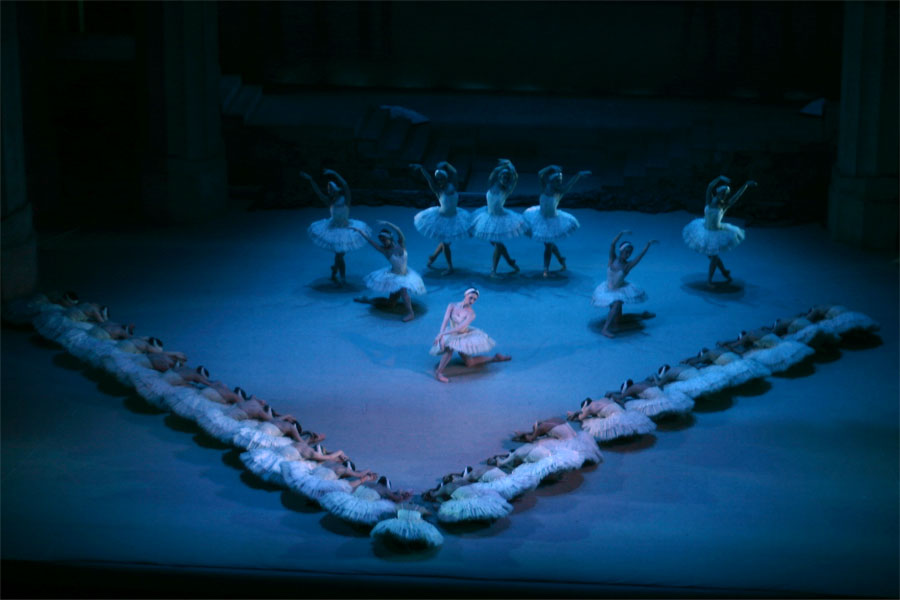 Swan LakeBallet · 1877Same lineage · video
 The NutcrackerBallet · 1892Same lineage · video
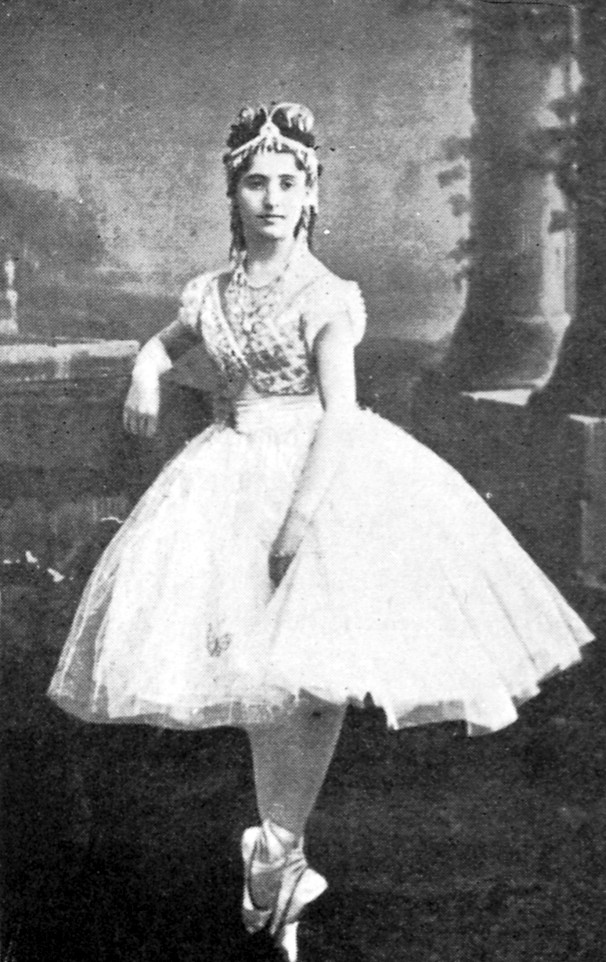 CoppéliaBallet · 1870Same lineage · video
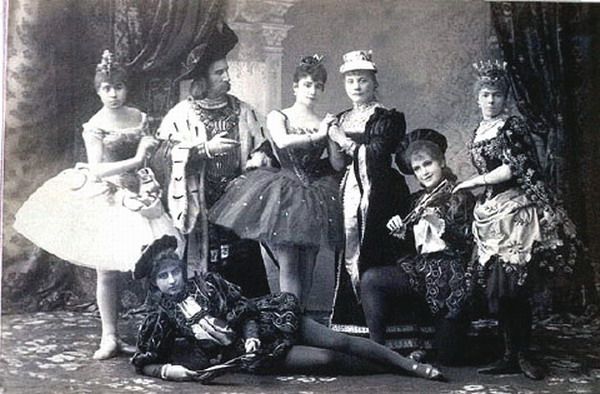 The Sleeping BeautyBallet · 1890Same lineage · video
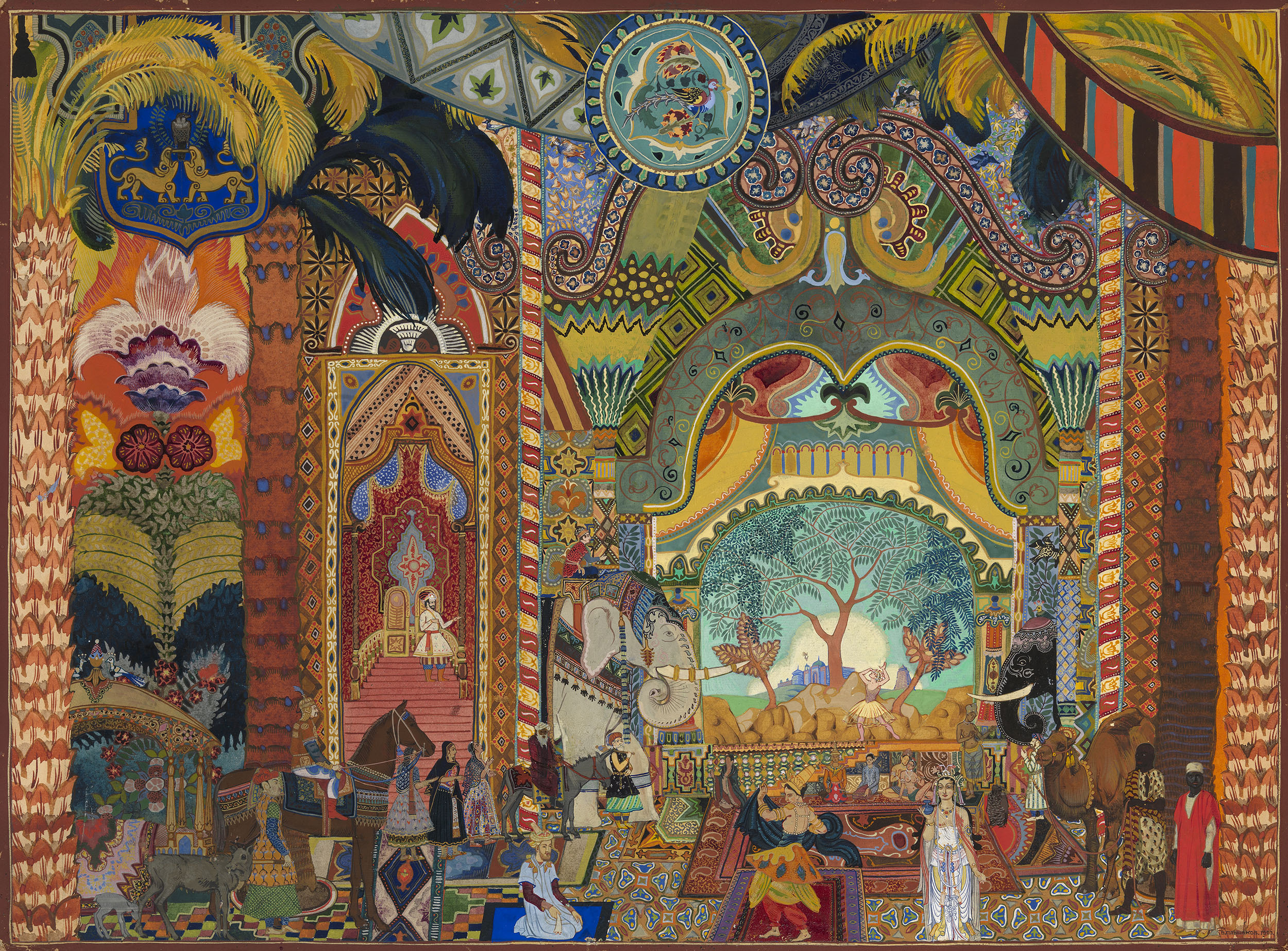 The FirebirdBallet · 1910Same lineage · video
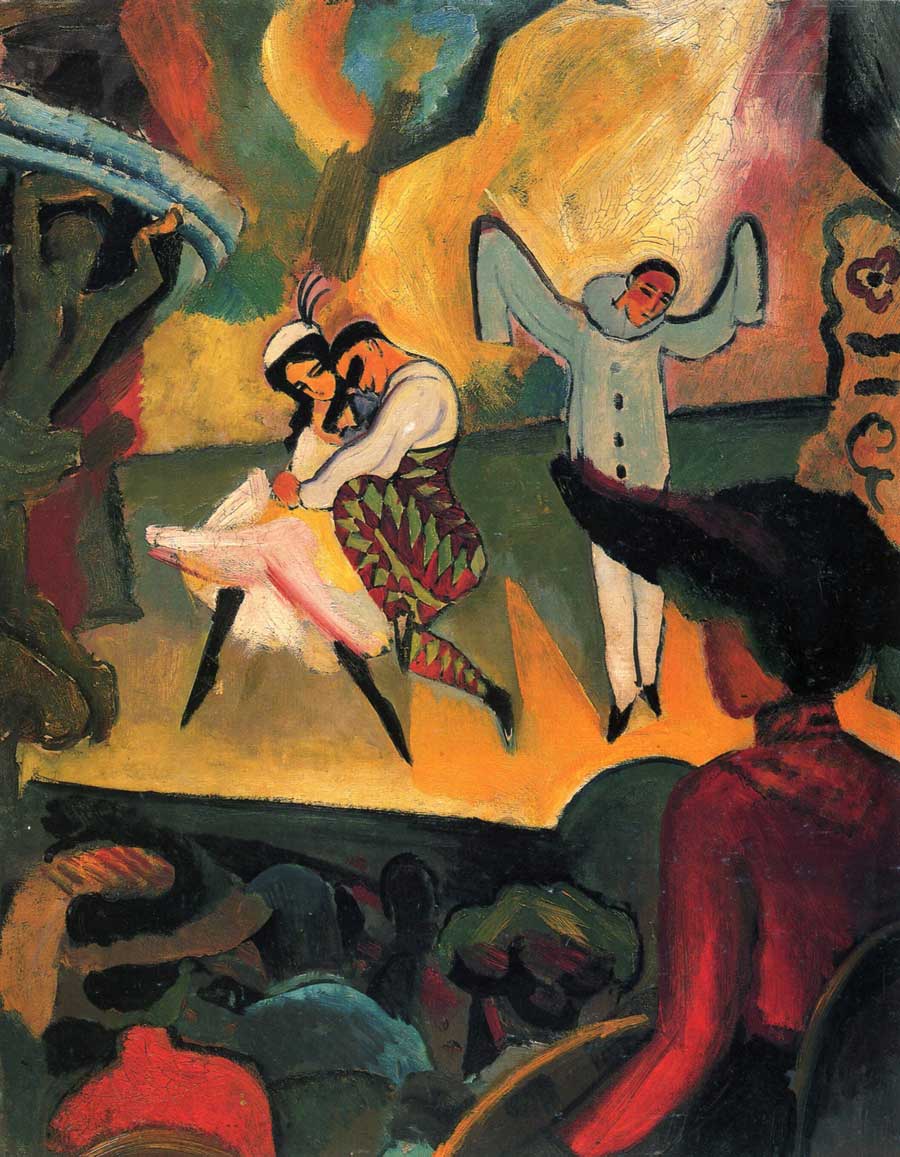 PetrushkaBallet · 1911Same lineage · video
 Raymonda VariationsBallet · 1961Same lineage · video
 Stars and StripesBallet · 1958Same lineage · video