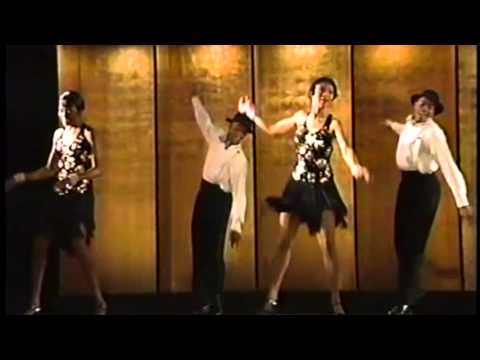
Black and Blue (1989)
Choreography by Dianne Walker, Fayard Nicholas, Frankie Manning, Henry LeTang
Black and Blue is a musical revue built around songs by W. C. Handy, Louis Armstrong, Duke Ellington, Fats Waller, Eubie Blake and others, framed as a celebration of black music and dance in Paris between the two world wars. It began at the Théâtre du Châtelet in Paris in 1985 and reached Broadway's Minskoff Theatre in January 1989, running for 829 performances under the direction of its conceivers Hector Orezzoli and Claudio Segovia.
What it contains
- Rhythm Tap (Hoofing) · Throughout the revue, in the featured tap solos and exchanges — The cast is built around individual rhythm-tap (hoofing) artists whose vocabulary is improvised, musically responsive footwork developed as soloists, not massed chorus steps. Source: "Jimmy Slyde, Bill Easley, Buster Brown (tap dancer), Jimmy "Preacher" Robbins, Lon Chaney (the jazz tap dancer, not the actor) and Bunny Briggs"
- Vernacular Jazz · The revue as a whole, in its recreation of interwar black social and stage dance — The show restages the vernacular jazz dance culture of black Paris and Harlem between the wars, the milieu its songs and skits are drawn from. Source: "Black and Blue is a musical revue celebrating the black culture of dance and music in Paris between World War I and World War II."
- Lindy Hop · The number built around the song 'Stompin' at the Savoy' — A Savoy Ballroom-titled number choreographed under Frankie Manning's credit points to swing partner-dance vocabulary rather than solo tap, though no steps are described. Source: "The score included "St. Louis Blues," "I Can't Give You Anything But Love," "In a Sentimental Mood," "Am I Blue?," "Stompin' at the Savoy," and the title tune."
What is danced
The choreography credits (Henry LeTang, Cholly Atkins, Frankie Manning and Fayard Nicholas on the article's account, with Dianne Walker named as curator and sustainer of the choreography and a featured dancer herself) sit alongside a cast built substantially from tap specialists rather than chorus dancers trained in a single unified style. The article names Jimmy Slyde, Buster Brown, Lon Chaney and Bunny Briggs alongside a young Savion Glover — all rhythm-tap (hoofing) performers whose art is improvised, musically driven footwork rather than the drilled, uniform steps of a Broadway kickline. This makes rhythm tap the show's dominant vocabulary: numbers were vehicles for individual tap voices to solo and trade steps in the manner of a jazz jam session, a structure distinct from book-musical dance-as-plot-device.
Beyond tap, the piece draws on the wider black vernacular jazz dance of the interwar period the revue claims to memorialise — the article frames the whole show as 'celebrating the black culture of dance and music' of that era, and the score's inclusion of 'Stompin' at the Savoy' alongside Frankie Manning's choreographic credit points toward a Lindy Hop or swing-inflected number, since Manning was one of the Savoy Ballroom's own Lindy Hop dancers (this last connection is my own inference from Manning's known career, not stated in the article itself, and the article gives no description of the number's actual steps).
Because the source is a plot/production summary rather than a scene-by-scene programme or libretto, it does not describe blocking, holds, or specific step sequences for any number — it names performers and songs, not choreography in technical detail. A dancer researching this work would need to go to reviews, the original cast recording notes, or the 1993 Altman television film for that level of detail.
Context
By 1989, tap's Broadway visibility had been rebuilt through shows like Bring Back Birdie, No, No, Nanette revivals and especially Sophisticated Ladies (1981) and this revue's own line of descent from LeTang and the surviving hoofers of the 1930s–40s. Black and Blue was part of a wave of shows recovering and re-presenting the generation of tap and vernacular jazz dancers — Slyde, Briggs, Buster Brown, the Nicholas Brothers' Fayard, Frankie Manning — who had originated their art in the Harlem and Savoy Ballroom scenes the show's songs evoke, at a moment when many of them were being rediscovered by a younger tap revival (Glover among them) rather than retired.
Staging history
The production originated at the Théâtre du Châtelet in Paris in 1985 with Sandra Reaves-Phillips in the cast, predating the Broadway mounting on our record by four years. After the Broadway run closed in January 1991, Mel Howard toured it through Europe (Paris again, Hamburg, Berlin, Munich, Amsterdam), and a television version directed by Robert Altman was taped at the Minskoff and broadcast on PBS's Great Performances in 1993, later sold as pay-per-view in Japan. LaVern Baker made her Broadway debut mid-run, in 1990, replacing Ruth Brown.
How to watch it
Watch for the difference between staged production numbers and the tap solos and trade-offs given to Slyde, Briggs, Buster Brown and Glover, where the vocabulary is improvisatory hoofing keyed to the live band rather than set choreography. The Altman television version is the most accessible way to see the actual dancing referenced here, since the stage run itself is undocumented in step-by-step detail in the source material.
In the same lineage
Other staged works in the register connected to this one by author or lineage.


