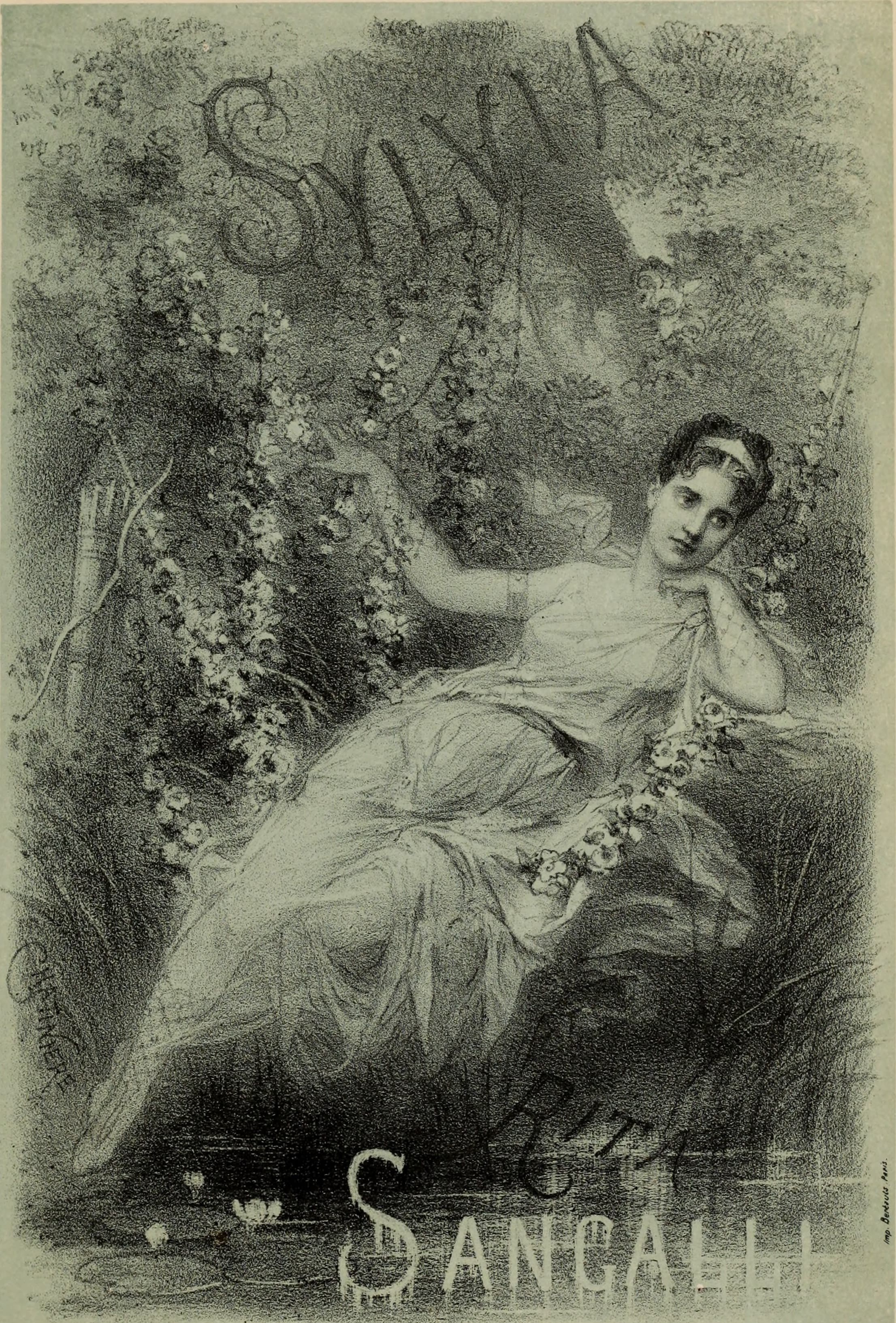
Delibes, Léo, 1836-1891, composer; Barbier, Jules, 1825-1901, librettist — https://www.flickr.com/photos/internetarchivebookimages/14585145288/ Source book page: https://archive.org/stream/sylviaoulanymphe00deli2/sylviaoulanymphe00deli2#page/n10/mode/1up · No restrictions
Sylvia, ou la nymphe de Diane, is a full-length classical ballet made for the Paris Opera, with music by Léo Delibes and original choreography by Louis Mérante, premiered at the newly opened Palais Garnier on 14 June 1876. Its libretto, adapted by Jules Barbier and Baron de Reinach from Tasso's pastoral play Aminta, sets a chaste huntress-nymph, a lovestruck shepherd, a predatory hunter and the gods Eros and Diana against a mythological Arcadia; Mérante's own choreography did not survive its initial run, and the ballet was a commercial failure for its first seven productions.
What it contains
- Classical Ballet · the whole ballet, across all three acts — a full-length narrative work built on classical mime, corps de ballet ensembles, character divertissements and set pas de deux, staged by the Paris Opera's own maître de ballet Source: "Sylvia, originally Sylvia, ou La nymphe de Diane, is a full-length classical ballet in two or three acts"
- Contemporary Ballet · Frederick Ashton's 1952 Royal Ballet choreography, now the basis of almost all modern stagings — blending of mime and dance with intricate footwork on a classical base, described as modernized without becoming either pastiche or fully modern in idiom Source: "Sir Frederick Ashton created quite contemporary choreography for his 1952 production at the Royal Opera House, while retaining a classic feel, it has been modernized."
- Balanchine Method · Sylvia Pas de Deux, New York City Ballet, 1950 (excerpted concert piece, separate from the full-length stagings) — a stand-alone concert pas de deux extracted and choreographed independently of the full-length narrative productions Source: "the New York City Ballet premiered Sylvia Pas de Deux, choreography by George Balanchine"
What is danced
The article gives little detail on what Mérante's 1876 steps actually looked like beyond the fact that they were praised by contemporary critics and then lost; what survives as choreographic record is Frederick Ashton's 1952 version for the Royal Ballet, built around Margot Fonteyn, which the article describes as blending mime and dance with 'more intricate footwork' while keeping a classical vocabulary rather than lapsing into either pastiche or overt modernism. Ashton's version is reported to contain a demanding pas de deux in Act III described as the ballet's choreographic climax, and the role is described as requiring the same unusually wide dance range Fonteyn possessed.
Context
Sylvia arrived at a pivotal moment for the Paris Opera - it was the first ballet staged at the newly built Palais Garnier - and for ballet music generally: Delibes's score, with its extensive leitmotifs and prominent brass, winds and (unusually for the period) alto saxophone, was singled out by Tchaikovsky as the first ballet score where the music itself, not the choreography or spectacle, carried the primary interest, a judgment he made explicitly in comparing it favourably to his own Swan Lake. Despite this, the ballet's choreographic side struggled from the start and repeatedly failed commercially until Ashton's 1952 reworking gave it a lasting stage life; the intervening decades saw the ballet largely survive only as extracted numbers, notably in Anna Pavlova's touring repertoire.
Staging history
After the unsuccessful 1876 original and a failed, heavily compromised 1901-02 Mariinsky staging (choreographed first by Lev Ivanov, completed after his death by Pavel Gerdt, with a young Agrippina Vaganova among the corps), the ballet survived mainly in excerpted form until Ashton's full 1952 Royal Ballet production for Fonteyn secured its place in the repertoire; that production was revived in 1963 after a lapse requiring substantial reconstruction, and later reconstructed again by Christopher Newton for the Royal Ballet (2004) and American Ballet Theatre (2005, in a shortened two-act version). Mark Morris made a rare non-Ashton staging for San Francisco Ballet in 2004, working directly from the original 1876 score and libretto rather than from Ashton's choreography, and Stanton Welch made a further new three-act version for Houston Ballet and the Australian Ballet in 2019; Balanchine separately made a concert Sylvia Pas de Deux for New York City Ballet in 1950 and later interpolated music from the score into his Coppélia.
How to watch it
Watch the Act III pas de deux as the choreographic centre of gravity in the Ashton version, and listen for the famous pizzicato variation, traditionally danced in a halting, hesitant rhythm not actually written into Delibes's score. Because almost every modern staging (Royal Ballet, ABT) descends from Ashton's reconstructed 1952 choreography rather than Mérante's lost original, comparing those to Mark Morris's 2004 San Francisco Ballet version - deliberately built back from the 1876 score and libretto - shows two different answers to the same missing original.
Structure
- Act I · Pas des chasseressesSylvia arrives with her band of huntresses; the number includes an entrée and a slow waltz.
- Act II · Danse des ÉthiopiensA character dance within the scene at Orion's cave.
- Act III · Danse barcarolleA barcarolle-rhythm number near the Temple of Diana, scored with heavy use of winds and brass including alto saxophone.
- Act III · Divertissement (Pizzicato, Pas des esclaves, Galop générale)A suite of set variations including the famous pizzicato variation created for Rita Sangalli, a slaves' dance, and a closing general galop.
Structure read from an encyclopaedia article, not from a libretto or score we hold. Confirm against a programme before treating the numbering as authoritative.
Credits
- composer: Léo Delibes
Related works
Other staged works in the register connected to this one by author or lineage.
 Les Deux PigeonsBallet · 1886Mérante · video
 Les PatineursBallet · 1937Ashton · video
 Symphonic VariationsBallet · 1946Ashton · video
 Marguerite and ArmandBallet · 1963Ashton · video
 OndineBallet · 1958Ashton · video
 A Month in the CountryBallet · 1976Ashton · video
 FaçadeBallet · 1931Ashton · video
 Moon WaterBallet · 1998Same lineage · video