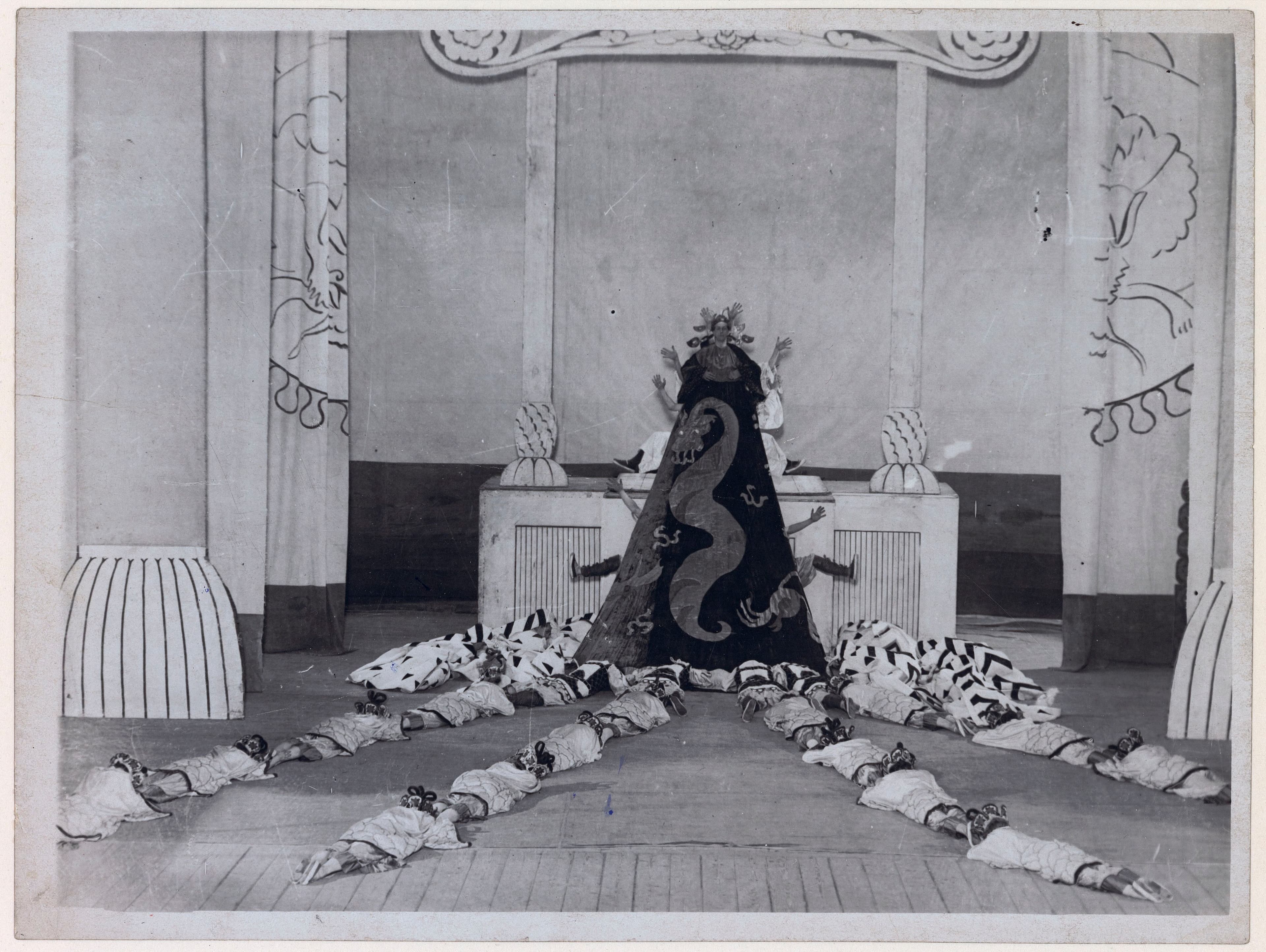
Henri Manuel · Public domain
Le chant du rossignol as danced is George Balanchine's 1925 staging, for Diaghilev's Ballets Russes, of a symphonic poem Stravinsky had extracted in 1917 from the last two acts of his opera The Nightingale (after Andersen's fairy tale). Stravinsky had already resisted a first choreographic version — Léonide Massine's 1920 production with Matisse designs — believing the piece belonged in the concert hall; when Massine was unavailable for the 1925 revival, Diaghilev handed it instead to a young student named Balanchine.
Its place in the catalogue rests less on an established performance tradition than on origin: this was the work on which Stravinsky and Balanchine first worked together, the beginning of what became the most consequential composer-choreographer partnership in twentieth-century ballet. The article treats it primarily as a musical object with two contested stage lives attached to it, one of which (Balanchine's) is what our record preserves.
What is danced
The article does not describe Balanchine's actual choreography — no positions, holds, partnering, or step vocabulary for the 1925 production survive in the source. What it gives instead is a plot synopsis keyed to the music: a Nightingale (danced, per the article, in place of the singing role of the opera) performs for the Emperor of China in music that is 'chromatic and swooping ... free and natural, like the song of a bird'; a mechanical nightingale is then given as a gift, its music 'short and clear, without the smooth runs of the real Nightingale' and closer to 'an automaton'; the Emperor falls ill and is visited by Death, from whom the real Nightingale's return persuades a reprieve; the ballet closes with the Nightingale leaving the court again for the wild.
That musical contrast — fluid, chromatic material for the living bird against clipped, mechanical material for its artificial double — is the clearest structural handle the article offers a choreographer or historian: it implies (though does not state) two contrasted movement idioms within the same work, one lyrical and one automaton-like, mapped onto the ballet's central theme of nature versus artifice. Beyond this the source is silent on the movement itself, so no vocabulary, technique, or named set piece can be responsibly attributed to Balanchine's staging from this article alone.
Context
The 1925 revival sits inside Diaghilev's Ballets Russes at a moment of transition: Massine, the company's leading choreographer through the 1910s, had fallen through for this commission, and Diaghilev turned to Balanchine, then newly arrived among his dancers. The piece is explicitly framed by the article as the site where Stravinsky and Balanchine first met and where their working relationship began, alongside a simultaneous cooling between Diaghilev and Stravinsky as each wanted directorial control. The earlier 1920 Massine version, designed by Matisse, belongs to an earlier phase of the same company's engagement with Stravinsky scores turned into stageworks against the composer's own preference for the concert hall.
Staging history
The symphonic poem was premiered as a concert work on December 6, 1919 in Geneva under Ernest Ansermet. Its first stage life came on February 2, 1920 at the Théâtre National de l'Opéra in Paris, choreographed by Léonide Massine with designs by Henri Matisse, a production Stravinsky himself regarded as unnecessary. The version credited in our record followed in 1925, when Diaghilev commissioned George Balanchine — chosen after Massine's involvement lapsed — to make a new choreography for the Ballets Russes; the article does not name a specific premiere date, venue, or cast for this revival.
How to watch it
Attend to the score's own contrast between the living Nightingale's music — chromatic, swooping, birdlike — and the mechanical nightingale's stiffer, automaton-like material, since the article frames this as the piece's central dramatic opposition; a staging that honours it should visibly differentiate the two figures' movement quality even though no specific steps are recorded here. Because Stravinsky wrote the piece for concert performance and only reluctantly agreed to its being staged, it is worth watching for how far any given production leans toward illustrative narrative versus abstract, musically-driven movement.
Structure
- Scene 1The Nightingale sings/dances for the Emperor of China, who is pleased; the music is described as chromatic and swooping, birdlike.
- Scene 2The Emperor of Japan's gift of a mechanical nightingale mesmerizes the court, and the real Nightingale flies away; the music here is short, clear, and automaton-like.
- Scene 3The Emperor, ill and confronted by Death, is saved when the real Nightingale returns and persuades Death to relent.
- Scene 4The courtiers find the Emperor recovered, but the Nightingale departs once more for the wild.
Structure read from an encyclopaedia article, not from a libretto or score we hold. Confirm against a programme before treating the numbering as authoritative.
Credits
- composer: Igor Stravinsky
More from George Balanchine
Other staged works in the register connected to this one by author or lineage.
 CoppéliaBallet · 1870Balanchine · video
 ApolloBallet · 1928Balanchine · video
 AgonBallet · 1957Balanchine · video
 The Prodigal SonBallet · 1929Balanchine · video
 The Seven Deadly SinsBallet · 1933Balanchine · video
 Circus PolkaBallet · 1942Balanchine · video
 The Boys from SyracuseMusical theatre · 1938Balanchine · video
- Requiem CanticlesRequiem CanticlesBallet · 1968Balanchine