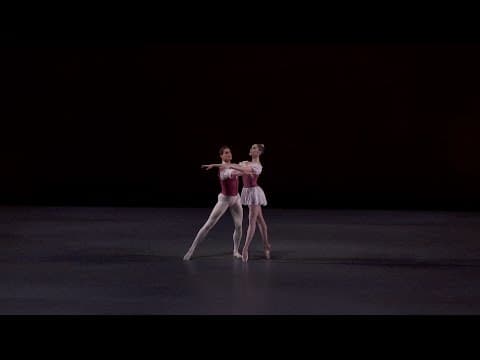
Brandenburg is a plotless, large-cast neoclassical ballet Jerome Robbins made for New York City Ballet in the mid-1990s, set to the third Brandenburg Concerto in full plus single movements drawn from Concertos Nos. 1, 2 and 6. It premiered on January 22, 1997, danced by twenty dancers including two principal couples and a corps de ballet of sixteen, and holds a particular place in the catalogue because it turned out to be Robbins' final completed ballet before his death in 1998.
What it contains
- Neoclassical Ballet · The whole ballet — Plotless ensemble choreography alternating principal duets with large corps formations, built from what Teachout describes as Robbins' recurring 'signature moves' within a classically structured framework. Source: "Brandenburg is a neoclassical ballet choreographed by Jerome Robbins to compositions by Johann Sebastian Bach."
What is danced
The article describes an ensemble structure built from alternation: duets for the two principal pairs set against large group formations for the rest of the cast, with 'intricate' patterns and 'lightning-fast transformations' that two separate critics (Kisselgoff and Jowitt) independently likened to a kaleidoscope. The opening is described by biographer Greg Lawrence as 'a festive folk dance,' from which the piece moves into the alternating duet/ensemble pattern; the costumes reinforce this with dancers dressed in 'peasant attire.' Terry Teachout frames the piece as a 'large-scale ensemble piece structured along classical lines' with no individualized characters, built from 'Robbins-style' signature moves that recur across his output.
Context
Robbins had first used Bach for The Goldberg Variations in 1971 and did not return to the composer until near the end of his life, when three of his last four ballets - this one, A Suite of Dances, and 2 and 3 Part Inventions - were set to Bach. Made in declining health (heart surgery, emerging Parkinson's symptoms, balance problems from a fall), Brandenburg was developed slowly over roughly two years, workshopped repeatedly in front of different viewers, and finished only under pressure from NYCB director Peter Martins. Critics at the time read it as a late synthesis of Robbins' own vocabulary, explicitly echoing Dances at a Gathering, The Goldberg Variations, Glass Pieces, Fanfare, Interplay and Fancy Free.
Staging history
The article covers only the creation and premiere: Robbins began the piece as a pas de deux for Lourdes Lopez and Nikolaj Hübbe, then expanded it by adding a second principal pair, Wendy Whelan and Peter Boal, and the corps de ballet. It premiered at the New York State Theater on George Balanchine's birthday, as part of what became an annual birthday tribute series, and was funded through NYCB's New Combination Fund. No later revivals or stagings by other companies are described in the source.
How to watch it
Watch the shifting balance between the two principal duets and the sixteen-dancer corps: the piece is built on rapid recombination of small and large groupings rather than narrative or character contrast, which is why critics reached for the kaleidoscope image. The folk-tinged opening and peasant-style costuming set a communal, festive tone before the piece moves into denser, faster ensemble patterning that several writers link back to earlier Robbins ensemble works like Dances at a Gathering and Glass Pieces.
Credits
- composer: Johann Sebastian Bach
More from Jerome Robbins
Other staged works in the register connected to this one by author or lineage.
 West Side StoryMusical theatre · 1957Robbins · video
 Fancy FreeBallet · 1944Robbins · video
- DybbukDybbukBallet · 1974Robbins
 The ConcertBallet · 1956Robbins · video
 Antique EpigraphsBallet · 1984Robbins · video
 A Suite of DancesBallet · 1994Robbins · video
- ÉlégieÉlégieBallet · 1948Same lineage
 Danses concertantesBallet · 1944Same lineage · video