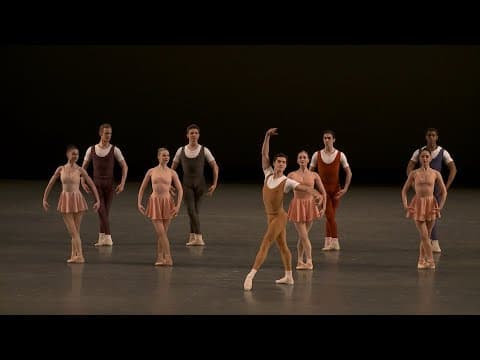
The Goldberg Variations is a plotless, full-length ballet Jerome Robbins made for New York City Ballet, set to the entirety of Bach's Goldberg Variations, including repeats concert pianists often cut, which stretches the piece to roughly ninety minutes. It premiered on May 27, 1971 at the New York State Theater, following a deliberate change of direction for Robbins after the Chopin-scored Dances at a Gathering: he wanted a score that gave him, in his words, no easy 'finger ledge to climb.'
What it contains
- Neoclassical Ballet · The whole ballet, across the Theme and both parts of the variations — A plotless work built entirely from Bach's own musical divisions — solos scaling up through sextets and full-group numbers, without narrative, in the musical-visualization mode typical of plotless NYCB ballets of this period. Source: "A plotless ballet, it starts with two performers dancing to the Theme, followed by the variations divided into two parts, with variations repeated as Bach had intended in the score."
- Classical Ballet — Part II · Part II, in the later variations as costumes are built up — Costuming shifts toward tutus and jackets as Part II progresses, marking the point where the piece's classical ballet vocabulary and formality become most explicit, per Jowitt's description of the section as 'formal, classical and mature.' Source: "and later tutus and jackets."
What is danced
The article gives the ballet's architecture rather than its step vocabulary. It opens with two dancers performing the Theme in Baroque costume, then moves into Part I, built from solos, duets, trios, quartets, quintets, sextets and larger group numbers danced in jewel-toned practice clothes and described by Deborah Jowitt as 'more playful and experimental.' Part II is described as 'more formal, classical and mature,' with costumes accumulating piece by piece across the variations — shirts for the men, breeches and short skirts for the women, and eventually tutus and jackets — until a final variation brings both casts together in full period dress. The ballet closes as it began, with the original couple returning in leotards to repeat the Theme, framing the whole structure.
Beyond this costume-and-ensemble scaffolding, the source does not specify steps, holds or technique, and Robbins is quoted stressing that the difficulty of the piece was not the size of the cast but that all thirty variations sit in the same key and are 'formally all alike' — a compositional problem he says forced him toward 'endlessly rich' variety of interpretation rather than a fixed vocabulary. Arlene Croce's contemporary review, calling the result 'endless ingenious musical visualizations' rather than 'a theatrical experience,' points to a piece organized around close musical mirroring of Bach's variation structure rather than narrative or thematic movement motifs.
Context
The ballet was made in 1970–71 at New York City Ballet during the company's era of large-scale plotless, score-driven works, the tradition most associated with Balanchine and one Robbins was working directly against and within: he sought a score that offered no 'easy finger ledge,' choosing Bach over the romantic Chopin he had just used for Dances at a Gathering because he found the Goldberg Variations 'very big and architectural.' The choreography took a full year, was interrupted by a snapped Achilles tendon (Robbins reportedly choreographed part of the work from a wheelchair) and by a hospitalization for hepatitis, and was first shown incomplete as an open rehearsal at Saratoga Springs on July 4, 1970 before its formal premiere the following spring.
Staging history
After its 1971 New York City Ballet premiere, with Gordon Boelzner at the piano, the article records that the Paris Opera Ballet also staged the work. Robbins was undecided between harpsichord and piano until late in the process — a harpsichord was used at the Saratoga Springs open rehearsal, but he settled on piano for theatrical volume. Allegra Kent had been set to appear in an all-female quartet that was cut before completion, and Violette Verdy worked on the ballet but never performed it.
How to watch it
Watch the costuming as the real structural marker: practice clothes and jewel tones in Part I give way to progressively fuller period dress in Part II, climaxing when both casts appear together in full Baroque costume, before the opening couple returns in plain leotards to close the frame. Because Robbins kept every musical repeat, the same material is often revisited by different groupings of dancers — solo through sextet — so the interest lies in how each repeat is redistributed among bodies rather than in a changing step vocabulary.
Structure
- ThemeTwo dancers in Baroque costumes dance the opening Theme.
- Part IVariations for solos, duets, trios and larger groupings in jewel-tone practice clothes, described as playful and experimental.
- Part IIFurther variations, formal and classical in character, with costumes progressively built up from shirts and breeches toward tutus and jackets.
- Final variationDancers from both parts appear together in full period costume.
- Theme (reprise)The original couple returns in leotards and repeats the Theme to close the ballet.
Structure read from an encyclopaedia article, not from a libretto or score we hold. Confirm against a programme before treating the numbering as authoritative.
Credits
- composer: Johann Sebastian Bach
More from Jerome Robbins
Other staged works in the register connected to this one by author or lineage.
 West Side StoryMusical theatre · 1957Robbins · video
 Fancy FreeBallet · 1944Robbins · video
- DybbukDybbukBallet · 1974Robbins
 The ConcertBallet · 1956Robbins · video
 Antique EpigraphsBallet · 1984Robbins · video
 A Suite of DancesBallet · 1994Robbins · video
 The SeasonsBallet · 1899Same lineage
 Arabian NightsBallet · 1979Same lineage · video