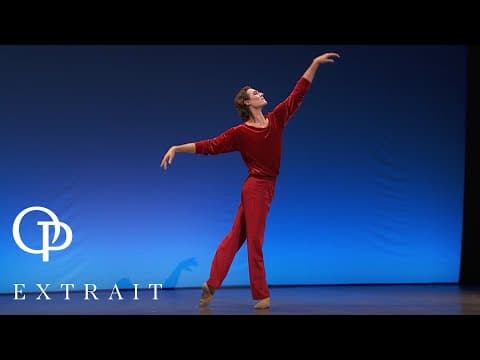
A Suite of Dances is a solo ballet Jerome Robbins made for Mikhail Baryshnikov, set to four movements drawn from Bach's unaccompanied Cello Suites and played live on stage by a cellist. It premiered on March 3, 1994 at the New York State Theater, given by Baryshnikov's own touring company, the White Oak Dance Project, with Wendy Sutter on cello.
What is danced
The article does not describe the choreography's steps, shapes or technique in any detail — it gives only the music, the fact that it is a sixteen-minute solo, and a history of who has since danced it. What can be said with confidence from the text: it is built as a single unbroken vehicle for one dancer against a solo cello, structured across four contrasting Bach movements (a Prelude, a Sarabande, a Gigue and a second Prelude), and it was made specifically around Baryshnikov's late-career instrument rather than for a corps or a narrative frame. Robbins composed it discontinuously — 'most of the choreography was made without Baryshnikov's presence' — over roughly two years while both men were traveling, which is itself a fact about the work's making rather than its vocabulary.
Because every dancer named as having taken the role since — Baryshnikov, Nicolas Le Riche, Carlos Acosta, Herman Cornejo — is a classical/neoclassical-trained ballet dancer performing it as a self-contained recital piece, it is reasonable to assume the vocabulary sits within a ballet idiom suited to a mature, virtuoso soloist rather than a corps showpiece. The article itself, however, gives no line of movement description to confirm this, so no style code is being attached on that basis alone.
Context
By 1994 Robbins was in his late career at New York City Ballet and had spent decades moving between narrative ballet, musical theatre and abstract, music-driven concert works; a solo built entirely around a single mature dancer and unaccompanied Bach cello sits with that late interest in intimate, stripped-down vehicles rather than large ensemble spectacle. The piece was made outside NYCB's own machinery, for Baryshnikov's smaller touring company, before entering the repertories of NYCB and the Paris Opera Ballet — a route that reflects how a major choreographer's smaller, dancer-specific works could migrate into big-company repertory once proven.
Staging history
The work premiered with the White Oak Dance Project on March 3, 1994, and Baryshnikov performed it again two months later as a guest artist at New York City Ballet, still with Sutter on cello. It entered Paris Opera Ballet's repertory, and NYCB's own dancers took it up for the first time in 1997. Since then it has typically been reserved for an experienced soloist: Nicolas Le Riche danced it at a 1999 Paris Opera Ballet gala eight months after Robbins's death and again at NYCB's 2008 Jerome Robbins Celebration, Carlos Acosta performed it in his 2009 solo program, and Herman Cornejo danced it at the 2018 Vail Dance Festival. Paris Opera Ballet released a filmed performance during the COVID-19 pandemic as part of a Tribute to Jerome Robbins program, and Vail released an excerpt of Cornejo's performance online.
How to watch it
Watch for how the choreography answers the cellist live on stage rather than a recording, and for the way it is shaped around one dancer's individual qualities at a particular stage of a career — it was built on and around Baryshnikov in his forties, and later interpreters bring their own maturity to the same four Bach movements rather than reproducing a fixed 'ideal' body. There is no corps, set, or narrative to read; the interest is in the single dancer's phrasing against the Prelude, Sarabande and Gigue.
Credits
- composer: Johann Sebastian Bach
More from Jerome Robbins
Other staged works in the register connected to this one by author or lineage.
 West Side StoryMusical theatre · 1957Robbins · video
 Fancy FreeBallet · 1944Robbins · video
- DybbukDybbukBallet · 1974Robbins
 The ConcertBallet · 1956Robbins · video
 Antique EpigraphsBallet · 1984Robbins · video
- AndantinoAndantinoBallet · 1981Robbins
- In Memory Of ...In Memory Of ...Ballet · 1985Robbins
 BrandenburgBallet · 1997Robbins · video