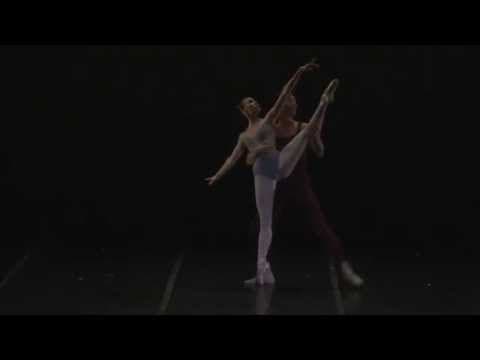
Liturgy is a short ballet made by Christopher Wheeldon, then resident choreographer of New York City Ballet, set to Arvo Pärt's Fratres. It premiered on May 31, 2003 at the New York State Theater, Lincoln Center, with Jock Soto and Wendy Whelan as the originating couple. Wendy Whelan, one of the two dancers it was made on, described it as "a piece about union."
What is danced
The article gives almost no technical description of the choreography itself: it names the composer, the premiere details, the two originating dancers, and Whelan's own characterisation of the piece as being 'about union.' Beyond confirming that it was made on a single couple (Soto and Whelan) and later danced by another couple (Kowroski and Angle) for the 2017 recording, the source does not describe steps, partnering shapes, or vocabulary, so nothing about the actual movement can be responsibly extracted from it. From general knowledge of Wheeldon's output at this period and of Fratres as a score (frequently used for extended, searching pas de deux built on off-balance lifts and sustained adagio partnering), one would expect Liturgy to be a duet of this kind — but this is recall, not something the article states, and is flagged accordingly rather than asserted as fact.
Context
The piece dates from Wheeldon's tenure as New York City Ballet's resident choreographer in the early 2000s, a period in which he was becoming known for extending the company's Balanchine-descended vocabulary into more overtly contemporary, emotionally legible pas de deux work; this is context drawn from general knowledge of the choreographer's career rather than from the article, which supplies only the bare production facts.
Staging history
The article records only one specific later staging note: in response to the COVID-19 pandemic's effect on live performance, New York City Ballet released a recording of the ballet featuring Maria Kowroski and Jared Angle, filmed in 2017. No other revivals, casts, or companies are mentioned.
How to watch it
Given the source material, a viewer should attend to the pairing itself — the piece was built around one specific partnership (Soto and Whelan) and later re-set on another (Kowroski and Angle) — and to how the choreography answers Pärt's Fratres, a score built on repeating, slowly intensifying string figures. Beyond that, the convention at work (classical partnering versus something looser) is not something the article establishes.
Credits
- composer: Arvo Pärt
More from Christopher Wheeldon
Other staged works in the register connected to this one by author or lineage.
 Alice's Adventures in WonderlandBallet · 2011Wheeldon · video
 The Winter's TaleBallet · 2014Wheeldon · video
 An American in ParisBallet · 2005Wheeldon · video
 Like Water for ChocolateBallet · 2022Wheeldon · video
 PolyphoniaBallet · 2001Wheeldon · video
 After the RainBallet · 2005Wheeldon · video
 Within the Golden HourBallet · 2008Wheeldon · video
 Five Movements, Three RepeatsBallet · 2012Wheeldon · video