Unknown authorUnknown author — This image is available from the United States Library of Congress's Prints and Photographs division under the digital ID fsa.8e07916.This tag does not indicate the copyright status of the attached work. A normal copyright tag is still required. See Commons:Licensing. · Public domain
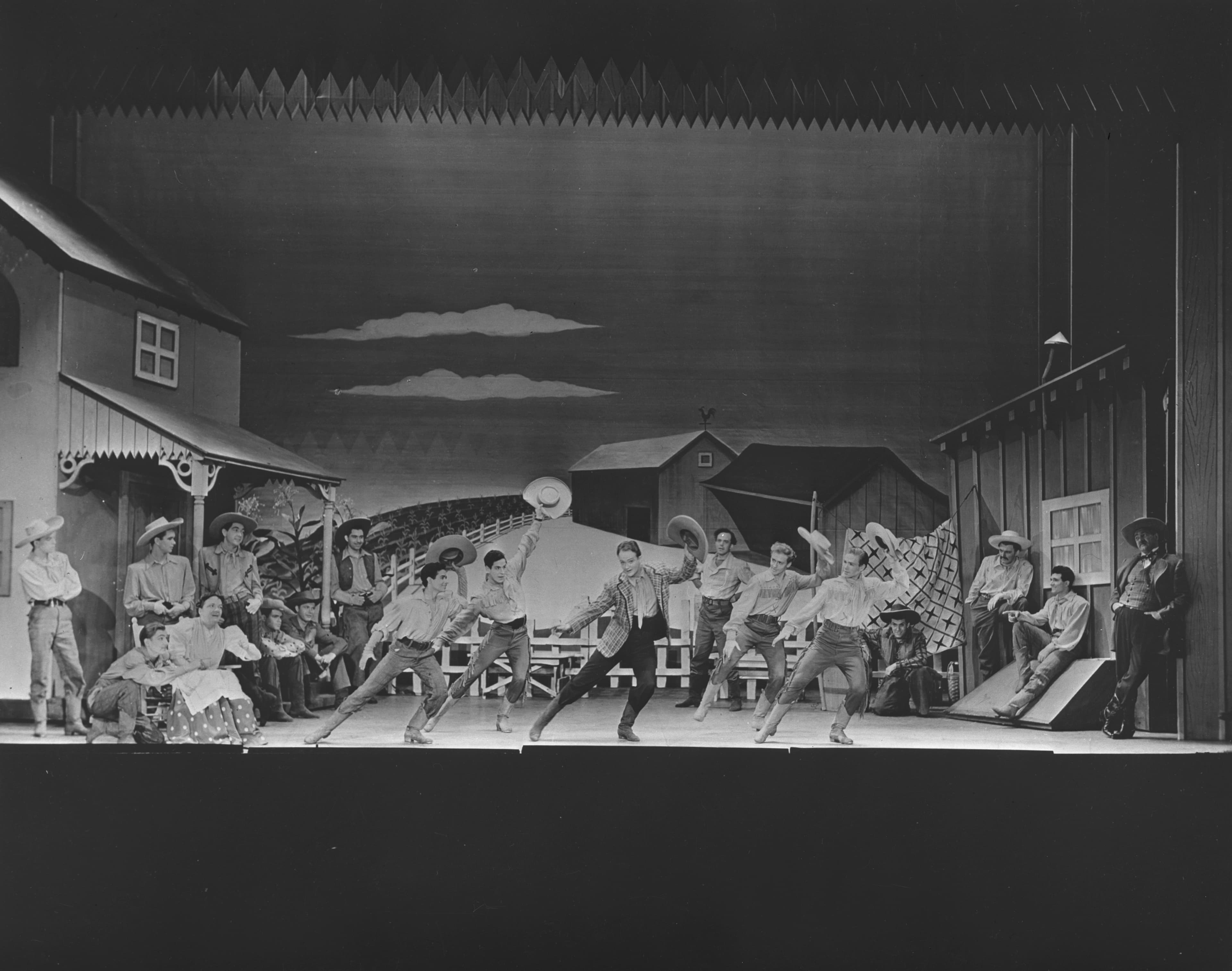
Oklahoma! (1943) is the first Rodgers and Hammerstein musical, adapted from Lynn Riggs's 1931 play Green Grow the Lilacs and set among farmers and cowmen in Oklahoma Territory in 1906. It is catalogued here principally for its choreography: Agnes de Mille, working on her first Broadway musical, built a fifteen-minute first-act ballet sequence (the 'dream ballet') and a set of story-driven dance numbers that Broadway had not previously staged in this form.
What it contains
- Dream Ballet — Dream Ballet (Out of My Dreams) · Act I, closing dream-ballet sequence — An extended ballet sequence, danced by cast members separate from the singing principals (Dream Curly, Dream Laurey, Dream Jud, plus the dancing role of Aggie), depicting Laurey's dream of marriage curdling into a nightmare in which Jud kills Curly. Source: "a 15-minute first-act ballet finale (often referred to as the dream ballet) depicting Laurey's struggle to evaluate her suitors, Jud and Curly."
- Musical Theatre Character Dance · Throughout the show, across the individual dance numbers de Mille built into the score — Dance was built to advance character and plot rather than stand apart as specialty numbers; critics of the day identified specific danced sequences, including 'Out of My Dreams' and 'All Er Nuthin'', as the choreographic high points rather than the songs themselves. Source: "The "Out of My Dreams" and "All Er Nuthin'" dances are such supreme aesthetic delights."
What is danced
The article's clearest dance evidence is the Act I dream ballet: an 'extended ballet sequence' in which Laurey, drugged by a laudanum 'magic potion', dreams first of marriage to Curly and then watches the dream curdle into nightmare as Jud appears and kills him. Crucially, the original production cast this sequence with dedicated dancers distinct from the singing principals — Marc Platt as Dream Curly, Katharine Sergava as Dream Laurey, George Church (later Vladimir Kostenko) as Dream Jud, and Bambi Linn in the small dancing role of Aggie — confirming that this was a discrete, technically demanding ballet interlude rather than mimed stage business.
Context
Oklahoma! arrived at a moment when Broadway musicals, per the article, were built around 'big production numbers, novelty acts, and show-stopping specialty dances' that halted the story rather than advancing it. De Mille's contribution — dance folded into character and plot, following on from the integrated-song model Rodgers and Hammerstein were building — was singled out by contemporary critics as 'actually the biggest hit of the show,' and the production is credited by historians quoted in the article with helping usher in the 'Golden Age' of American musical theatre, in which dance became a vehicle for dramatic and psychological content rather than diversion.
Staging history
Agnes de Mille's original choreography was restaged for the 1951 and 1953 Theatre Guild revivals (with de Mille and director Rouben Mamoulian returning), and it was subsequently 'recreated' or 'adapted' by her associate Gemze de Lappe for the 1979 Broadway revival, the 1980 West End revival, and the 1982 Australian tour, indicating the choreography was treated as a preservable, transmissible text in its own right. Later productions departed from it deliberately: Susan Stroman created an entirely new Dream Ballet and redesigned several numbers for the dark-themed 1998 National Theatre production (transferring to Broadway in 2002), while the 2019 Daniel Fish revival, choreographed by John Heginbotham, recast the dream ballet and the character of Jud within a starkly reconceived, in-the-round staging.
How to watch it
Watch for the split between the singing principals and the silent 'Dream' dancers in the Act I ballet — the doubling of Curly, Laurey and Jud with dedicated dance performers is the clearest sign that the sequence is functioning as dance rather than blocking. Compare stagings against the de Mille original where possible: later choreographers (Stroman, Heginbotham) rewrote the dream ballet outright rather than simply restaging it, so the vocabulary and tone of that number vary sharply between productions even when the songs and book do not.
Structure
- Act I · Oh, What a Beautiful Mornin'Curly visits Laurey's farmyard on a beautiful morning; they tease each other while Aunt Eller looks on.
- Act I · Dream Ballet (Out of My Dreams)Drugged by a laudanum potion, Laurey dreams of marrying Curly; the dream turns nightmarish as Jud appears and kills him, danced by separate 'Dream' performers rather than the principal actors.
- Act II · The Farmer and the CowmanAt the box social, a square dance escalates into fighting between farmers and cowboys over fences and water rights until Aunt Eller fires a gun to stop it.
- Act II · OklahomaLaurey and Curly's wedding and the territory's statehood celebration, disrupted by Jud's drunken return and fatal fight with Curly.
Structure read from an encyclopaedia article, not from a libretto or score we hold. Confirm against a programme before treating the numbering as authoritative.
On screen
- Oklahoma! (1955)
More from Agnes de Mille
Other staged works in the register connected to this one by author or lineage.