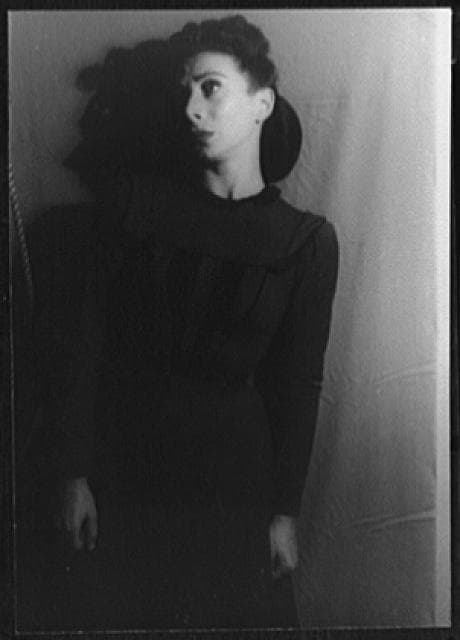
Carl Van Vechten — Library of Congress Catalog: http://lccn.loc.gov/2004663120 Image download: http://cdn.loc.gov/service/pnp/van/5a52000/5a52200/5a52211r.jpg Original url: https://www.loc.gov/pictures/item/2004663120/ · Public domain
Fall River Legend is a narrative ballet by Agnes de Mille, set to an original score by Morton Gould, dramatizing the Lizzie Borden murder case in 1892-93 Massachusetts. It departs from the historical record by having its central figure, called "The Accused," convicted rather than acquitted — a change de Mille and Gould settled on together because Gould felt he could not write convincing acquittal music.
What it contains
- Classical Ballet · The pas de deux between The Accused and the Pastor — A partnered duet form (pas de deux) built to echo an earlier pas de deux between the Mother and Father characters, using musical repetition to link the two couples choreographically. Source: "In one affectionate pas de deux, the Pastor and the Accused dance together, with the music echoing that of a previous dance between the Mother and Father characters."
- Dream Ballet · The dream sequence early in the ballet — A younger double of the heroine dances with her mother while the adult heroine watches, a dream-ballet convention used to dramatize memory and interior state outside of literal narrative time. Source: "Early in the ballet, a younger version of "The Accused" dances in a dream sequence with her mother, while the adult version of the character looks on."
What is danced
The article gives little technical detail about steps or vocabulary, but it does point to two identifiable set pieces. The first is a dream sequence early in the ballet in which a younger version of The Accused dances with her mother while the adult Accused watches from the side — a device de Mille used to compress backstory and establish psychological state without dialogue, the same technique she was known for in stage-work of this period. The second is a pas de deux between The Accused and the Pastor, described as "affectionate," whose music deliberately echoes an earlier dance between the Mother and Father characters — a structural rhyme meant to be felt by the audience through the choreography's musical memory rather than spelled out.
Context
The article situates the work's origin in the wake of de Mille's 1942 ballet Rodeo, and notes it was commissioned by American Ballet Theatre for its 1948 season at the Metropolitan Opera House. De Mille's practice of building ballets around dramatic character and narrative causality, rather than pure abstract classicism, is named directly in the article as typical of her output ("Like the majority of de Mille's ballets, Fall River Legend is deeply character driven"), and this work is called her masterpiece by later scholars.
Staging history
The article records a 1957 television broadcast on Omnibus with Nora Kaye as The Accused, a 1989 Dance Theatre of Harlem production (commercially released on video) starring Virginia Johnson, and American Ballet Theatre revivals in 1999 and 2007, the latter featuring Julie Kent and Gillian Murphy in the role. It does not describe how the choreography itself has changed across these stagings, only who danced them.
How to watch it
Watch for the dream sequence's doubling of the heroine at two ages, used to externalize memory and guilt without dialogue, and for the musical rhyme de Mille and Gould build between the Mother/Father pas de deux and the later Pastor/Accused pas de deux. De Mille avoided depicting the murders themselves on stage, believing stage violence "nearly always silly," so the drama is carried through gesture and structural repetition rather than literal enactment.
Credits
- composer: Morton Gould
More from Agnes de Mille
Other staged works in the register connected to this one by author or lineage.
 Oklahoma!Musical theatre · 1943Mille · video
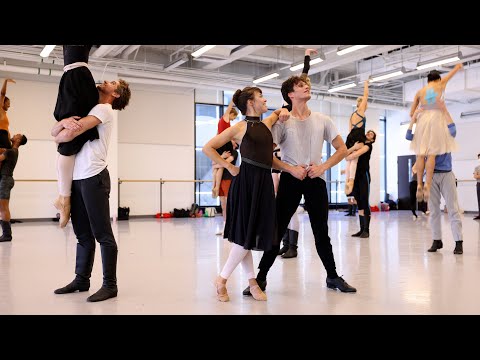 RodeoBallet · 1942Mille · video
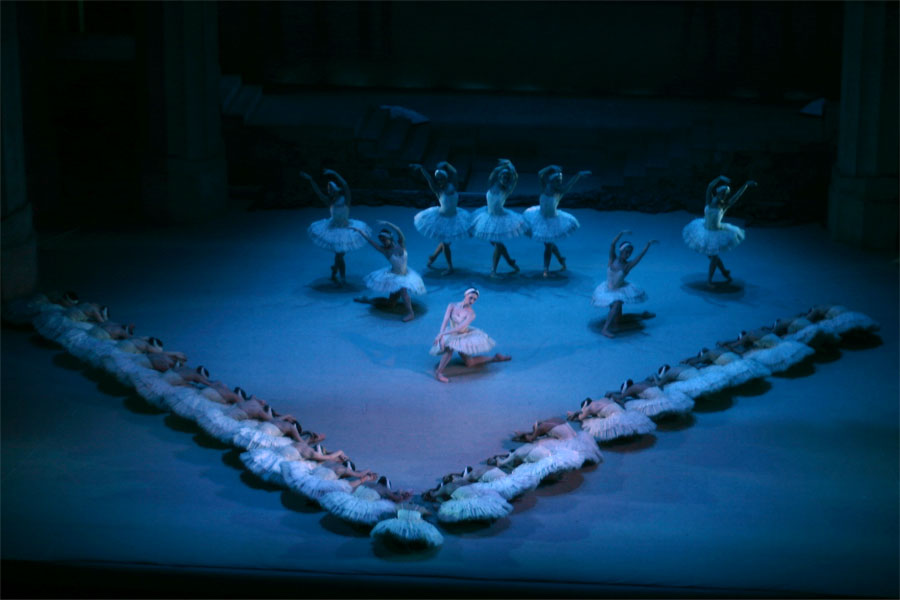 Swan LakeBallet · 1877Same lineage · video
 The NutcrackerBallet · 1892Same lineage · video
 West Side StoryMusical theatre · 1957Same lineage · video
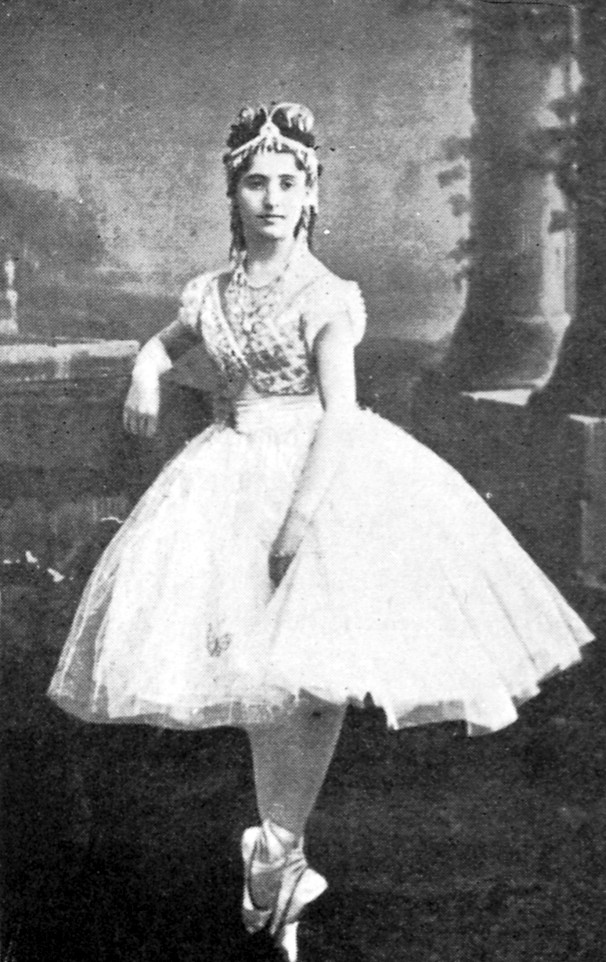 CoppéliaBallet · 1870Same lineage · video
 Stars and StripesBallet · 1958Same lineage · video
 The Green TableBallet · 1932Same lineage · video