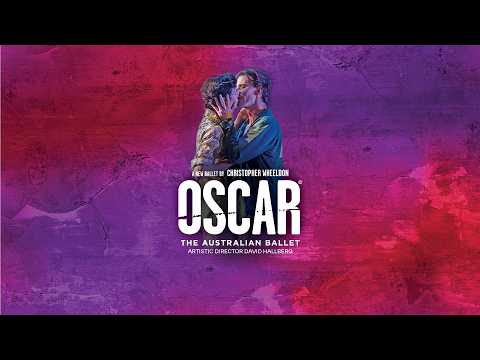
Oscar is a two-act narrative ballet by Christopher Wheeldon, set to a score by Joby Talbot, tracing the life and downfall of Oscar Wilde with particular focus on his imprisonment in Reading Gaol. The ballet interweaves biographical scenes — Wilde's family life, his London social circle, his relationships with Robbie Ross and Lord Alfred Douglas, his trial and conviction — with staged versions of two of his own fictions, The Nightingale and the Rose and The Picture of Dorian Gray, using the latter's Faustian bargain as a structural mirror for Wilde's own unravelling.
What it contains
- Classical Ballet · Act 2, centred on the Wilde–Douglas relationship — A named pas de deux for Wilde and Lord Alfred Douglas, praised as a major romantic partnering set-piece within the ballet's classical duet structure. Source: "the pas de deux between Oscar Wilde and Lord Alfred Douglas "deserves to take its place in the pantheon of great romantic balletic pairings""
What is danced
The article is written almost entirely as literary synopsis rather than choreographic description, so the concrete dance evidence it yields is limited. The one piece of vocabulary the source confirms directly is a pas de deux for Wilde and Lord Alfred Douglas, which reviewer Jane Howard singled out as belonging "in the pantheon of great romantic balletic pairings" — indicating a major duet built around the two men's relationship, staged with enough emotional and physical weight to be read as a landmark same-sex romantic pas de deux within the classical repertoire.
Beyond that, the synopsis implies a layered structure a choreographer would need to solve: courtroom scenes, a domestic picnic, London social-circle scenes, a fairy-tale-within-the-ballet (The Nightingale and the Rose), a second embedded narrative (Dorian Gray) that must visually track its hero's corruption against an unchanging portrait, and prison scenes depicting hard labour and physical deterioration. None of this is described in terms of steps, positions, or technique in the source, so no further vocabulary claims can be responsibly attached beyond the confirmed pas de deux.
Context
The article frames Oscar as a milestone for its commissioning company rather than for ballet at large: it is described as "the first full-length ballet commissioned by the Australian Ballet's artistic director David Hallberg" and "the first full-length narrative ballet commissioned by the Australian Ballet in 20 years," marking a return to large-scale story-ballet commissioning after a long gap in that company's programming.
How to watch it
Watch how the production handles the doubling of Wilde's real decline against Dorian Gray's fictional one — the choreography is asked to make two parallel corruption arcs legible at once, one in a prison cell and one in a portrait. Pay particular attention to the central pas de deux between Wilde and Douglas, which reviewers treated as the emotional and technical centre of the piece.
Structure
- Act PrologueWilde is prosecuted under the Criminal Law Amendment Act 1885, his private life scrutinised in court.
- Act IIn his cell, Wilde recalls a family picnic and reads his children The Nightingale and the Rose, which unfolds alongside scenes of his London social life and his growing relationship with Robbie Ross.
- Act IIBroken by hard labour, Wilde recalls The Picture of Dorian Gray and his relationship with Lord Alfred Douglas, whose father's denunciation leads to Wilde's conviction, paralleled against Dorian's own collapse.
- Act EpilogueReleased from prison and collected by Robbie Ross, Wilde dies a few years later at 46, his reputation destroyed but his writing enduring.
Structure read from an encyclopaedia article, not from a libretto or score we hold. Confirm against a programme before treating the numbering as authoritative.
Credits
- composer: Joby Talbot
More from Christopher Wheeldon
Other staged works in the register connected to this one by author or lineage.
 Alice's Adventures in WonderlandBallet · 2011Wheeldon · video
 The Winter's TaleBallet · 2014Wheeldon · video
 An American in ParisBallet · 2005Wheeldon · video
 Like Water for ChocolateBallet · 2022Wheeldon · video
 PolyphoniaBallet · 2001Wheeldon · video
 After the RainBallet · 2005Wheeldon · video
 ZenobiaBallet · 1936Same lineage · video
 Les RendezvousBallet · 1933Same lineage · video