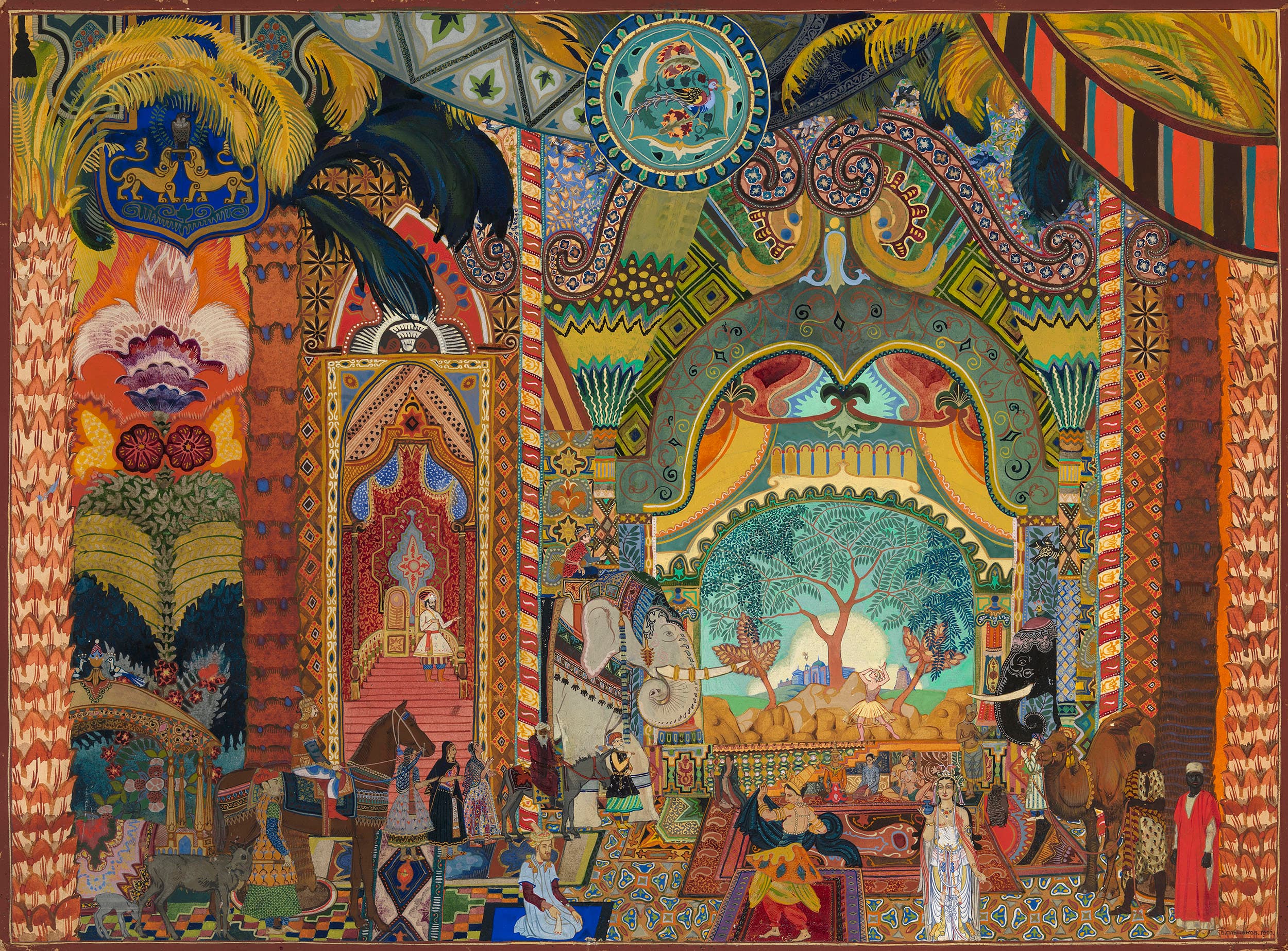
PLESHAKOV, VLADIMIR (1891-1942) — http://macdougallauction.com/Indexx0613.asp?id=501&lx=a · Public domain
The Firebird is Igor Stravinsky's first ballet score, written for Sergei Diaghilev's Ballets Russes and choreographed by Michel Fokine to a scenario he developed with Alexandre Benois and others, drawn from Russian fairy tales of the Firebird and the immortal sorcerer Koschei. It premiered at the Palais Garnier (Opéra de Paris) on 25 June 1910 with Tamara Karsavina as the Firebird, and its success launched both Stravinsky's international career and the Diaghilev–Stravinsky partnership that went on to produce Petrushka and The Rite of Spring.
What it contains
- Classical Ballet · The Firebird's own appearances throughout the ballet (capture, supplication, lullaby), as distinct from Koschei's court and the princesses — danced with exaggerated classical steps and deep bending at the waist, built to be 'powerful, hard to manage, and rebellious' rather than conventionally graceful Source: "The titular Firebird danced classically, Koschei and his subjects in a more violent and grotesque manner, and the Princesses in a looser, gentler way."
What is danced
The article gives Fokine's stated choreographic scheme character by character: the Firebird herself danced in a heightened classical idiom, described as 'powerful, hard to manage, and rebellious' rather than conventionally graceful, with 'exaggerated classical steps' and 'deep bending at the waist' — a deliberate departure from the era's decorative ballerina roles, since the Firebird represents a magical force rather than a person. Koschei and his subjects moved 'in a more violent and grotesque manner', most famously in the Infernal Dance, where the enchanted Firebird sets the whole court dancing but, as the article stresses, each figure or group dances differently — a scene the critic Alastair Macaulay is quoted as calling 'the most complex choreography that had ever been attempted in ballet' up to that point. The captive princesses, by contrast, moved 'in a looser, gentler way', including a catching game with golden apples and a slow khorovod (a Russian round dance) danced with Prince Ivan, set to a folk melody Rimsky-Korsakov had also used.
The article also notes that critics praised the ballet's 'natural miming', pointing to a pantomime layer running alongside the set dances (Ivan's capture of the Firebird, his bargaining with her, the destruction of Koschei's egg). Because Stravinsky built the score around leitmotifs ('leit-harmony') tied to specific characters and the mortal/supernatural divide, the choreography and mime were built to track very closely with musical cues — Robert Craft is quoted calling the result 'as literal as opera' in its 'mimetic specificity', a trait Stravinsky himself later said he regretted. Dancers approaching Fokine's original therefore need a vocabulary split across three registers within one work — extended, off-centre classical line for the Firebird, grotesque/character movement for Koschei's court, and soft, folk-inflected pantomime for the princesses and Ivan — rather than a single uniform technique.
Context
The ballet was made for the Ballets Russes' pivotal 1910 Paris season, at a moment when Fokine was consciously reacting against what he saw as the 'conventional system of gesticulation' of academic ballet, pushing instead toward continuous dramatic illusion, close music-dance integration, and expressive, naturalistic movement — ideas already tested in his Les Sylphides and The Dying Swan. The Firebird was the first time this reform programme was matched to a large-scale, purpose-composed Russian score, and the article credits it with establishing a genuinely new type of female lead: a title role built as an abstract, non-human force rather than a princess, swan or lover, danced with hard, angular classical steps rather than lyrical grace.
Staging history
The original Fokine production, with designs by Alexandre Golovin, ran in Paris through July 1910 and reached London in 1912; the Ballets Russes revived it in 1926 with new Natalia Goncharova designs, still using Fokine's choreography, and that version was itself revived by Ballets Russes de Monte Carlo in 1935 and 1940. Several companies (Berlin State Opera, Royal Swedish Ballet, Royal Danish Ballet, Croatian National Theatre) mounted their own productions between 1927 and 1933, and later stagings that kept Fokine's steps include Adolph Bolm's 1945 Ballet Theatre production and Serge Lifar's 1954 Paris Opera Ballet version. The 1954 Sadler's Wells staging by Serge Grigoriev and Lubov Tchernicheva, coached partly by Karsavina herself and danced by Margot Fonteyn, is singled out as one of the most authentic revivals and was filmed in 1959. New choreography using Stravinsky's music followed from mid-century onward — George Balanchine's 1949 New York City Ballet version (with Marc Chagall designs, Maria Tallchief, later revised with Jerome Robbins), Maurice Béjart's 1971 all-male, revolution-themed staging, John Neumeier's 1970 science-fiction version, and further new productions by John Cranko (1964), Glen Tetley (1981), John Taras (1982, Caribbean-set), Christopher Wheeldon (1999), Krzysztof Pastor (1999) and Alexei Ratmansky (2012).
How to watch it
Watch for the contrast Fokine built into the cast: the Firebird's hyper-extended, deep-bending classical line against Koschei's grotesque, distorted court movement and the princesses' soft, pantomimic ease — three vocabularies deliberately kept unlike one another within a single work. In the Infernal Dance, listen for how the ensemble is made to dance out of step with itself under the Firebird's spell rather than in unison, and note where mime (Ivan's capture of the bird, the tossing and crushing of Koschei's egg) carries the plot rather than steps.
Structure
- Introduction – Koschei's Enchanted Garden – Dance of the FirebirdThe Firebird enters pursued by Prince Ivan and is captured; she begs to be released and, freed, leaves him a feather.
- The Princesses' Game with Golden ApplesThirteen enchanted princesses held captive by Koschei play a catching game in the garden.
- The Princesses' KhorovodIvan and the youngest princess, with whom he has fallen in love, perform a slow khorovod (Russian round dance) set to a folk melody.
- Infernal Dance of all Koschei's SubjectsKoschei confronts Ivan; the Firebird enchants Koschei and his subjects, who dance in a frenzy that winds down as they collapse exhausted.
- LullabyThe Firebird sings Koschei and his court to sleep so Ivan can find and destroy the egg holding Koschei's soul.
- FinaleIvan crushes the egg, killing Koschei; his enemies and captives are freed and celebrate as dawn breaks.
Structure read from an encyclopaedia article, not from a libretto or score we hold. Confirm against a programme before treating the numbering as authoritative.
Credits
- composer: Igor Stravinsky
Related works
Other staged works in the register connected to this one by author or lineage.
 PetrushkaBallet · 1911Fokine · video
 Les SylphidesBallet · 1908Fokine · video
 Le Spectre de la RoseBalletFokine · video
 The Dying SwanBallet · 1905Fokine · video
 JosephslegendeBallet · 1914Fokine
 Le Dieu bleuBallet · 1912Fokine
 Danses concertantesBallet · 1944Music by Stravinsky · video
 The CageBallet · 1951Music by Stravinsky · video