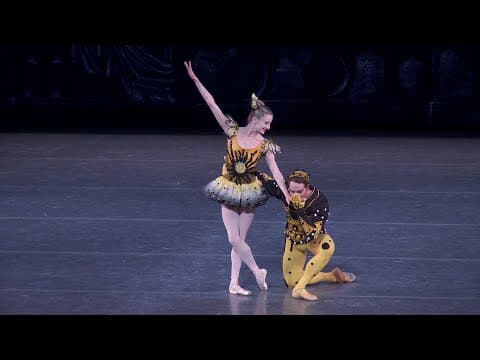
Danses concertantes is a title shared by many stage works, all set to Igor Stravinsky's 1941–42 chamber-orchestra score of the same name, commissioned by conductor Werner Janssen. The record in this catalogue credits George Balanchine, who made two distinct ballets to the score for two different companies: a 1944 version for the Ballet Russe de Monte-Carlo and a substantially re-choreographed 1972 version for New York City Ballet's Stravinsky Festival, both designed by Eugene Berman.
What it contains
- Classical Ballet — Pas de trois sequence · 1944 premiere for the Ballet Russe de Monte-Carlo, framed by opening and closing parades — Company parades open and close the piece; between them come several rhythmically quirky pas de trois for soloists and a demanding academic pas de deux for the principal couple, plus a fourth-variation trio. Source: ""Between them," one observer wrote, "came several rhythmically quirky pas de trois for company soloists and a demanding pas de deux for Danilova and Franklin."
- Neoclassical Ballet · 1972 New York City Ballet remounting for the Stravinsky Festival — Almost entirely new steps replacing the 1944 choreography, but kept within the same academic, plotless, formally patterned idiom, structured again around parades, a pas de trois sequence and a pas de deux. Source: "The choreography was, however, largely different from the original, although it was similar in its neoclassical style."
What is danced
The 1944 version is built as a suite framed by two company parades, with a run of 'rhythmically quirky' pas de trois for soloists, a technically demanding pas de deux made for Alexandra Danilova and Frederic Franklin, and a fourth variation danced by Maria Tallchief, Nicholas Magallanes and Mary Ellen Moylan. Contemporary critics disagreed sharply about what this amounted to: John Martin called it 'a clever, somewhat mathematical job of choreography, almost totally devoid of dancing,' while Edwin Denby praised its 'joyousness' — a split that itself tells you something about the piece's dry, formally patterned wit rather than expressive dancing.
The 1972 remounting kept the same architecture (opening and closing parades, a pas de trois sequence, a pas de deux) but Balanchine largely rewrote the steps; only the fourth variation retained the structure of the 1944 original. The article explicitly calls this later choreography 'similar in its neoclassical style' to the first, which is the clearest style marker the source gives: academic pas de deux and pas de trois vocabulary treated with rhythmic angularity and structural cleverness rather than dramatic incident. A 1989 NYCB performance with Darci Kistler and Robert LaFosse is preserved on video at the New York Public Library.
Context
Balanchine made the 1944 version as his first new work at the start of a two-year appointment as choreographer to the Ballet Russe de Monte-Carlo, immediately after working on the operetta Song of Norway — a moment when he was moving between commercial and classical ballet stages in the United States. The 1972 remaking was one of many scores revisited for New York City Ballet's Stravinsky Festival, a large-scale institutional tribute that prompted Balanchine to re-examine his own earlier Stravinsky ballets rather than simply revive them.
Staging history
Balanchine's own two versions bookend a much wider history: the article documents separate, unrelated choreographies to the same Stravinsky score by Kenneth MacMillan (Sadler's Wells Theatre Ballet, 1955), Lew Christensen (San Francisco Ballet, 1959), Job Sanders (Nederlands Dans Theater, 1964), Todd Bolender (Cologne Ballet, 1964), Félix Blaska (Ballet-Théâtre Contemporaine, 1968), Leonid Yakobson (Choreographic Miniatures, Leningrad, 1971), John Taras (Deutsche Oper Berlin, 1971), Fernand Nault (Les Grands Ballets Canadiens, 1972), Leslie White (Queensland Ballet, 1978, retitled A Little of What You Fancy), Nils Christe (Scapino Ballet, early 1990s), Giuseppi Urbani (Compagnia Artedanza, 1987), Michael Corder (Hong Kong Ballet, 1993; restaged Boston Ballet, 2000) and Mark Baldwin (Cisne Negro, 1998). None of these other stagings belong to the choreographic lineage recorded here under Balanchine, but they establish that the title functions almost as a shared commission across twentieth-century ballet, not a single fixed work.
How to watch it
Watch for the framing device of the opening and closing parades, which mark the piece as a formal suite rather than a narrative ballet, and for how the pas de trois passages are handled with rhythmic irregularity rather than smooth classical phrasing. In the 1972 version, compare the fourth variation — the one passage Balanchine kept structurally close to 1944 — against the surrounding, newly invented choreography to see what he changed and what he preserved.
Structure
- Opening and closing paradesThe 1944 ballet begins and ends with a company parade framing the suite of dances.
- Pas de trois sequenceBetween the parades, company soloists dance several rhythmically quirky pas de trois.
- Pas de deux (Danilova and Franklin)A demanding pas de deux was created for the principal couple, Alexandra Danilova and Frederic Franklin.
- Fourth variationThe fourth variation was danced by Maria Tallchief, Nicholas Magallanes and Mary Ellen Moylan.
Structure read from an encyclopaedia article, not from a libretto or score we hold. Confirm against a programme before treating the numbering as authoritative.
Credits
- composer: Igor Stravinsky
More from George Balanchine
Other staged works in the register connected to this one by author or lineage.
 CoppéliaBallet · 1870Balanchine · video
 ApolloBallet · 1928Balanchine · video
 AgonBallet · 1957Balanchine · video
 Le chant du rossignolBallet · 1920Balanchine · video
 The Prodigal SonBallet · 1929Balanchine · video
 The Seven Deadly SinsBallet · 1933Balanchine · video
 The SeasonsBallet · 1899Same lineage
 Union JackBallet · 1976Balanchine · video