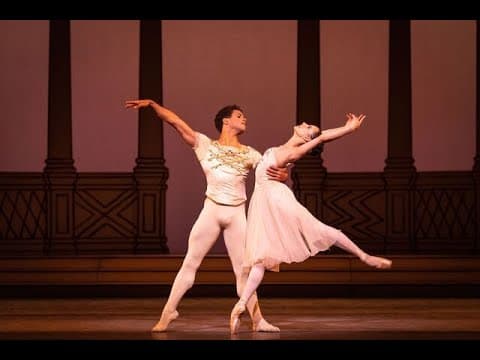
Rhapsody (1980)
Rhapsody is a one-act ballet made by Frederick Ashton to Rachmaninoff's Rhapsody on a Theme of Paganini, created for two overlapping occasions: the 80th birthday of Queen Elizabeth the Queen Mother and a guest engagement by Mikhail Baryshnikov with the Royal Ballet. It received its premiere on 4 August 1980 at the Royal Opera House, with Baryshnikov and Lesley Collier as the principal couple, and is dedicated to the Queen Mother.
What it contains
- Classical Ballet · The ensemble sections danced by the corps de ballet — A corps de ballet of six men and six women dances material distinct from the principal couple's, described as the ensemble having its own dances within the classical structure. Source: "The ballet is danced by a principal couple and a corps de ballet of six men and six women."
What is danced
The ballet is built around a principal couple set against a corps de ballet of six men and six women, all described in the article as younger company members. The male lead, made for Baryshnikov, is written in what the article calls a 'virtuosic Russian ballet style,' and some critics read the role as an embodiment of the solo violin line in Rachmaninoff's score. The female lead, danced by Collier, is described as being in the 'British ballet style' by contrast, and she does not appear until the ballet is half over. Ashton himself framed the piece as an exercise in classicism rather than narrative: he said he wanted to develop his classicism 'to enrich and fit in with the repertory of a classical company,' working from nineteenth-century classical technique rather than a story.
The two principals mostly dance separately rather than in sustained partnership, and the article notes that their shared moments together have been compared to Fred Astaire and Ginger Rogers, suggesting a ballroom-inflected duet quality within the classical vocabulary rather than a conventional grand pas de deux structure. The corps is not merely decorative: the article specifies that 'the ensemble also has its own dances,' separate from the leads' material. Ashton worked non-chronologically because Baryshnikov could not arrive until after choreography had begun, building the ballet's structure first and fitting the leads' material around each dancer as they became available, including working around Collier's knee injury.
Context
Rhapsody was made in 1980, late in Ashton's career, for a company (the Royal Ballet) whose classical style he had spent decades shaping. The commission arose from two coincidental pressures — a royal birthday gala and a high-profile guest appearance by a Kirov-trained star who, per the article, would only perform with the company if Ashton created something new for him rather than casting him in an existing classical role. Ashton had first set choreography to this same Rachmaninoff score in 1953, for the film The Story of Three Loves, a project he said he 'hates'; Rhapsody let him return to music that had stayed with him for nearly three decades under very different circumstances.
Staging history
The original sets, devised by Ashton himself from eighteenth-century arches, and costumes by William Chappell, were replaced in 1995 by new designs from Patrick Caulfield, then redesigned again in 2005 by Jessica Curtis; the original Ashton/Chappell designs were reinstated in 2016. Beyond the Royal Ballet, the article records that the Paris Opera Ballet mounted the work in 1996, and that Sarasota Ballet and K-Ballet have also performed it.
How to watch it
Watch for the stylistic split between the two leads: the male role is pitched toward bravura Russian-style virtuosity, while the female role, entering only midway through, sits in the more understated British classical idiom that Ashton built the Royal Ballet's identity around. The corps of twelve dances its own material independently of the principals rather than simply framing them, and the couple's shared passages are worth watching for a ballroom-partnership quality rather than a conventional adagio pas de deux.
Credits
- composer: Sergei Rachmaninoff
More from Sergei Rachmaninoff
Other staged works in the register connected to this one by author or lineage.
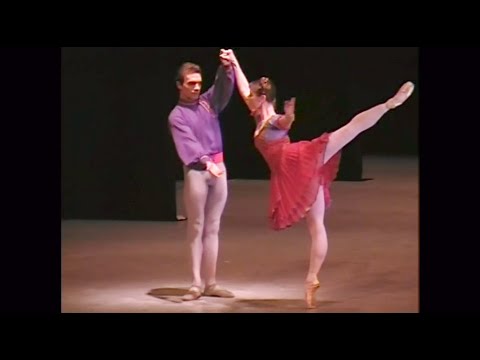 ZakouskiBallet · 1992Music by Rachmaninoff · video
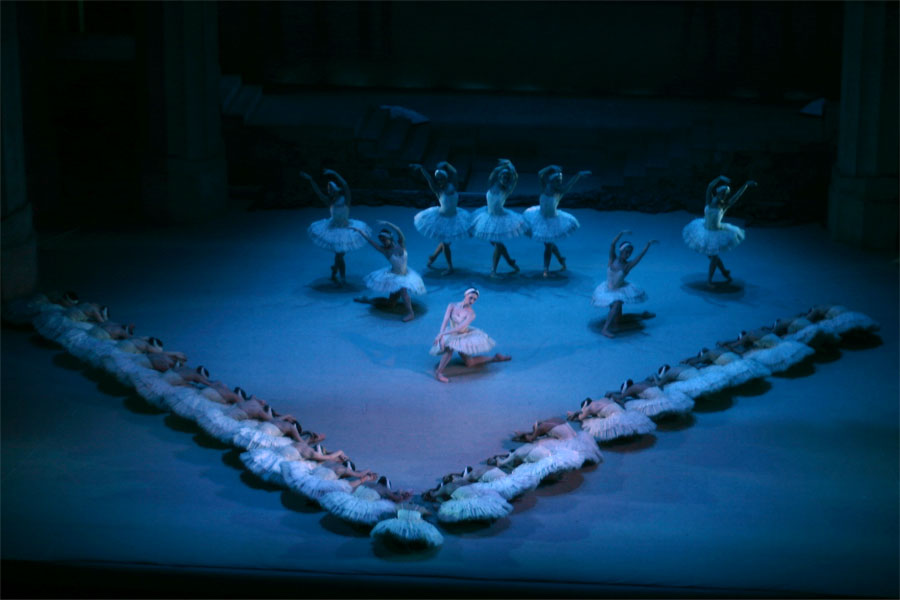 Swan LakeBallet · 1877Same lineage · video
 The NutcrackerBallet · 1892Same lineage · video
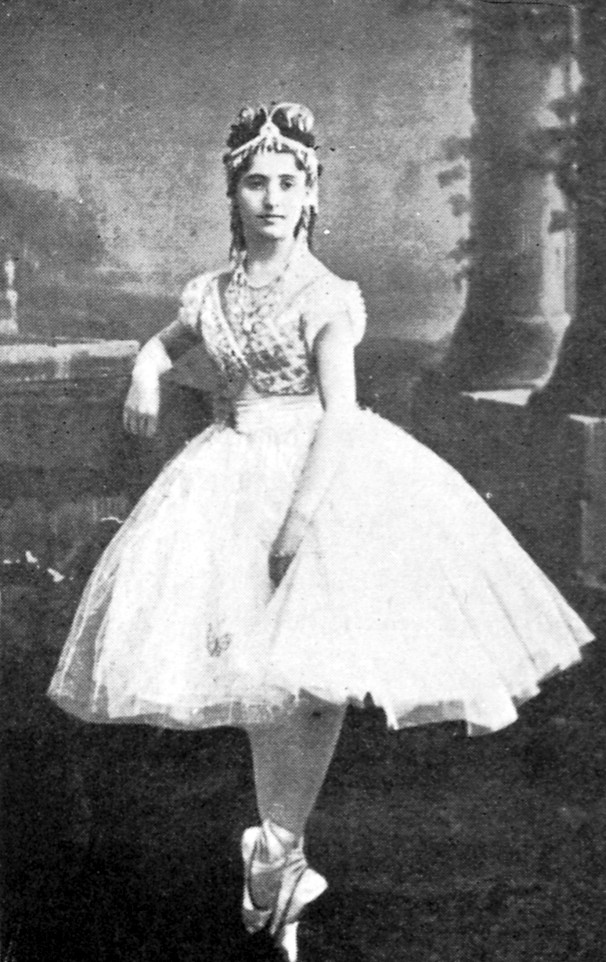 CoppéliaBallet · 1870Same lineage · video
 The Sleeping BeautyBallet · 1890Same lineage · video
 The FirebirdBallet · 1910Same lineage · video
 Square DanceBallet · 1957Same lineage · video
 The White-haired GirlBallet · 1945Same lineage · video