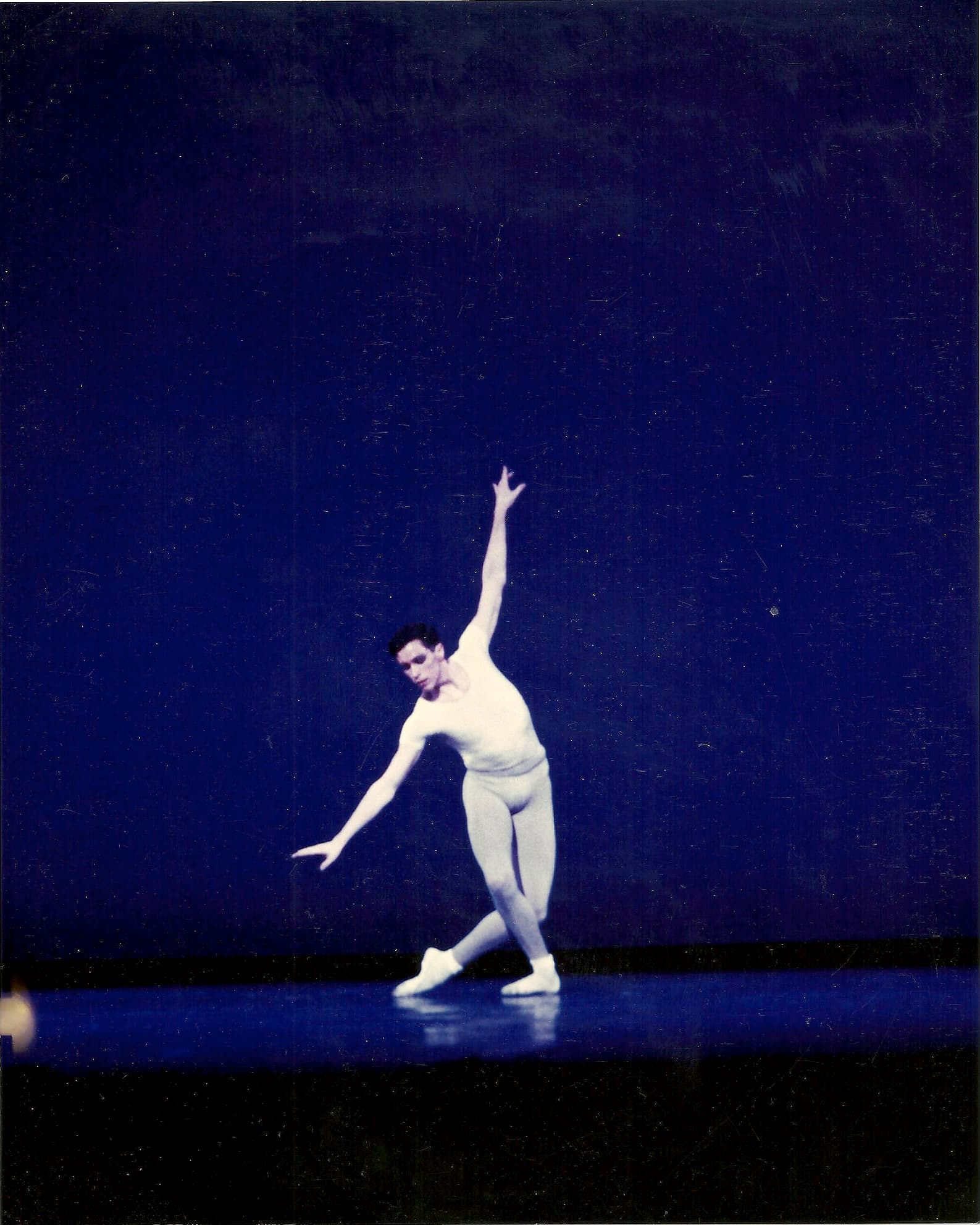
KCBalletMedia · CC BY 2.0
Square Dance is a plotless, one-act ballet George Balanchine made for New York City Ballet, set to Vivaldi's Concerto Grosso in B minor and the first movement of his Concerto Grosso in E major (Op. 3, nos. 10 and 12), with Corelli's Sarabanda, Badinerie e Giga added in a 1976 revision. It belongs to the small group of Balanchine works that stage an explicit collision between a European concert form (the Baroque concerto grosso) and an American vernacular dance practice named directly in the title and, in its original staging, spoken aloud by a live caller.
It is in this catalogue because its performance history is itself a documented sequence of choreographic decisions: what began as a piece with musicians and a square-dance caller on stage was later stripped of both in favour of a conventional pit orchestra and an added solo, a change significant enough that a company (Pacific Northwest Ballet) has since staged a one-off reconstruction of the original format.
What it contains
- Modern Western Square Dance · Original 1957 staging, danced throughout to live calling — The piece's ensemble figures were originally cued live by a square dance caller calling the steps while musicians played on stage, tying the choreography's patterning directly to called square-dance formations. Source: "with a square dance caller calling the steps"
- Classical Ballet · 1976 revival, the added solo to the Corelli Sarabanda — A soloistic passage for the male principal ('premier danseur'), a classical-ballet role designation, set to Corelli's Sarabanda and added independently of the surrounding concerto grosso material. Source: "a solo added for the premier danseur to the Corelli Sarabanda"
What is danced
The article does not supply step-by-step description of the choreography, but its central, verifiable fact is structural: the original 1957 version had a square dance caller calling the steps live, with the musicians placed on stage rather than in the pit. This means the piece's ensemble patterning was built, at least in part, to correspond to called square-dance figures — couples moving through set formations cued in real time — even though the dancers themselves are NYCB dancers working in classical technique, not a folk-dance ensemble. The caller device was removed in the 1976 revival, after which the choreography stood as a purely danced, uncalled concerto ballet.
The one added element the article specifies concretely is the 1976 solo for the premier danseur, set to the Corelli Sarabanda — a discrete display passage for the male lead layered onto the existing Vivaldi-based structure, giving the revised version a moment of soloistic, virtuosic focus that the caller-driven original did not carry in the same place. Beyond this, a dancer researching the piece should know that the two surviving structural layers — the Vivaldi concerto grosso material (with its call-and-response, ensemble-versus-soloist logic inherent to the concerto grosso form) and the interpolated Corelli solo — are what define the piece's shape, according to the article's own account of the 1976 changes.
Because the source gives no scene-by-scene or step-by-step synopsis, claims about pointe work, partnering holds, or specific classical steps cannot be drawn from it directly; what can be documented is the alternation between an ensemble/caller-driven format and a soloist-driven one, which is the ballet's own choreographic argument about American square dance versus concert dance.
Context
The ballet premiered in 1957 at City Center of Music and Drama in New York, under Balanchine's NYCB directorship. The article does not characterize the broader dance landscape of the period, so context beyond the piece's own revision history is not drawn from the source.
Staging history
The ballet premiered on November 21, 1957, at City Center of Music and Drama, New York, with lighting by Nananne Porcher, and its original cast was Patricia Wilde and Nicholas Magallanes. In 1976 Balanchine revised the work: he added the Corelli movements (Sarabanda, Badinerie e Giga), eliminated the on-stage square dance caller, moved the orchestra into the pit, and added a solo for the premier danseur to the Corelli Sarabanda. The Pacific Northwest Ballet later restored the caller for a single performance at the 2007 Vail International Dance Festival, making the original 1957 format a documented, if rare, alternative to the standard 1976-onward staging.
How to watch it
If you see the 1976-onward standard version, listen for the Corelli Sarabanda passage partway through: it is the interpolated male solo added specifically in that revision, distinct from the surrounding Vivaldi material. If you encounter a staging that restores the caller (as Pacific Northwest Ballet did in 2007), pay attention to how the spoken calls line up with the ensemble's patterning — that alignment, not the calls themselves, is the point of the original format. In either version, notice where the orchestra sits: on stage in the 1957 conception, in the pit from 1976, a small production choice the article treats as consequential enough to record.
More from George Balanchine
Other staged works in the register connected to this one by author or lineage.
 CoppéliaBallet · 1870Balanchine · video
 ApolloBallet · 1928Balanchine · video
 AgonBallet · 1957Balanchine · video
 Le chant du rossignolBallet · 1920Balanchine · video
 The Prodigal SonBallet · 1929Balanchine · video
 The Seven Deadly SinsBallet · 1933Balanchine · video
 The VestalBallet · 1888Same lineage
 Symphony in Three MovementsBallet · 1972Balanchine · video