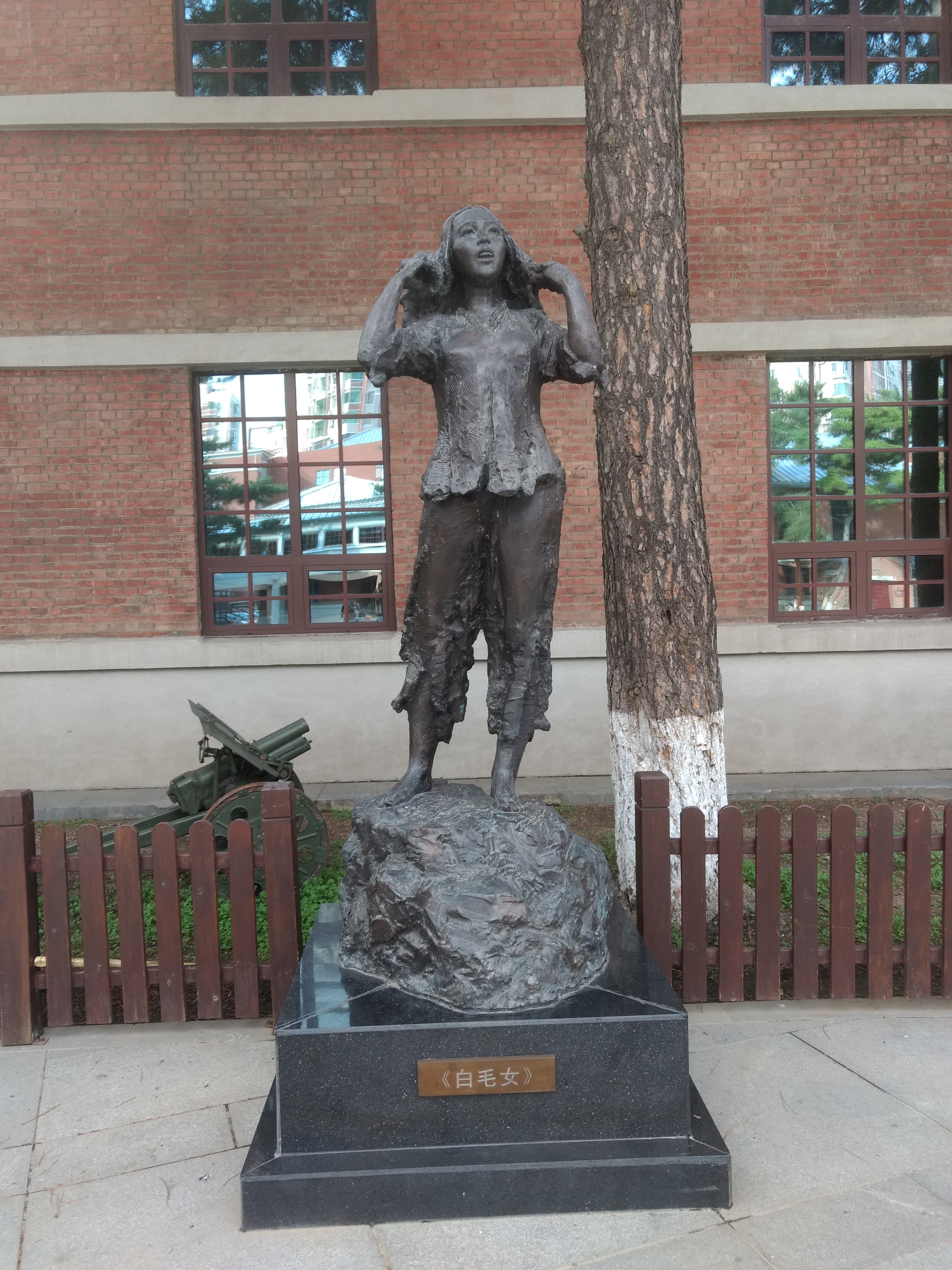
Francesc Fort — Own work · CC BY-SA 4.0
The White-haired Girl (1945)
The White-Haired Girl began as a Chinese vernacular opera composed by Yan Jinxuan to a libretto by He Jingzhi and Ding Yi, first staged in Yan'an in April 1945 as a tribute to the Seventh National Congress of the Chinese Communist Party. The stage work our record files as a ballet is, per the article, a later adaptation: the Shanghai Ballet Academy turned the opera into a ballet-opera in 1964, and it was subsequently reworked into one of the Eight Model Operas promoted by Jiang Qing during the Cultural Revolution.
What it contains
- Classical Ballet · The 1964 Shanghai Ballet Academy ballet-opera adaptation — Described as drawing on Western ballet technique alongside traditional Chinese dance, folk dance, martial arts and Chinese musical drama to stage the narrative. Source: "It drew on a variety of artistic traditions, including Western ballet, traditional Chinese dance and folk dance, martial arts, and Chinese musical drama."
What is danced
The article does not give a scene-by-scene choreographic account, but it names the sources the 1964 ballet-opera drew on directly: "Western ballet, traditional Chinese dance and folk dance, martial arts, and Chinese musical drama." This places the work at a deliberate junction of pointe-based classical vocabulary with Chinese theatrical and martial movement idioms rather than in a single lineage.
Specific staged physical action described in the article includes confrontation and combat: in revised versions Xi'er's father Yang Bailao is shown "being shot dead while resisting the landlord with his shoulder pole" rather than committing suicide, and in the 1972 version Xi'er "fights heroically against Landlord Huang's attempt to rape her" and "fends off his rape attempt and escapes." These are dramatic, mimed physical set pieces central to the revolutionary reworking of the story, replacing the earlier opera's passive, victimized staging with active resistance choreography.
The music is described as using "Wagnerian-style leitmotifs: recurring musical themes tied to characters and emotional shifts," which the article says shaped Xi'er's staged psychological journey — a structural device relevant to how the dance-drama is built scene to scene, even though the article does not describe specific steps or positions.
Context
The work is a direct product of Mao Zedong's 1942 Yan'an Talks, which called for art to serve workers, peasants and soldiers using forms they could recognise; the opera was built from a folk legend collected by the Northwest Battleground Service Corps and became, in the article's words, "a classic example of the approach described in the Yan'an Talks." Its later transformation into a ballet-opera in 1964, and into a model ballet approved by Jiang Qing during the Cultural Revolution, made it (alongside Red Detachment of Women) one of the two ballets that defined Chinese revolutionary ballet as a genre — a hybrid built to carry explicit class-struggle politics through a Western theatrical form remade with Chinese vocabulary.
Staging history
The article traces staging across decades and media: the 1945 Yan'an opera premiere, a 1950 film tied to the Land Reform Movement, the 1964 Shanghai Ballet Academy ballet-opera, a Cultural Revolution-era model-work revision that removed the romantic plot between Xi'er and Dachun, a 1970 black-and-white television version and a 1972 colour film (both directed by Sang Hu with the same cast), and a 1955 adaptation by the Japanese Matsuyama Ballet company (based on the 1950 film) that toured Beijing and contributed to Sino-Japanese "ballet diplomacy." Popularity declined after 1978 reform — a 1981 Shanghai Dance Troupe performance in Qingdao was booed for softening its revolutionary content — until a state-sponsored revival toured from Yan'an to Beijing in 2015 under Peng Liyuan's artistic direction, with further stagings by the China National Opera including a 2021 CCP centenary performance.
How to watch it
Compare versions rather than watching one in isolation: the article notes that the same scenes were re-choreographed to match shifting political requirements, so watch for whether Yang Bailao dies by suicide or armed resistance, and whether Xi'er is a victim or an active fighter in the rape scene, as markers of which era's version you are seeing. Attend also to how folk and martial movement is integrated with ballet vocabulary, since the 1964 adaptation was explicitly built by blending these traditions rather than staging a straight classical ballet.
Credits
- composer: Yan Jinxuan
In the same lineage
Other staged works in the register connected to this one by author or lineage.
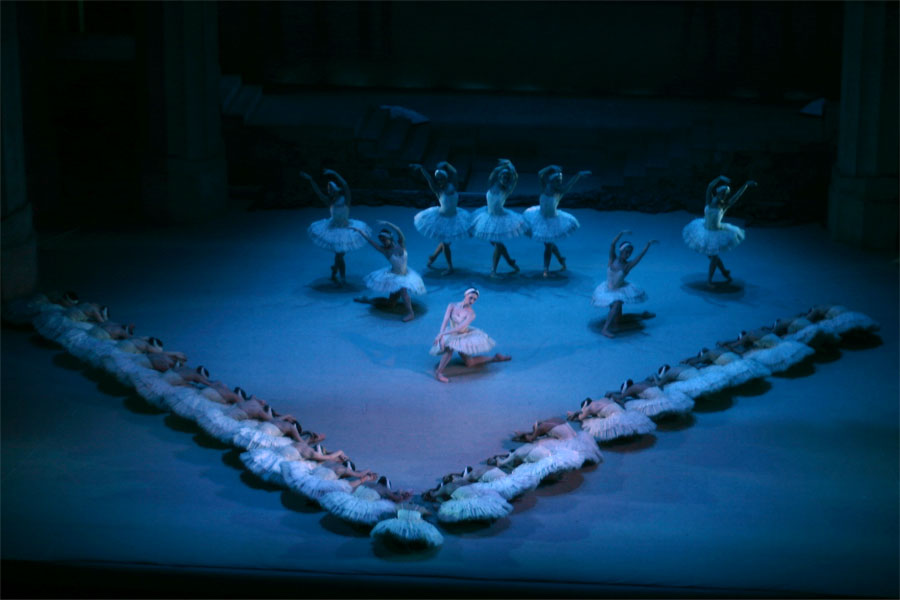 Swan LakeBallet · 1877Same lineage · video
 The NutcrackerBallet · 1892Same lineage · video
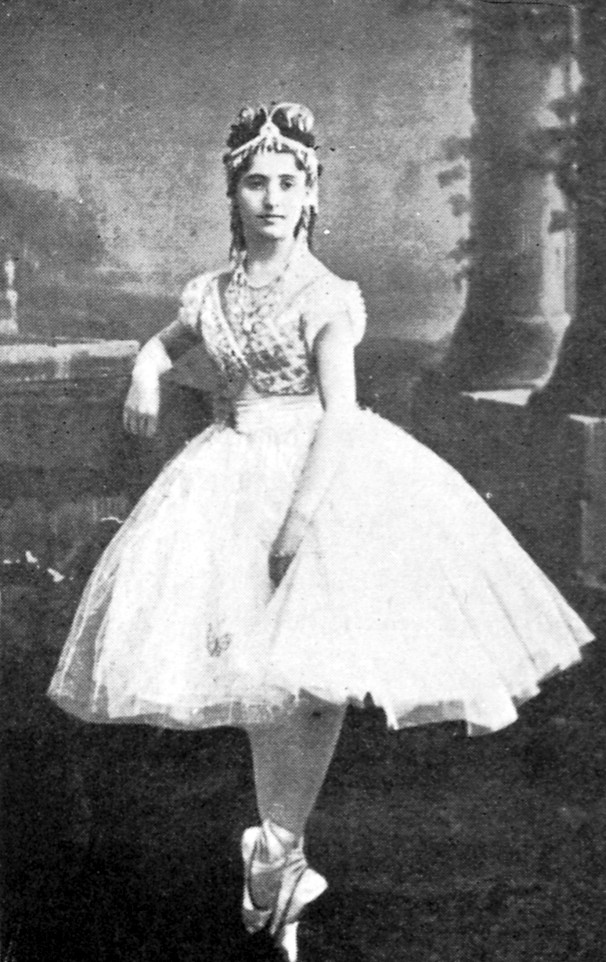 CoppéliaBallet · 1870Same lineage · video
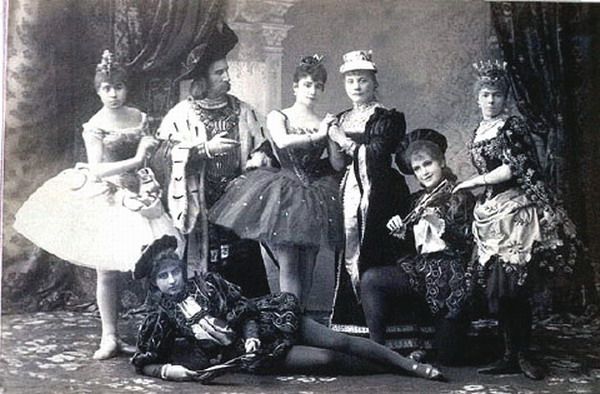 The Sleeping BeautyBallet · 1890Same lineage · video
 The FirebirdBallet · 1910Same lineage · video
 PetrushkaBallet · 1911Same lineage · video
 Raymonda VariationsBallet · 1961Same lineage · video
 ZenobiaBallet · 1936Same lineage · video