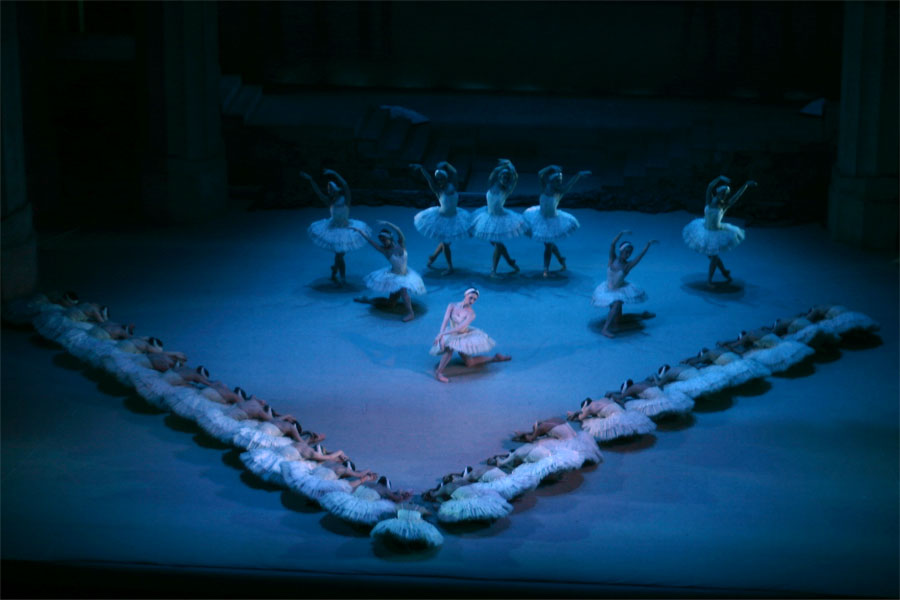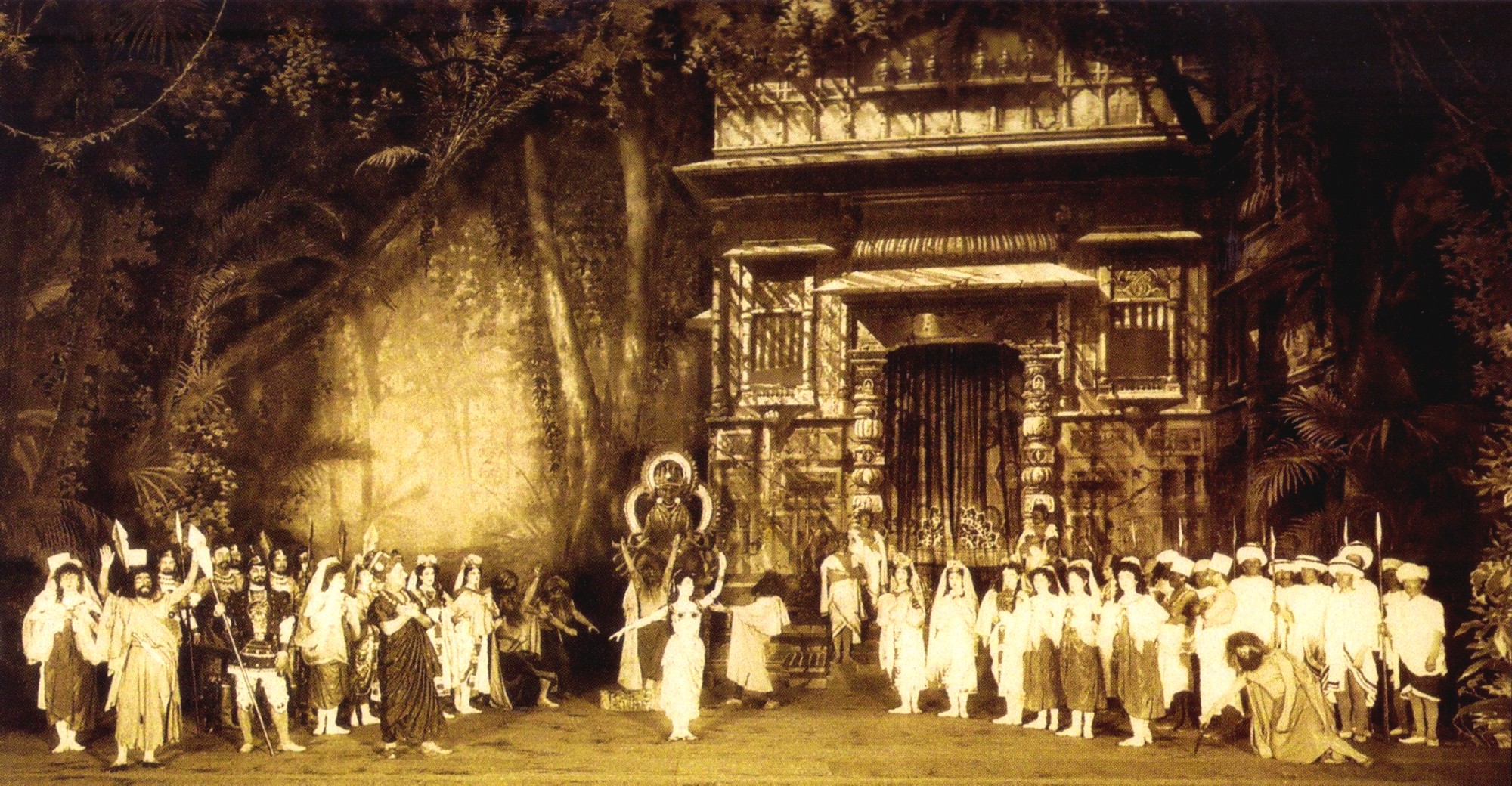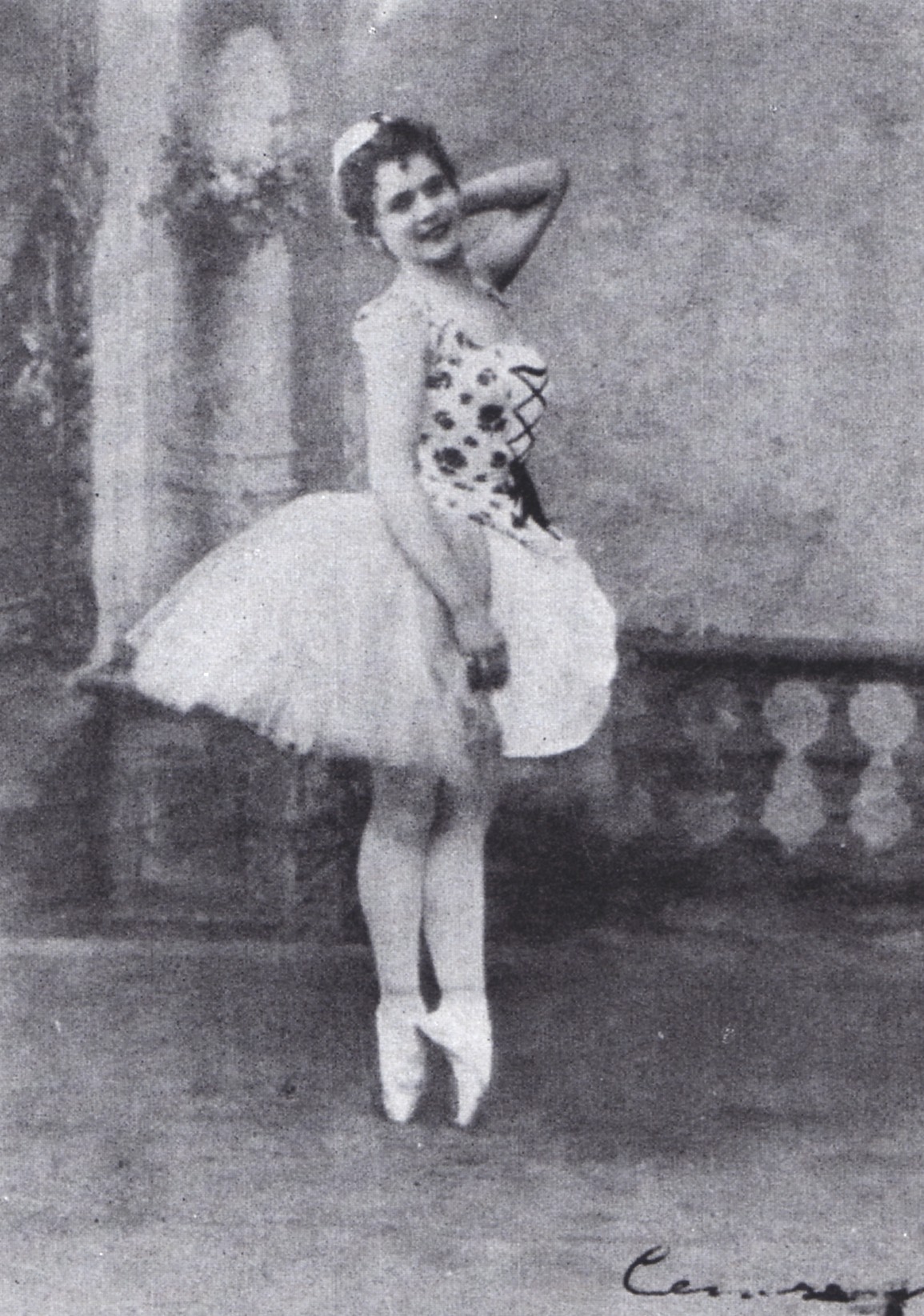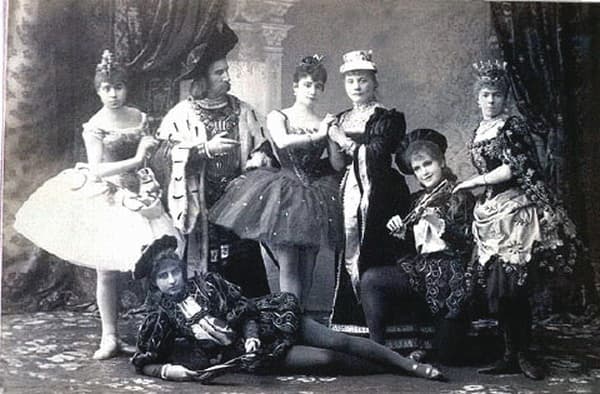
Unknown authorUnknown author — This photo is in the archives of RIA Novosti (Photo #60755, RIA05-011343, А69-32163). It has also been published in Warrack, John (1973) Tchaikovsky, London: Hamish Hamilton ISBN: 024102403X. Book was also published in New York by Charles Scribner's Sons. · Public domain
The Sleeping Beauty is a three-act ballet with prologue, choreographed by Marius Petipa to a score by Pyotr Ilyich Tchaikovsky (his Opus 66), first given at the Mariinsky Theatre in St Petersburg on 15 January 1890. Built on a libretto by Ivan Vsevolozhsky drawn from Perrault's fairy tale, with elements from the Brothers Grimm folded in, it stages the Petipa-era template of prologue plus divertissement-heavy acts, structured throughout as sequences of entrée, adagio, variation and coda.
What it contains
- Classical Ballet — Les quatre fiancés de la Princesse Aurore · Act I, the Rose Adagio — A sustained adagio in which the ballerina is partnered in succession by four suitors through balances, promenades and supported turns, a classical technical set piece. Source: "Aurora and the suitors perform the famous Rose Adagio."
- Classical Ballet — Les noces de Désiré et d'Aurore · Act III, the Grand Pas de Deux for Aurora and Désiré — The principal wedding duet built on the classical adagio-variations-coda formula, danced by the two leads with the full ensemble around them. Source: "Aurora and Désiré perform a grand Pas de Deux, and the entire ensemble dances."
What is danced
The ballet's dance architecture is the Imperial Ballet's classical formula in its most fully worked-out form: named grand pas built from entrée, grand adage, a string of solo variations and a coda, repeated across the Prologue's Pas de six for the fairies, Act I's Grand pas d'action, and Act III's Grand pas de deux for Aurora and Désiré. The Rose Adagio in Act I is the ballet's signature set piece: Aurora is partnered in turn by four suitors in a sustained balance-and-promenade sequence that is one of classical ballet's standard tests of a ballerina's control. Act III adds a run of character and fairy-tale divertissements built on the same pas de deux/variation/coda skeleton, including a formal Pas de deux for the Bluebird and Princess Florine (originally planned as a pas de quatre, restaged by Petipa as a duet for Enrico Cecchetti and Varvara Nikitina), alongside pas de caractère numbers for Puss in Boots and the White Cat, Little Red Riding Hood and the Wolf, and Tom Thumb and his brothers.
The article's musical-numbers listing gives, in effect, a map of the choreographic units: Grand adage/Petit allégro and named variations (Candide, Coulante, Miettes, Canari, Violente, and the Lilac Fairy's own) in the Prologue's Pas de six; a Grand polonaise dansée and Grand pas de quatre for the Jewel Fairies in Act III; and a Panorama and Entr'acte symphonique used as transitional, largely mimed or scenic interludes rather than danced numbers. Carabosse and the Lilac Fairy carry the narrative through mime scenes (Scène mimique) rather than through virtuosic dancing, which the article notes is deliberately abandoned in Act III in favour of the individual court and fairy-tale divertissements.
Context
The Sleeping Beauty followed Tchaikovsky's Swan Lake, whose original reception had been tepid, and it was made at a moment when Petipa, as ballet master of the Imperial Ballet in St Petersburg, was consolidating the grand multi-act narrative ballet built on strict musical-choreographic set pieces (adagio, variations, coda) as the house style of the Imperial Theatres. The work's premiere was better received by the press than Swan Lake's had been, and within little more than a decade it was the second most-performed ballet in the Imperial repertory, establishing the template later exported and adapted by companies far beyond Russia.
Staging history
The ballet was slow to travel: a Milan production at La Scala in 1896 made little impact, and it was Diaghilev's 1921 London staging as The Sleeping Princess, with designs by Léon Bakst, that secured the work a permanent place in the Western classical repertoire. The Sadler's Wells Ballet's 1946 Royal Opera House production and the Royal Ballet's 1968 staging kept the work central to British ballet, while in Russia the Mariinsky reconstructed Petipa's original 1890 production from Stepanov notation in 1999, and American Ballet Theatre staged a comparable reconstruction under Alexei Ratmansky in 2015. Alongside straight revivals, the work has also been substantially reworked, notably by Marcia Haydée for Stuttgart Ballet in 1978 (Carabosse recast as a virtuoso male role, subsequently taken up by companies from Antwerp to Berlin) and by Youri Vámos in Basel in 1992, who reset the ballet's musical numbers into a narrative about Anna Anderson's claim to be Anastasia.
How to watch it
Watch for the repeating adagio–variations–coda pattern that Petipa uses for almost every major dance, from the fairies' Pas de six in the Prologue to the wedding Pas de deux in Act III — it is the choreographic skeleton of the whole evening. The Rose Adagio (Act I) and the Bluebird Pas de deux (Act III) are the two set pieces most often extracted for gala programmes, and are useful gauges of a company's classical technique on their own.
Structure
- Act Prologue · Le baptême de la Princesse AuroreAt Aurora's christening the fairies bestow gifts; Carabosse, uninvited, curses the princess to die at sixteen, and the Lilac Fairy softens the curse to a hundred-year sleep.
- Act I · Les quatre fiancés de la Princesse AuroreOn her sixteenth birthday Aurora dances the Rose Adagio with four suitors, then pricks her finger on a spindle brought by the disguised Carabosse and falls into the enchanted sleep.
- Act II · Scene 1 · La chasse du Prince DésiréA century later, Prince Désiré is shown a vision of Aurora by the Lilac Fairy and is led to the hidden, sleeping castle after Carabosse is defeated.
- Act II · Scene 2 · Le château de la belle au bois dormantDésiré wakes Aurora with a kiss; the court revives and the couple's engagement is approved.
- Act III · Les noces de Désiré et d'AuroreThe wedding divertissement brings on the Jewel Fairies and fairy-tale characters (Puss in Boots, the White Cat, the Bluebird and Princess Florine, Red Riding Hood and the Wolf, Tom Thumb) before Aurora and Désiré dance the Grand Pas de Deux.
Structure read from an encyclopaedia article, not from a libretto or score we hold. Confirm against a programme before treating the numbering as authoritative.
On screen
- Sleeping Beauty (1959)
More from Marius Petipa
Other staged works in the register connected to this one by author or lineage.