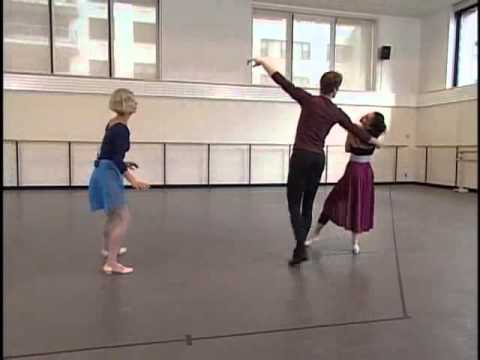
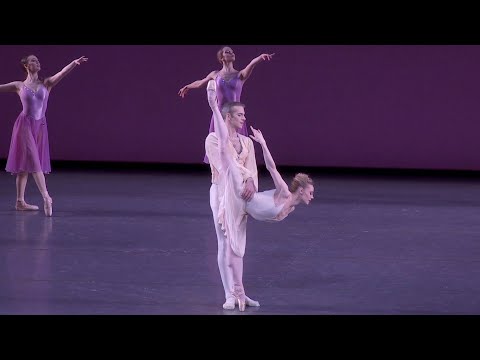
This is George Balanchine's 1980 ballet for New York City Ballet, set complete to Robert Schumann's piano cycle Davidsbündlertänze (Dances of the League of David), Op. 6 of 1837. It was among the last major works Balanchine made before his death, a series of dances for four couples that the article says draws on Schumann's own life, centred on his reunion with Clara Wieck after a sixteen-month estrangement in the year the score was written.
What is danced
The article does not describe the choreography itself — no step vocabulary, partnering detail, or pointe/character-shoe distinctions are given. What it does establish is structural: the ballet is built as a series of dances for four couples, danced straight through to Schumann's complete Op. 6 piano cycle, and it carries a biographical undertone (the Clara Wieck reunion) rather than a conventional narrative plot. Anyone wanting the actual movement content — how Balanchine handles the four pairings, whether the piece is plotless-abstract or more overtly theatrical/mimetic in passages — will need to go past this source to eyewitness accounts, the Balanchine Trust materials, or film.
Context
The ballet belongs to the final phase of Balanchine's career as founding choreographer and balletmaster-in-chief of New York City Ballet. The article traces a specific genealogy behind it: pianist Neil Stannard suggested the Schumann cycle to Jonathan Watts, a Joffrey protégé running the Joffrey apprentice company, who made a version called Evening Dialogues to the same score in the mid-1970s; Robert Joffrey then made his own setting for the Joffrey Ballet itself, premiered at City Center in the late 1970s; Balanchine's ballet followed in 1980. That chain — three different choreographers independently drawn to the same Schumann cycle within a few years — is itself a notable piece of repertory history around this score.
Staging history
The premiere is recorded as June 19, 1980, at the New York State Theater, Lincoln Center, with an original cast of Karin von Aroldingen, Suzanne Farrell, Kay Mazzo, Heather Watts, Adam Lüders, Jacques d'Amboise, Ib Andersen, and Peter Martins. The article cites a Jack Anderson review in the New York Times from November 21, 1980, indicating the work remained in repertory into that later season, but gives no further account of revivals or restagings by other companies.
How to watch it
Watch how the four couples are differentiated from one another, since the article frames the piece as a series of dances for paired dancers rather than a corps-and-principal structure. Given the biographical frame the article supplies, attention to any passage suggesting reunion or estrangement between a single couple (standing in for Schumann and Clara Wieck) is worth tracking, though the source does not specify where in the ballet this occurs.
Credits
- composer: Robert Schumann
More from George Balanchine
Other staged works in the register connected to this one by author or lineage.
 CoppéliaBallet · 1870Balanchine · video
 ApolloBallet · 1928Balanchine · video
 AgonBallet · 1957Balanchine · video
 Le chant du rossignolBallet · 1920Balanchine · video
 The Prodigal SonBallet · 1929Balanchine · video
 The Seven Deadly SinsBallet · 1933Balanchine · video
 Walpurgisnacht BalletBallet · 1980Balanchine · video
- RagtimeRagtimeBallet · 1966Balanchine