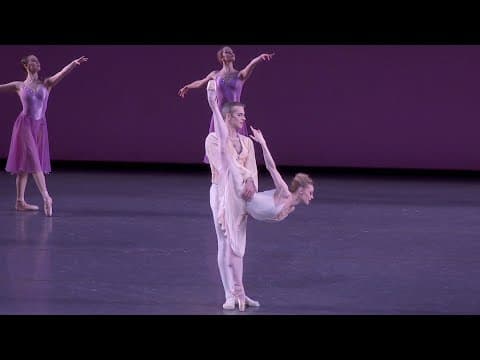
Walpurgisnacht Ballet is the danced sequence Balanchine made for Gounod's opera Faust, using the ballet music (including the 1869 additions) that traditionally opens the last act, where Mephistopheles shows Faust a folk revel on the eve of May Day. Balanchine set it most recently for a 1975 Paris Opera production of Faust before it entered the New York City Ballet repertory in 1980 as a self-standing concert piece, detached from the opera and its plot.
What is danced
The article gives no scene-by-scene or step-by-step account of the choreography. What it does establish is the piece's relationship to its source: it is drawn from an opera divertissement rather than built as a narrative ballet, and Balanchine explicitly did not choreograph the Walpurgis Night ritual itself (the release of the dead to wander before May Day) but instead built the dance around 'a sense of joyful revelry.' That is the only description of tone or intent the source provides.
Context
The article documents that Balanchine returned to this Gounod music repeatedly across his career -- for Diaghilev's Ballets Russes at the Opéra de Monte-Carlo, for the Metropolitan Opera in 1935, for the Opera Nacional in Mexico City in 1945, and finally for the Paris Opera's 1975 Faust -- before lifting it out of the opera entirely for New York City Ballet in 1980. This trajectory, from occasional opera-house ballet to independent repertory work, mirrors a broader pattern in Balanchine's practice of converting incidental opera dances into freestanding pieces for his own company late in his career.
Staging history
The article traces four opera productions carrying Balanchine's Faust choreography before the ballet's separation from the opera: Ballets Russes at the Opéra de Monte-Carlo, the Metropolitan Opera (1935), the Opera Nacional in Mexico City (1945), and the Théâtre National de l'Opéra, Paris (1975). Its first life as a standalone dance work came with New York City Ballet on 15 May 1980 at the New York State Theater, Lincoln Center.
How to watch it
Because the piece was extracted from an opera divertissement, watch for how it stands apart from narrative ballet: there is no plot to follow, and Balanchine deliberately avoided literal illustration of the Walpurgis Night story (souls of the dead released to wander). Attend instead to the atmosphere of communal celebration the article says the choreography aims for, and to the fact that the same music was reworked by Balanchine across several earlier opera productions before reaching this form.
Credits
- composer: Charles Gounod
More from George Balanchine
Other staged works in the register connected to this one by author or lineage.
 CoppéliaBallet · 1870Balanchine · video
 ApolloBallet · 1928Balanchine · video
 AgonBallet · 1957Balanchine · video
 Le chant du rossignolBallet · 1920Balanchine · video
 The Prodigal SonBallet · 1929Balanchine · video
 The Seven Deadly SinsBallet · 1933Balanchine · video
 Stars and StripesBallet · 1958Balanchine · video
 Tschaikovsky Suite No. 3Ballet · 1970Balanchine · video