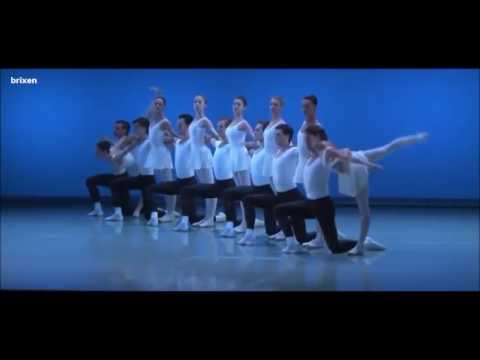
Monumentum pro Gesualdo is a Balanchine ballet made in 1960 for New York City Ballet, set to Stravinsky's own 1960 orchestral recomposition of three Gesualdo madrigals. The score itself was written to mark the 400th anniversary of Gesualdo's birth and premiered at the Venice Biennale under Stravinsky's own baton before Balanchine choreographed it for the stage that same year.
What is danced
The source article does not describe the choreography itself — no steps, holds, groupings, or vocabulary are recorded. It gives only the production history: premiere date and venue, the designer credited for scenery and lighting, and the fact that the ballet was later paired in performance with Balanchine's Movements for Piano and Orchestra from 1963 onward. Anyone writing further on this entry would need a separate source (company repertory notes, reviews, or the Balanchine Trust materials) to speak to what is actually danced.
Context
The ballet dates from a period when Balanchine was building a repertory of short, score-driven, plotless works for New York City Ballet, often to newly commissioned or newly arranged Stravinsky scores — the collaboration between the two men was by 1960 long-standing and close. The article notes the piece was conceived as a companion to Stravinsky's Tres Sacrae Cantiones and was itself a tribute piece, arranging Renaissance madrigals through a modern orchestral lens; Balanchine's decision to stage it fits his practice of setting difficult, non-narrative modern scores rather than adapting existing story ballets.
Staging history
The ballet premiered on November 16, 1960 at City Center of Music and Drama in New York, with scenery and lighting by David Hays. Lighting was later redesigned by Ronald Bates in 1974, and the article notes the production now in use is lit by Mark Stanley. From 1963 the work was regularly performed paired with Balanchine's choreography for Stravinsky's Movements for Piano and Orchestra, a pairing the article says became the standard way the two ballets were programmed together.
How to watch it
Because the underlying score recomposes Renaissance madrigals for modern orchestra, listen for how the music's older vocal lines sit inside Stravinsky's spare, angular scoring — this tension is the premise the choreography was built to answer, even though the article does not describe the answer. Note also that the ballet is traditionally seen on a program with Movements for Piano and Orchestra rather than alone, which is itself part of the performance convention worth watching for.
Credits
- composer: Igor Stravinsky
More from George Balanchine
Other staged works in the register connected to this one by author or lineage.
 CoppéliaBallet · 1870Balanchine · video
 ApolloBallet · 1928Balanchine · video
 AgonBallet · 1957Balanchine · video
 Le chant du rossignolBallet · 1920Balanchine · video
 The Prodigal SonBallet · 1929Balanchine · video
 The Seven Deadly SinsBallet · 1933Balanchine · video
 Tschaikovsky Suite No. 3Ballet · 1970Balanchine · video
 Stars and StripesBallet · 1958Balanchine · video