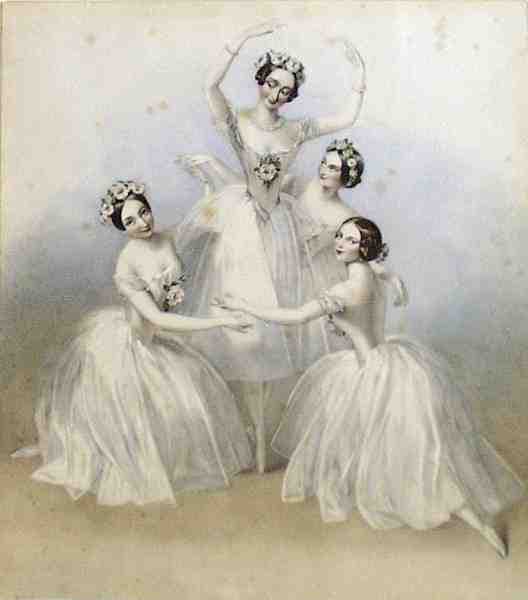
Alfred Edward Chalon — Theatre Museum · Public domain
Grand Pas de Quatre is a Romantic-era ballet divertissement made in 1845 by Jules Perrot to music by Cesare Pugni, built around a single event: putting four of the leading ballerinas of the age on one London stage in the same piece. It has no plot; it exists to display four contrasting styles of virtuosity and lyricism inside a shared classical framework, and it has been restaged repeatedly since as a vehicle for comparing dancers rather than telling a story.
What it contains
- Classical Ballet · Throughout the piece, across the opening, variations and finale — The choreography is built to run every core area of classical technique: adagio work, petite and grand allegro, fast footwork, changes of position, and fluid arm movements. Source: "These areas include adagio movements, petite allegro, grand allegro, fast footwork, graceful changes of position, and the elegant and fluid arm movements that have become a signature element of Pas de Quatre."
- Romantic Ballet · Throughout the piece, in both the ensemble sections and the individual variations — Ballerinas dance with demure lightness, delicacy, and poise, using fluid, elegant arm movements described as the work's signature feature - the core stylistic markers of Romantic ballet. Source: "Pas de Quatre captured the essence of the Romantic style as the ballerinas danced with demure lightness, delicacy, and poise."
What is danced
The piece has a simple, fixed shape: an ensemble opening for all four ballerinas, a sequence of individual variations performed one after another, and a closing ensemble finale that reunites them. The variations were built by Perrot on the specific ballerina who premiered each role, designed to show off her particular strengths, so the choreography functions as a set of tailored solo showcases rather than interchangeable steps.
According to the record, the work is meant to touch every area of classical ballet technique across its short span: adagio movements, petite allegro, grand allegro, rapid footwork, and graceful changes of position. Arm work is singled out as a defining feature - fluid, elegant use of the arms is described as a signature element that has stayed attached to the piece through its later stagings. The overall manner called for is the Romantic ballerina ideal: lightness, delicacy and poise rather than force or attack, with the ensemble opening and finale providing a unifying frame around the contrasted solo variations.
Context
The piece was made in 1845 at Her Majesty's Theatre in London at the suggestion of the theatre's director, at a moment when Romantic ballet's cult of the individual ballerina was at its peak; several of the most celebrated dancers of the era were working in London and Paris at once, and the novelty was assembling rivals on a single bill. The order of appearance was fixed by age, youngest to oldest, specifically to defuse rank disputes among the ballerinas - a sign of how much status and precedence mattered in this milieu. A fifth star of the period was invited and declined, and her replacement accepted without objection, underlining how contested a booking like this was among Romantic-era ballerinas.
Staging history
The original quartet danced together only four times in 1845, one performance attended by Queen Victoria and Prince Albert; after that the specific combination of dancers and roles was not repeated for the piece's original run, and the music went unperformed for decades. Nearly a century later, in 1941, Anton Dolin staged a new version with a fresh cast taking on the four named roles, and this version has since been the one carried forward by companies, including a mounting for the Irish Ballet Company in Cork in 1975. Performance rights to Dolin's version were left exclusively to dancers Belinda Wright and Jelko Yuresha by Dolin's estate, meaning that version cannot be staged, performed, produced or recorded without their permission and direct involvement in the staging.
How to watch it
Watch how each ballerina's variation is shaped to a distinct temperament rather than a shared step vocabulary - the piece is a comparative display, not a unified dance. Pay attention to the arms and épaulement rather than to attack or elevation; the described ideal is delicacy and poise, and the opening and closing ensembles exist mainly to frame the four solos in between.
Structure
- Opening ensembleAll four ballerinas dance together to open the piece before the individual variations begin.
- Individual variationsEach ballerina performs a solo variation choreographed to display her own particular strengths.
- FinaleThe four ballerinas reunite for a closing ensemble after the variations.
Structure read from an encyclopaedia article, not from a libretto or score we hold. Confirm against a programme before treating the numbering as authoritative.
Credits
- composer: Cesare Pugni
Related works
Other staged works in the register connected to this one by author or lineage.
 GiselleBallet · 1841Perrot · video
 La EsmeraldaBallet · 1844Perrot · video
- Catarina or La Fille du BanditBallet · 1846Perrot
 La Vivandière or MarkitenkaBallet · 1844Music by Pugni · video
 The Little Humpbacked HorseBalletMusic by Pugni · video
 The Pharaoh's DaughterBallet · 1862Music by Pugni · video
 La PériBallet · 1912Same lineage · video
 Liebeslieder WalzerBallet · 1960Same lineage · video
