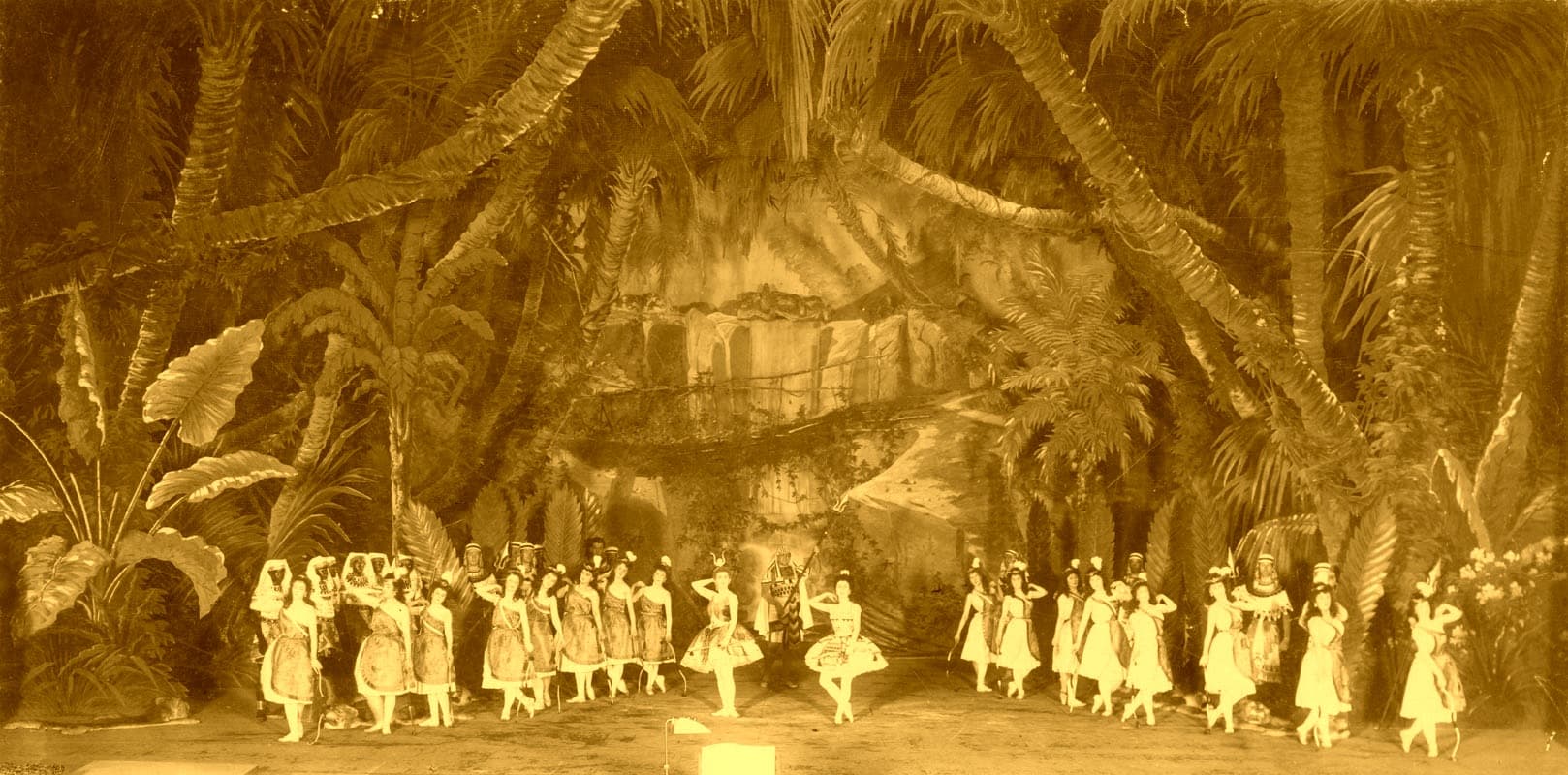
Unknown · Public domain
The Pharaoh's Daughter is a multi-act grand ballet made by Marius Petipa to a score by Cesare Pugni, first given by the Imperial Ballet in St Petersburg on 30 January 1862 as a benefit for the Italian ballerina Carolina Rosati. Its libretto, adapted by Jules-Henri Vernoy de Saint-Georges and Petipa from Théophile Gautier's novel Le Roman de la momie, frames an opium-induced vision: an English lord in a pyramid dreams himself into ancient Egypt as Ta-Hor, lover of the Pharaoh's daughter Aspicia.
What it contains
- Classical Ballet · the whole production, staged as a large-scale four-hour spectacle — A grand multi-act ballet à grand spectacle using roughly 400 performers, mixing dramatic mime with ensemble and soloist dancing across strongly contrasted dramatic episodes, the format Petipa established here before reusing it in his later Imperial ballets. Source: "which lasted four hours and used different styles and techniques and a large number of people (about 400), with plots characterized by strong dramatic contrasts"
What is danced
The article identifies this as the first grand, multi-act ballet Petipa staged for the Imperial Theatres, built on the model of the ballet à grand spectacle: a four-hour production using 'different styles and techniques and a large number of people (about 400)'. That scale is the central fact for a dancer or stager to know — the work is a vehicle for massed corps de ballet spectacle, sharp dramatic contrast, and set-piece pageantry rather than a chamber work.
The article credits Petipa with inserting divertissements into this and his later ballets (Swan Lake, La Bayadère, The Sleeping Beauty) specifically to give Russian-trained soloists, not just imported foreign stars, room to display technique outside the main plot. Within The Pharaoh's Daughter this takes the form of 'the dance of bayadères and the pageant of the rivers (from Guadalquivir to Neva), all dressed up in national costumes' — a folkloric, character-costumed ensemble sequence performed by personifications of the world's rivers under the Nile, a forerunner of the kind of large symmetrical corps tableau Petipa would later use for the Kingdom of the Shades in La Bayadère.
The title role of Aspicia is described as demanding 'a special dramatic talent', built around a sequence of mimed high-stakes moments — resurrection from the sarcophagus, seduction and terror, and a climactic gesture toward a snake hidden in a flower-basket, 'a classic gesture since Cleopatra's time' — rather than pure step vocabulary. The article notes how differently interpreters played this: Rosati dramatic, Virginia Zucchi more humane, Mathilde Kschessinskaya turning it into 'more of a virtuoso role', which indicates the part sits at the intersection of pantomime and bravura classical dancing typical of the Imperial repertoire.
Context
The ballet was made in 1862 while Petipa was still second in command, assistant to Arthur Saint-Léon, and its success won him promotion to second Maître de Ballet, the position from which he would eventually inherit control of the Imperial Ballet. The article frames it as part of a broader trend, parallel to grand opera, toward spectacle ballet with huge casts and strong dramatic contrast, fed by contemporary Egyptological fascination and by Gautier's own literary exoticism.
Staging history
Petipa revived the ballet himself in 1885 and again in 1898, the latter mounted as a benefit for Mathilde Kschessinskaya and the version recorded in Stepanov notation now held in the Sergeyev Collection at Harvard. In 1905 Alexander Gorsky staged an unauthorized modified version for the Bolshoi, and the ballet held the stage until 1928. It re-entered the repertory in 2000 through Pierre Lacotte's restaging for the Bolshoi Ballet, based partly on the Stepanov notation and partly on dancers' personal recollections, and has remained active there since. In 2023 the Mariinsky Theatre mounted a separate historical reconstruction from the same Stepanov notation, staged by Toni Candeloro with designs by Robert Perdziola.
How to watch it
Watch for the split between the framing pantomime — the opium trance, transformation, and the mimed courtroom-like sentencing scene — and the danced set pieces such as the river pageant, since the ballet alternates dramatic gesture with ensemble spectacle rather than sustaining continuous dance. Note also how differently the Aspicia role has historically been played, from dramatic tragedienne to display virtuoso, since the part is a vehicle built to showcase a ballerina's range rather than a fixed choreographic text.
Credits
- composer: Cesare Pugni
More from Marius Petipa
Other staged works in the register connected to this one by author or lineage.
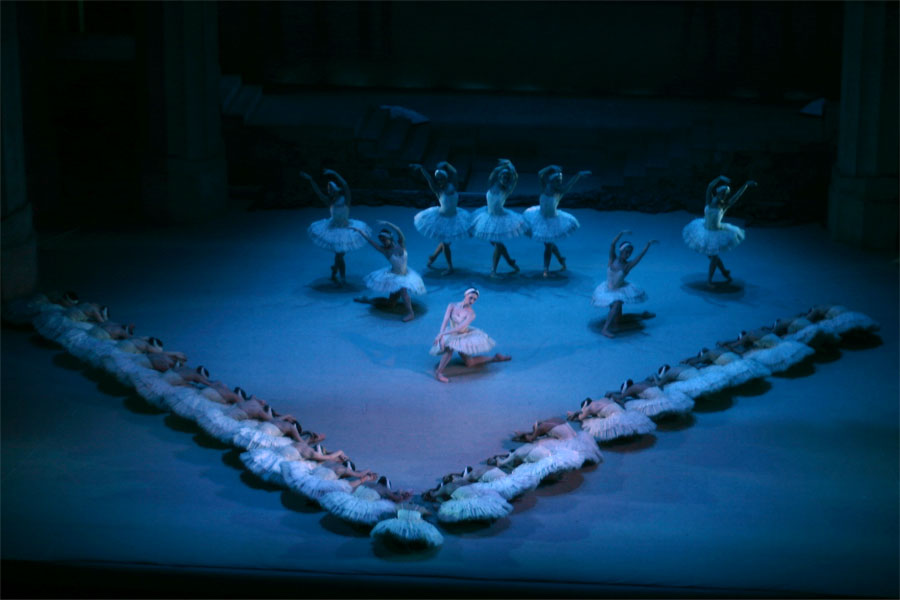 Swan LakeBallet · 1877Petipa · video
 The NutcrackerBallet · 1892Petipa · video
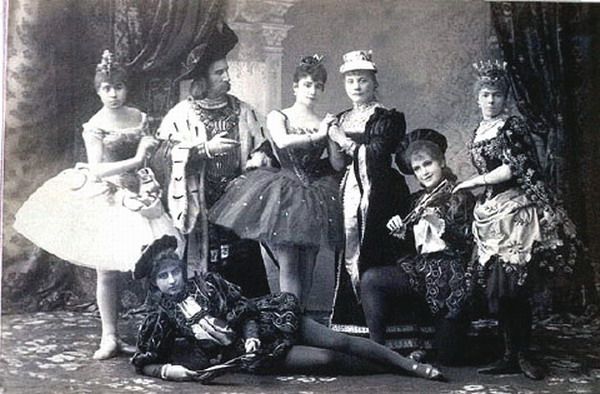 The Sleeping BeautyBallet · 1890Petipa · video
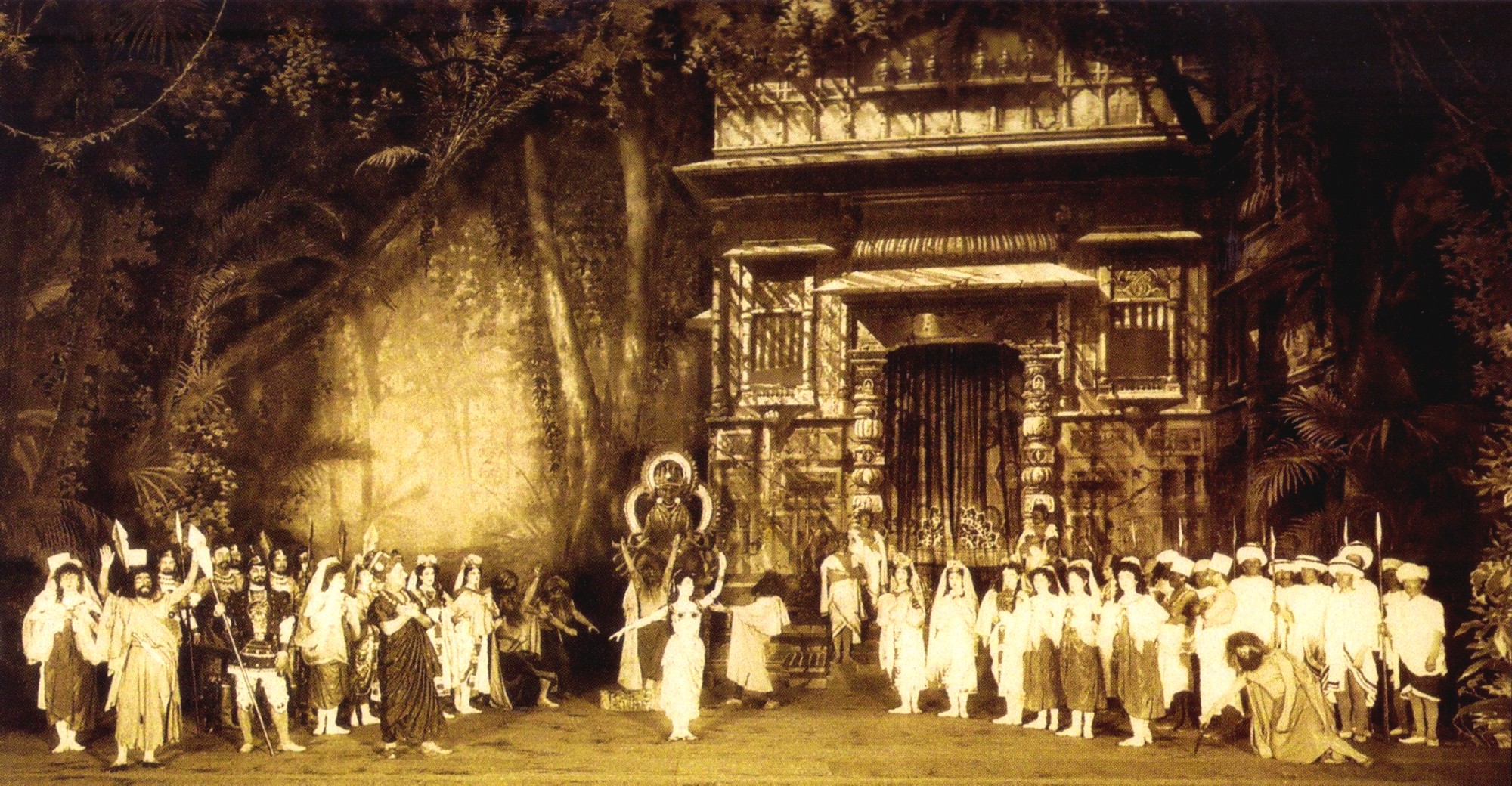 La BayadèreBallet · 1877Petipa · video
 Don QuixoteBallet · 1869Petipa · video
 RaymondaBallet · 1898Petipa · video
 Ballo della ReginaBallet · 1978Same lineage · video
 Allegro BrillanteBallet · 1956Same lineage · video