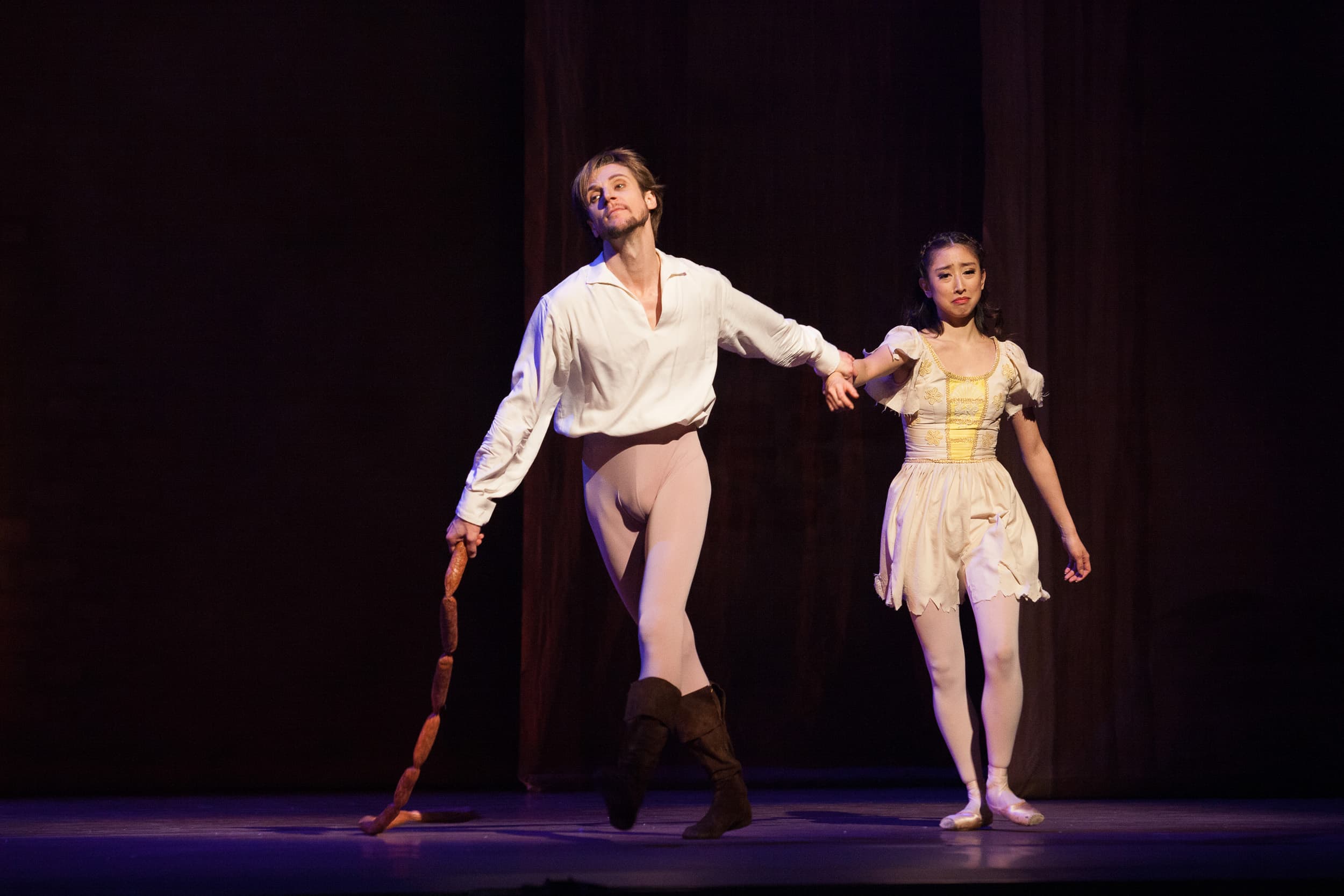
Ewa Krasucka TW-ON · CC BY-SA 4.0
John Cranko's The Taming of the Shrew is a two-act comic narrative ballet made for the Stuttgart Ballet, premiered there in 1969 under the German title Der Widerspenstigen Zähmung. It adapts Shakespeare's play into pure dance-comedy, built around the sparring courtship of Katherina and Petruchio and the parallel wooing of her sister Bianca by three suitors.
What it contains
- Classical Ballet · Throughout, centred on the Katherina–Petruchio partnership — Lead role built around partnering technique and dance virtuosity rather than mime alone, per contemporary critical description of the Petruchio role's demands. Source: "provided a first-class showcase for his virtuosity and partnering skills"
What is danced
The article does not describe steps, holds or technique in detail; it is written as plot synopsis and critical reception rather than choreographic notation. What it does establish is that the ballet is a vehicle for a lead male dancer of strong partnering ability and comic stage presence: Richard Cragun's Petruchio was singled out as 'a first-class showcase for his virtuosity and partnering skills', suggesting the role carries substantial classical pas de deux and lift work opposite Katherina. The reviewer's comment that the ballet provoked more laughter than any other he had seen points to a strong mime/comic-acting component built into the dancing itself — Cranko's reputation, per the article, rested on 'genius for comic invention' rather than on abstract or purely virtuosic display.
Context
The ballet dates from Cranko's Stuttgart tenure, a period in which he was building the company's international reputation on full-length narrative ballets with strong dramatic and comic characterisation, danced by a company trained in classical technique. The score itself was not composed for the stage: Scarlatti's keyboard works were arranged and orchestrated for the production by Kurt-Heinz Stolze, a common Cranko-era practice of assembling a ballet score from existing concert music.
Staging history
The work was created for and premiered by the Stuttgart Ballet in 1969 and has remained closely associated with that company, which continues to perform it; a complete performance was recorded live at the Stuttgart Opera House in 2022 with Elisa Badenes and Jason Reilly in the leads, under ballet master Krzysztof Nowogrodzki. Earlier partial documentation survives on film: an excerpt in the 1983 film The Stuttgart Ballet: The Miracle Lives with the original leads Marcia Haydée and Richard Cragun, and an excerpt in the 1987 BBC programme Ballerina, the latter not commercially available.
How to watch it
Watch the Petruchio–Katherina duets for the balance between rough comic business (mock courtship, withheld food, physical sparring) and passages of pure classical partnering that surface once the couple's antagonism turns to attraction. The Bianca subplot, with its three competing suitors and the trick played on Hortensio and Gremio at the carnival, is where the ballet's lighter character-comedy plays out against the central pair's more virtuosic material.
Structure
- Act IIn Padua, Bianca's three suitors court her while her sister Katherina drives off all comers; Petruchio arrives, agrees to woo Katherina for her dowry, and after a stormy courtship marries her, carrying her off before the wedding feast begins.
- Act IIAt Petruchio's house he torments Katherina with mock deprivations until she submits and the two admit their love; meanwhile Lucentio tricks Hortensio and Gremio into other marriages to clear his path to Bianca, and at Bianca's wedding Katherina demonstrates the wifely behaviour her sister refuses to show.
Structure read from an encyclopaedia article, not from a libretto or score we hold. Confirm against a programme before treating the numbering as authoritative.
Credits
- composer: Domenico Scarlatti
More from John Cranko
Other staged works in the register connected to this one by author or lineage.
 OneginBallet · 1965Cranko · video
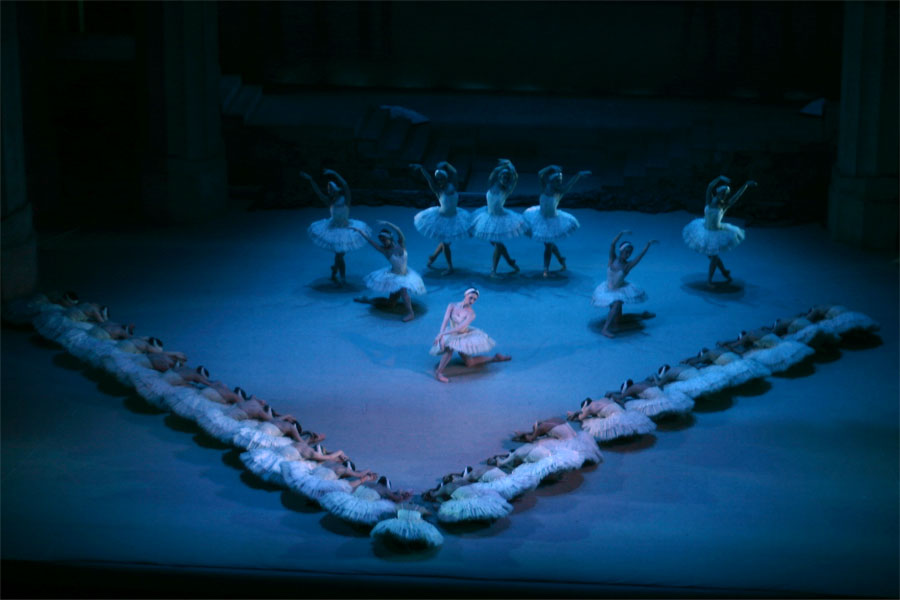 Swan LakeBallet · 1877Same lineage · video
 The NutcrackerBallet · 1892Same lineage · video
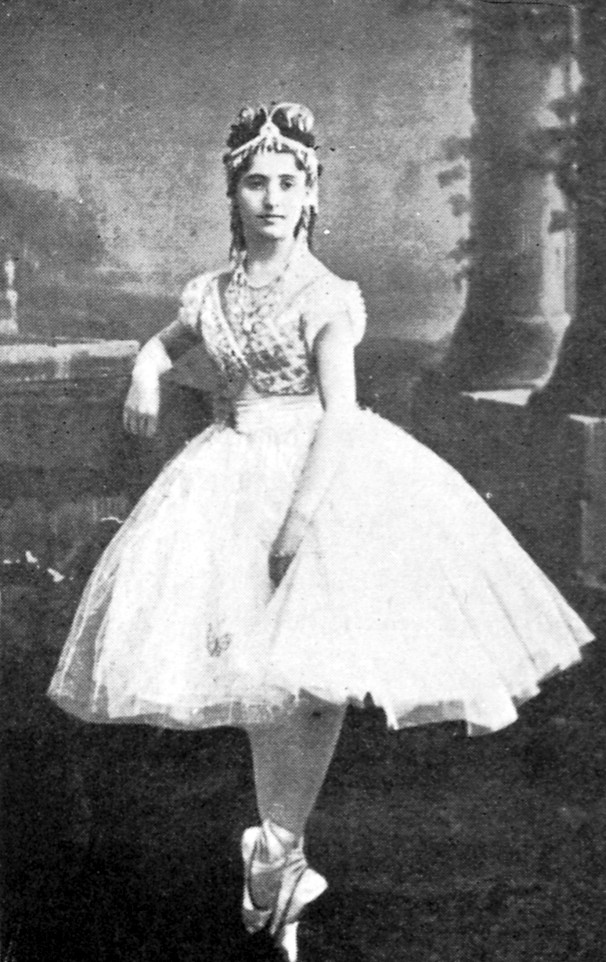 CoppéliaBallet · 1870Same lineage · video
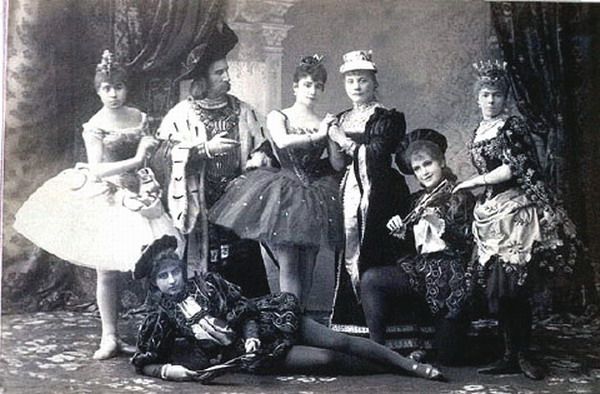 The Sleeping BeautyBallet · 1890Same lineage · video
 The FirebirdBallet · 1910Same lineage · video
 Ballo della ReginaBallet · 1978Same lineage · video
 The SeasonsBallet · 1899Same lineage