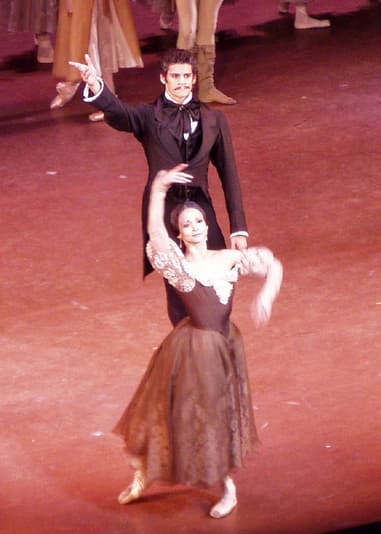
scillystuff from UK — Onegin · CC BY 2.0
Onegin is a three-act narrative ballet made by John Cranko for the Stuttgart Ballet, based on Alexander Pushkin's verse-novel Eugene Onegin, with music by Tchaikovsky arranged and orchestrated by Kurt-Heinz Stolze. Cranko had first encountered the Pushkin story while staging the dances for Tchaikovsky's opera of the same name in 1952, and he built the ballet's score not from the opera or the composer's orchestral output but chiefly from Tchaikovsky's solo piano works.
What is danced
The article states plainly that Cranko's choreography for the piece 'includes a wide range of styles, including folk, modern, ballroom and acrobatic' rather than a single fixed vocabulary — a deliberate mixing of idioms to serve the story rather than display technique for its own sake. Beyond that general description, the source gives no further detail on specific steps, holds or set pieces (no named pas de deux, divertissement or variation is described in the synopsis), so a precise breakdown of what is danced scene by scene cannot be drawn from this article alone.
Context
Cranko made Onegin in 1965 while directing the Stuttgart Ballet, having previously been turned down when he proposed the idea to the Royal Opera House board; the piece belongs to the wave of full-length, dramatically driven 'story ballets' that Cranko and contemporaries built their reputations on in the 1960s, as distinct from plotless neoclassical work being made elsewhere at the same moment. The ballet was substantially reworked between 1965 and 1967 — Cranko cut a prologue at Onegin's uncle's deathbed and changed the ending, removing a scene of Tatiana kissing her children goodnight because it undercut the drama of her final confrontation with Onegin — with the now-standard version first given by the Stuttgart company in October 1967.
Staging history
The Royal Ballet, which had rejected Cranko's original pitch, did not stage the work until 2001, decades after companies such as The Australian Ballet (1976, with Marilyn Rowe and John Meehan) and the National Ballet of Canada (1984, with Sabina Allemann and Frank Augustyn after injuries sidelined the planned leads) had taken it up, often coached or staged by original Stuttgart dancers such as Marcia Haydée and Reid Anderson. American Ballet Theatre premiered it in 2001 (Julie Kent and Roberto Bolle) and the Paris Opera Ballet in 2009 (Hervé Moreau and Isabelle Ciaravola); as the original sets and costumes aged, the National Ballet of Canada commissioned a Santo Loquasto redesign in 2010, later adopted by ABT in 2012, and the ballet has also entered the repertoires of Houston Ballet, Boston Ballet, Hamburg Ballet, Berlin State Ballet and La Scala Theatre Ballet.
How to watch it
Watch for how the choreography shifts register between the informal country scenes (Act 1's garden and folk game, Act 2's birthday party) and the formal St Petersburg ballroom of Act 3, since the article notes the movement deliberately spans folk, ballroom and acrobatic idioms rather than staying in one classical register. Pay attention to the two structurally paired encounters between Tatiana and Onegin — her bedroom letter-writing in Act 1 and their final confrontation in her boudoir in Act 3 — as the piece is built around this mirrored dramatic arc rather than around a divertissement of set numbers.
Structure
- Act I · Scene 1In Madame Larina's garden, Tatiana, Olga and the local girls play a mirror game to see their future beloveds; Lensky arrives with Onegin, and Tatiana falls for the visiting stranger.
- Act I · Scene 2In her bedroom that night, Tatiana dreams of Onegin and writes him a passionate love letter, sent via her nurse.
- Act II · Scene 1At Tatiana's birthday party Onegin rejects and tears up her letter, Prince Gremin is introduced, and Onegin provokes Lensky by flirting with Olga, leading to a duel challenge.
- Act II · Scene 2The duel scene: despite Tatiana and Olga's pleas, the duel proceeds and Onegin kills Lensky.
- Act III · Scene 1Years later in St Petersburg, Onegin attends a ball at Prince Gremin's palace and recognises Tatiana, now a princess, realising what he lost.
- Act III · Scene 2In Tatiana's boudoir, Onegin declares his love, but Tatiana, though still moved, tears up his letter and sends him away for good.
Structure read from an encyclopaedia article, not from a libretto or score we hold. Confirm against a programme before treating the numbering as authoritative.
Credits
- composer: Pyotr Ilyich Tchaikovsky
Related works
Other staged works in the register connected to this one by author or lineage.
 The Taming of the ShrewBallet · 1969Cranko · video
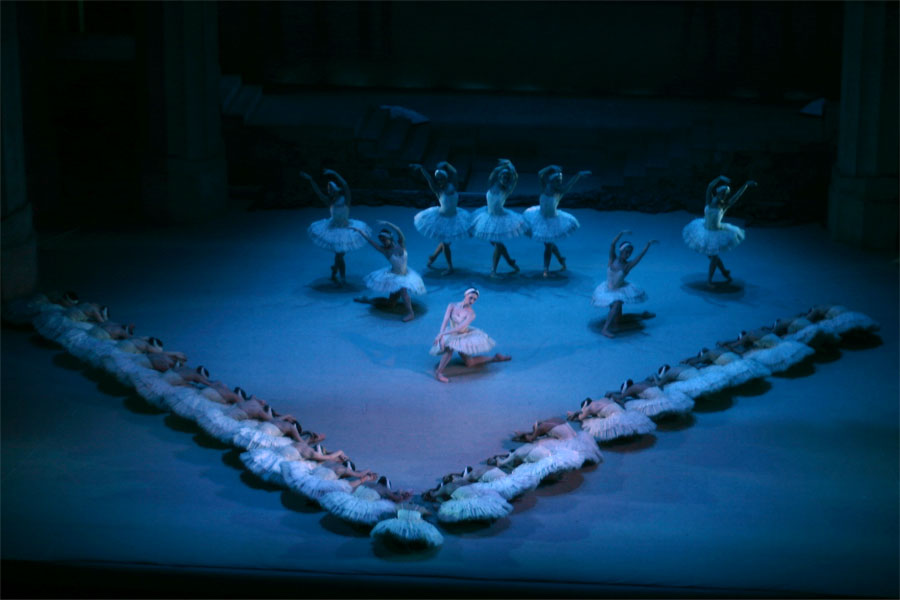 Swan LakeBallet · 1877Music by Tchaikovsky · video
 The NutcrackerBallet · 1892Music by Tchaikovsky · video
 JewelsBallet · 1967Music by Tchaikovsky · video
 SerenadeBallet · 1934Music by Tchaikovsky · video
 Danse des petits cygnesBallet · 1895Music by Tchaikovsky · video
 Allegro BrillanteBallet · 1956Music by Tchaikovsky · video
 Tschaikovsky Suite No. 3Ballet · 1970Music by Tchaikovsky · video